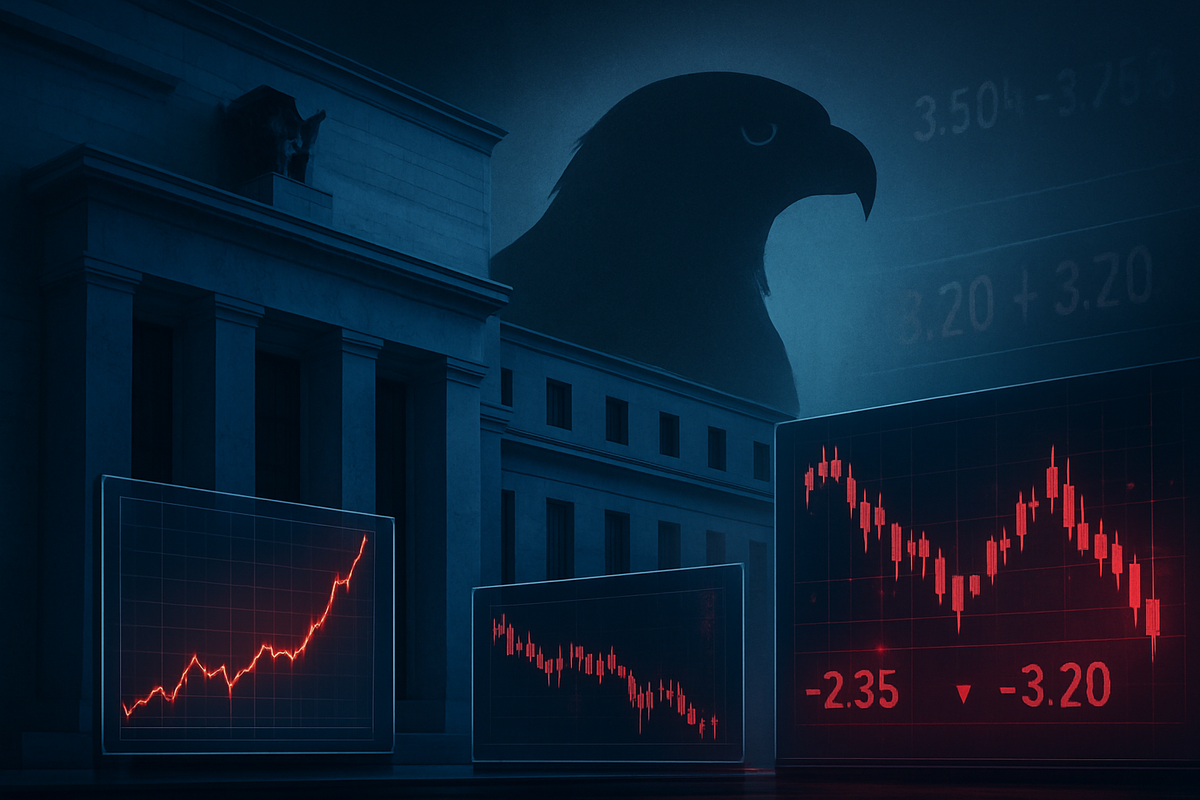
The dream of a rapid return to cheap money was abruptly deferred this week as a "hawkish shock" rippled through global markets. Following a combination of scorching inflation data and a stern policy update from the Federal Reserve’s March meeting, investors have been forced to recalibrate their expectations for 2026. The consensus, which just months ago anticipated a series of steady interest rate reductions, has now shifted toward a "higher-for-longer" reality, with markets pricing in just a single rate cut for the entire year.
This pivot comes as the Federal Open Market Committee (FOMC) maintained its benchmark interest rate target range of 3.50%–3.75% on March 18, 2026. While the pause was expected, the accompanying "dot plot" and commentary from Chair Jerome Powell signaled a central bank that is far more concerned with sticky inflation than with supporting equity valuations. For the public, this means that the high costs of borrowing for mortgages, car loans, and business expansions are likely to persist much longer than previously forecast.
A Perfect Storm of Inflation and Policy Shifts
The catalyst for this week's market volatility was a "double whammy" of economic data and central bank rhetoric. On the morning of March 18, the Bureau of Labor Statistics released the Producer Price Index (PPI) for February 2026, which showed a blistering 0.7% month-over-month increase—more than double what analysts had expected. On an annual basis, headline PPI accelerated to 3.4%, driven by a massive spike in energy costs and traveler accommodation services. This data confirmed fears that inflation was not merely "transitory" but was becoming deeply embedded in the service sector.
Hours later, the FOMC concluded its two-day meeting, confirming the hawkish tilt. The Committee’s Summary of Economic Projections revealed that the median expectation for year-end 2026 rates had moved to 3.4%, implying only one 25-basis-point cut is on the horizon. Furthermore, the Fed raised its estimate for the long-run neutral rate to 3.125%, the highest level in a decade. This move suggests that the era of ultra-low interest rates may be over for good, as the central bank acknowledges a structurally higher floor for the cost of capital.
Compounding the uncertainty is the impending transition in Fed leadership. With Chair Powell’s term nearing its end in May, the nomination of Kevin Warsh—known for his "Sound Money" doctrine—has sent a clear signal to the markets. Warsh has advocated for an aggressive acceleration of Quantitative Tightening (QT), aiming to shrink the Fed’s balance sheet from $6.5 trillion toward $4 trillion. This "Warsh Shock" has led many to believe that the "Fed Put"—the idea that the central bank will always step in to rescue markets—is being replaced by a regime of strict monetary discipline.
High-Stakes Winners and Losers
The market reaction to this policy shift has been swift and bifurcated, creating a clear divide between sectors. Large-cap financial institutions were among the primary beneficiaries of the "bear steepening" yield curve. JPMorgan Chase & Co. (NYSE: JPM) and The Goldman Sachs Group, Inc. (NYSE: GS) saw their shares climb as investors anticipated improved net interest margins from higher long-term rates. These banks are now positioned to earn more on their lending activities, provided the economy avoids a hard landing.
Conversely, the technology sector, particularly high-growth companies with valuations tied to future earnings, faced a significant "valuation reset." NVIDIA Corporation (NASDAQ: NVDA), Microsoft Corp. (NASDAQ: MSFT), and Apple Inc. (NASDAQ: AAPL) all saw selling pressure as higher discount rates diminished the present value of their long-term growth. Palantir Technologies Inc. (NYSE: PLTR) also struggled, as speculative growth stocks are typically the first to be discarded when the cost of capital rises.
The commodities market witnessed a "flash crash" in precious metals, which had been serving as a hedge against a weaker dollar. Gold and Silver prices plummeted as the prospect of higher-for-longer rates boosted the greenback. This led to a sharp sell-off in mining giants such as Newmont Corporation (NYSE: NEM), Barrick Gold Corporation (NYSE: GOLD), and Pan American Silver Corp. (NASDAQ: PAAS). Meanwhile, the energy sector remained a rare bright spot; Exxon Mobil Corporation (NYSE: XOM) and Chevron Corporation (NYSE: CVX) benefited from rising oil prices, which have approached the $100-per-barrel mark amid geopolitical tensions in the Middle East.
Broader Significance and Historical Precedents
The current environment draws striking parallels to the "Volcker Era" of the late 1970s and early 1980s, where the Federal Reserve had to maintain high rates for an extended period to break the back of persistent inflation. This shift away from the post-2008 era of "easy money" represents a fundamental change in the global financial architecture. It suggests that the "Great Moderation"—a period of low inflation and steady growth—may be giving way to a more volatile "Great Volatility" era characterized by supply-side shocks and geopolitical instability.
The ripple effects are reaching far beyond Wall Street. In the housing market, mortgage rates are expected to stay elevated, further cooling demand and pressuring homebuilders. In the corporate world, companies that relied on cheap debt for share buybacks or aggressive acquisitions, such as Carvana Co. (NYSE: CVNA) or The Trade Desk, Inc. (NASDAQ: TTD), are now facing a much more stringent credit environment. This policy shift acts as a "filter," separating companies with strong cash flows from those that are merely surviving on low-interest debt.
Furthermore, the Fed's focus on the "neutral rate" indicates a belief that the U.S. economy can handle higher rates without collapsing. However, this is a dangerous gamble. If the Fed overestimates the economy's resilience, the "hawkish shock" could inadvertently trigger a recession by late 2026. Analysts are closely watching for signs of credit stress in the shadow banking sector and among small-cap companies, which are traditionally more vulnerable to sudden spikes in borrowing costs.
Navigating the Road Ahead
As we move toward the second half of 2026, the primary challenge for investors will be navigating a market that no longer anticipates a "Fed rescue." Short-term, we may see continued volatility in the bond market as yields adjust to the new reality of "one-and-done" cuts. Investors will likely pivot toward "quality" stocks—those with strong balance sheets, high margins, and the ability to pass on costs to consumers.
Strategic pivots will also be required for corporate leaders. We may see a shift away from debt-fueled expansion toward organic growth and cost-cutting measures. For companies in the consumer discretionary space, such as Dollar Tree, Inc. (NASDAQ: DLTR) or Lululemon Athletica Inc. (NASDAQ: LULU), the focus will remain on how much pricing power they truly possess in an environment where consumer wallets are being squeezed by both high prices and high interest rates.
The upcoming May leadership change at the Federal Reserve remains the single most important variable. If Kevin Warsh is confirmed and proceeds with his "Sound Money" doctrine, the market must prepare for a significant reduction in liquidity. This could create a "survival of the fittest" scenario in the equity markets, where only the most efficient and well-capitalized firms thrive.
Conclusion: A New Economic Reality
The events of March 2026 mark a definitive turning point in the post-pandemic economic narrative. The transition from expecting multiple rate cuts to bracing for a single, solitary reduction reflects a Federal Reserve that is prioritizing its inflation-fighting credibility over short-term market stability. The target range of 3.50%–3.75% is no longer a temporary peak but a long-term plateau.
For investors, the key takeaway is that the "higher-for-longer" mantra is no longer just a warning—it is the baseline. The market's "hawkish shock" serves as a reminder that inflation is a stubborn foe, and the cost of capital is returning to historical norms. Moving forward, the focus will shift from the frequency of rate cuts to the health of the underlying economy and the ability of corporate America to operate without the crutch of zero-percent interest rates.
In the coming months, all eyes will be on the April and May inflation reports and the transition of power at the Fed. Should energy prices continue their upward trajectory, even that one lonely rate cut for 2026 may be taken off the table, leaving the market to face its most challenging environment in a generation.
This content is intended for informational purposes only and is not financial advice