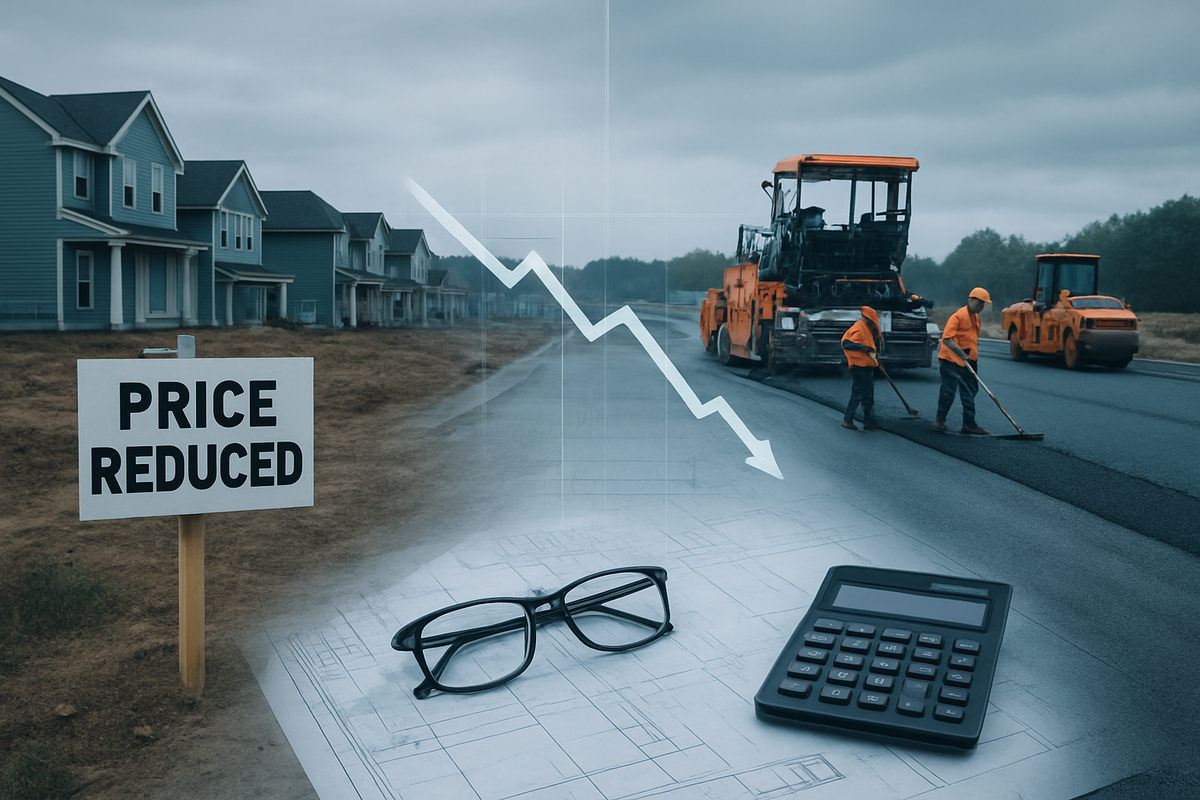
The U.S. economy received a sobering update this week as the U.S. Census Bureau released its latest construction spending data for January 2026, revealing a surprise 0.3% contraction. The decline, which caught Wall Street analysts off-guard, brought the seasonally adjusted annual rate of construction spending to $2,190.4 billion—a sharp reversal from the modest 0.1% growth many had predicted. While the overall figure remains 1.0% higher than this time last year, the monthly dip signals a widening fracture in the nation’s industrial engine.
The implications of this report suggest a deepening "economic softening" as the private sector buckles under the weight of persistent high borrowing costs and inflationary pressures. While government-funded infrastructure projects continue to provide a vital safety net, the primary driver of American growth—private residential and manufacturing investment—is increasingly moving into a "wait-and-see" mode. This divergence is raising urgent questions about whether the Federal Reserve’s prolonged "higher-for-longer" interest rate stance is finally pushing the construction industry toward a more significant downturn.
A Tale of Two Sectors: Private Retreat vs. Public Resilience
The 0.3% drop in January was largely fueled by a significant pullback in the private sector, which fell 0.8% in the residential category alone. Single-family construction, a cornerstone of the American housing market, slipped 0.2%, marking its tenth monthly decline in the last year. Perhaps more concerning for economists was the 1.4% plunge in home improvement spending. This sector had previously been considered "recession-proof" as homeowners opted to renovate rather than move, but the latest data suggests that the "financial math" for major additions no longer pencils out for many families as mortgage rates spiked from 5.98% to 6.22% in early 2026.
Beyond residential woes, the private non-residential sector saw its fourth consecutive monthly decline, falling 0.4% to $728.2 billion. The most dramatic drag came from manufacturing construction, which tumbled 2.0% in January and is now down a staggering 15.0% year-over-year. This sharp decline in industrial building suggests that the post-pandemic manufacturing "supercycle" may be losing steam as companies grapple with high capital costs and global economic uncertainty.
In stark contrast, public construction spending acted as the economy’s primary shock absorber, rising 0.6% to $529.2 billion. This growth was supercharged by a 3.3% surge in highway and street construction, totaling $148.5 billion. The Census Bureau noted that these figures are part of a complex "catch-up" period following data release delays caused by a 43-day government shutdown in late 2025. Despite these administrative hurdles, the steady flow of federal infrastructure funding remains one of the few reliable tailwinds in an otherwise cooling environment.
Market Winners and Losers: Infrastructure Surges While Homebuilders Pivot
The fallout from the January data has created a stark divide on Wall Street between "Public-Facing" and "Private-Facing" equities. Among the most visible losers are the major homebuilders and home improvement retailers. Lennar (NYSE: LEN) has seen its stock price under heavy pressure, recently trading nearly 47% below its highs after missing earnings expectations and reporting significant margin compression. To move inventory in this high-rate environment, Lennar and competitors like D.R. Horton (NYSE: DHI) and PulteGroup (NYSE: PHM) have been forced to offer aggressive mortgage rate buy-downs, effectively subsidizing buyers at the expense of their own bottom lines.
The "renovation recession" is also weighing heavily on the retail giants. Home Depot (NYSE: HD) and Lowe’s (NYSE: LOW) have both issued cautious outlooks for the remainder of 2026. With homeowners "locked-in" to low-rate pandemic mortgages, the incentive to embark on big-ticket kitchen or bathroom remodels has evaporated, leading to what analysts call "consumer project fatigue." Lowe’s, in particular, has seen its stock drop as it pivots toward the professional contractor market to offset the decline in do-it-yourself (DIY) spending.
Conversely, companies tied to public works and the booming AI infrastructure sector are emerging as the clear winners. Caterpillar (NYSE: CAT) recently saw its stock surge on the back of a record $51 billion backlog. While its residential equipment sales are soft, its Power & Energy segment is seeing explosive demand for massive generators required to power the nation’s expanding fleet of AI data centers. Similarly, materials giants like Vulcan Materials (NYSE: VMC) and Martin Marietta Materials (NYSE: MLM) are maintaining strong pricing power, as their aggregates are essential for the highway projects currently driving the public spending gains.
The Broader Economic Ripple Effect and Historical Context
The January slump in construction spending fits into a broader trend of economic cooling that mirrors the "soft landing" attempts of the late 1990s. Historically, construction is the "canary in the coal mine" for the broader economy; it is typically the first sector to contract when interest rates rise and the first to recover when they fall. The current 0.3% dip suggests that the cumulative effect of the Federal Reserve’s tightening cycle is finally saturating the industrial sector, potentially leading to a period of stagnant growth or "stagflation" if material costs remain high.
Furthermore, the shift toward public-sector dominance has significant policy implications. With private investment pulling back, the U.S. economy is becoming increasingly dependent on government spending to maintain GDP growth. This creates a regulatory environment where companies like AECOM (NYSE: ACM) and Fluor (NYSE: FLR) become critical barometers of national economic health. The transition from a consumer-led housing market to a government-led infrastructure market represents a structural shift that could define the late 2020s, especially as geopolitical tensions in the Middle East continue to pressure oil prices and material logistics.
The current situation also draws comparisons to the 2022–2023 period, where the market saw similar "unexpected" misses. However, the key difference today is the exhaustion of the "excess savings" that helped consumers weather previous storms. Without that cushion, the 1.4% drop in home improvements suggests a more permanent shift in consumer behavior, as households prioritize essential spending over discretionary property upgrades.
Looking Ahead: Strategic Pivots and Potential Outcomes
In the short term, the construction industry is bracing for a period of "bumpy stabilization." Market participants will be closely watching the Federal Reserve’s next move, as any hint of a rate cut could immediately unfreeze the "lock-in" effect that has paralyzed the housing market. However, if rates remain above 6% through the summer, homebuilders may be forced to further slash prices or pivot toward "build-to-rent" models to keep their labor forces employed and their balance sheets moving.
For investors, the long-term opportunity may lie in the "Infrastructure 2.0" wave. The continued growth in public spending, coupled with the immense power requirements of the AI revolution, suggests that heavy machinery and raw material providers will remain decoupled from the residential slump. Companies that can bridge the gap between traditional construction and high-tech utility infrastructure are likely to see the most sustained growth. We may also see an increase in mergers and acquisitions as larger firms like Lowe’s look to acquire smaller, specialized professional suppliers to capture a larger share of the resilient "Pro" market.
The ultimate outcome depends on whether the 0.3% January dip is a one-off anomaly caused by weather and government delays, or the start of a sustained downward trend. If February and March data continue to show private-sector contraction, the narrative of "economic softening" will likely transition into a full-scale discussion of a late-year recession.
Summary and Final Thoughts for Investors
The January construction spending report is a critical reminder that the U.S. economy is not a monolith. While the 0.3% headline decrease is a clear sign of cooling, the underlying data reveals a dramatic divergence between a struggling private residential sector and a surging public infrastructure market. The primary takeaway for the market is that the "higher-for-longer" interest rate environment has finally found its limit in the housing and home improvement sectors, forcing a period of painful adjustment for major players like Lennar and Home Depot.
Moving forward, investors should watch for the "divergence trade." High-performing industrial stocks like Caterpillar and Vulcan Materials are currently benefiting from a unique combination of government funding and technological shifts (AI data centers) that insulate them from the consumer's pain. Conversely, the residential sector will likely remain in a defensive crouch until there is clear evidence of a downward trend in mortgage rates.
In the coming months, the key metrics to monitor will be the "Pro" sales figures from major retailers and the quarterly backlog reports from heavy equipment manufacturers. These will serve as the most reliable indicators of whether the U.S. economy can navigate this softening period or if the foundation of the construction industry is beginning to crack.
This content is intended for informational purposes only and is not financial advice.