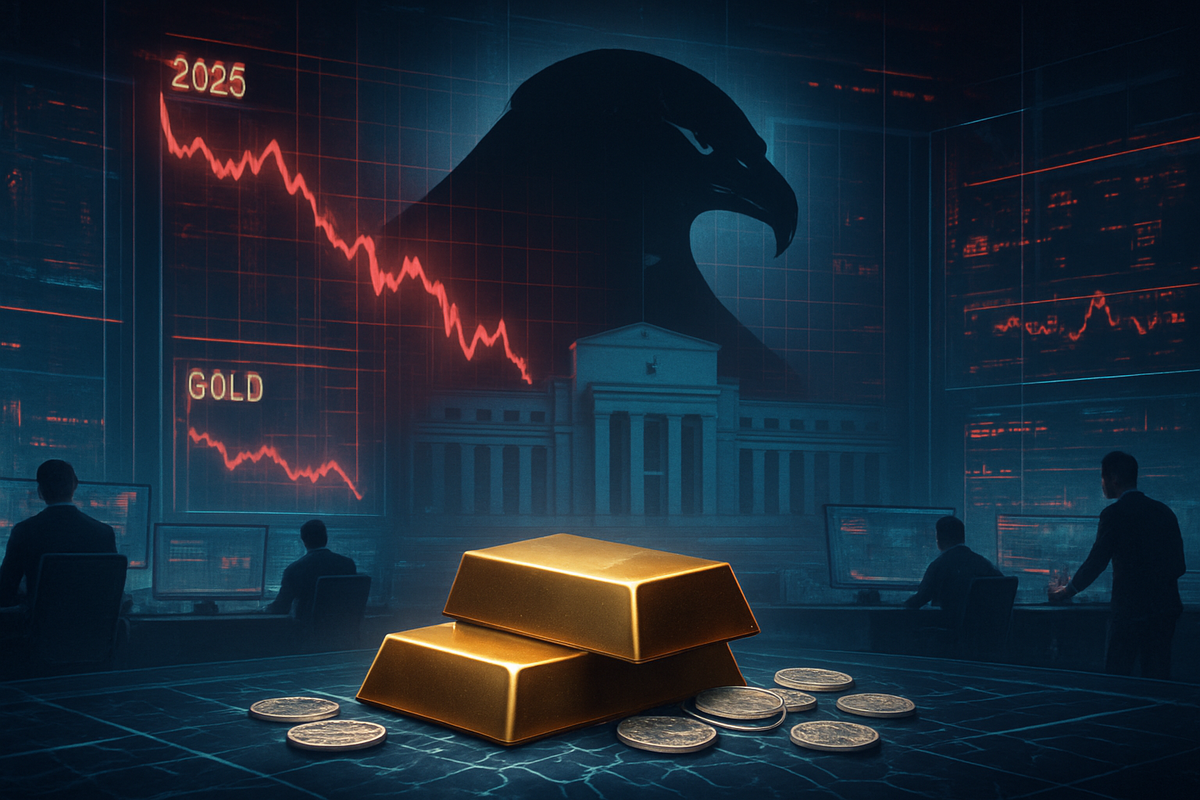
As of March 23, 2026, the global precious metals market is grappling with a profound identity crisis. After a historic rally that saw gold prices peak at a staggering $5,608 per ounce and silver touch $120 earlier this year, the "Warsh Shock" has fundamentally rewritten the narrative for commodities. The nomination of Kevin Warsh to succeed Jerome Powell as Chair of the Federal Reserve has acted as a catalyst for a massive technical correction, pulling gold back below the psychological $5,000 floor and leaving investors to wonder if the decade’s greatest bull run has finally met its match.
The immediate implications of this shift have been felt most acutely in the silver markets, which suffered a devastating 30% flash crash in late January 2026. What was once a market fueled by "dovish pivot" expectations and rampant safe-haven buying has now been chilled by the prospect of an "inflation hawk" taking the helm of the world's most powerful central bank. As the March 2026 correction deepens, the financial world is witnessing a violent transition from a liquidity-driven mania to a period of cautious repricing centered on "sound money" principles.
The January Flash Crash and the Timeline of Turbulence
The seeds of the current market malaise were sown on January 21, 2026, when the White House officially nominated Kevin Warsh to succeed Jerome Powell, whose term is set to expire in May 2026. The announcement caught markets off-guard, as many participants had priced in a continuation of Powell’s more flexible, "higher-for-longer" but ultimately accommodative stance. Warsh, known for his vocal skepticism of quantitative easing during his previous tenure on the Fed Board of Governors, was immediately branded by the media as the "Inflation Hawk" the market wasn't ready for.
Within hours of the nomination, the silver market—often considered the more volatile sibling of gold—experienced what is now being called the "Warsh Flash Crash." Silver, which had been trading near an all-time high of $120 an ounce, plummeted to $84 in a single afternoon as high-frequency trading algorithms reacted to the prospect of a lean Fed balance sheet. Gold followed suit, though less violently, beginning its steady descent from the $5,608 peak. The shock was compounded by Warsh’s first public statements post-nomination, where he emphasized a return to a "scarce-reserve" regime and suggested that the Fed’s $6.5 trillion balance sheet was a "historical anomaly" that needed aggressive pruning.
By February, the narrative had shifted entirely. The "debasement trade" that had propelled gold up 40% in late 2025 evaporated as the U.S. dollar surged on the back of rising real yields. As of late March, Jerome Powell remains in a "quagmire," serving as Chair pro tempore while the Senate confirmation for Warsh remains stalled in a contentious partisan battle. This leadership vacuum, combined with the looming threat of Warsh’s hawkishness, has kept a firm lid on any attempt at a gold recovery, trapping the yellow metal in a tight range between $4,800 and $4,950.
Mining Giants and the Toll of Volatility
The "Warsh Shock" has sent ripples through the equities of major mining corporations, which had previously been the darlings of Wall Street. Newmont (NYSE: NEM), the world’s largest gold miner, saw its stock price retreat from a January high of $132. While the company is still benefiting from higher-than-average gold prices compared to 2024 levels, the sudden compression in margins and the volatility of its primary asset have forced management to reassess their 2026 capital expenditure plans. Newmont’s focus on its "Tier 1" assets, such as the Ahafo North project, is now seen as a defensive necessity rather than an expansionist luxury.
Similarly, Barrick Gold (NYSE: GOLD)—recently rebranded as Barrick Mining to emphasize its copper-gold diversification—has faced significant headwinds. Although the company is pursuing a goal of 30% production growth by 2030, the recent price slide has cooled investor enthusiasm for its capital-intensive projects like Reko Diq. The stock has historically lagged the spot price of gold, and this latest correction has only exacerbated that trend, leading to a renewed push for share buybacks to support a sagging valuation.
On the silver side, Pan American Silver (NASDAQ: PAAS) has been hit hardest by the 30% flash crash. Despite reporting record Q4 2025 results, the company’s forward guidance is now under scrutiny as industrial demand—particularly from the AI and solar sectors—must now contend with a much more volatile pricing environment. Meanwhile, Wheaton Precious Metals (NYSE: WPM) has managed to weather the storm slightly better due to its streaming model, which offers protection against the rising operational costs that plague traditional miners. However, even WPM has seen its "Strong Buy" consensus tested as investors rotate out of precious metals and back into "Warsh-era" favorites like short-duration Treasuries.
Hawks, Hedges, and the New Monetary Reality
The wider significance of the "Warsh Shock" lies in the definitive end of the "dovish pivot" era. Throughout 2024 and 2025, the precious metals market was buoyed by the belief that the Fed would eventually succumb to political pressure and lower rates to service the burgeoning national debt. Warsh’s nomination suggests a shift toward "monetary realism," where inflation is treated as a choice and the balance sheet is used as a tool for discipline rather than a safety net. This is a callback to Warsh's 2011 resignation from the Fed, which he did in protest of Bernanke’s QE2 policies.
This event also highlights a growing divergence in market trends. While precious metals are suffering, some analysts argue that the U.S. is entering a "productivity-driven" boom fueled by AI integration, a view Warsh himself has championed. This "supply-side shock" theory suggests that the economy can grow without the need for the inflationary monetary support that gold bugs have long relied upon. If Warsh is correct, gold’s role as an inflation hedge may be diminished in the coming years, even as its industrial utility grows.
Furthermore, the "Warsh Shock" serves as a historical bookend to the era of ultra-loose monetary policy that began during the 2008 financial crisis. By signaling a return to "sound money," the nomination has forced a global repricing of risk. Competitors and partners in the global banking sector are now bracing for a more aggressive Quantitative Tightening (QT) cycle, which could drain liquidity not just from metals, but from high-growth tech and emerging market currencies as well.
The Road Ahead: Stabilization or Further Sliding?
In the short term, the precious metals market is likely to remain in a state of suspended animation until the Senate confirms a new Fed Chair. If Warsh is confirmed, the market could see another leg down as he begins the process of shrinking the Fed’s footprint. However, if his nomination fails or is delayed indefinitely, gold and silver could see a "relief rally" as the threat of an immediate hawkish pivot recedes. For now, the technical correction in March appears to be a consolidation phase where "weak hands" are being flushed out after the speculative frenzy of early 2026.
Long-term, the precious metals sector must adapt to a world where "inflation hawk" policies are once again the baseline. This may require a strategic pivot for mining companies, focusing less on aggressive expansion and more on operational efficiency and dividend sustainability. Market opportunities may still emerge in silver, particularly given its indispensable role in the AI-driven hardware boom, but the days of easy, liquidity-fueled gains appear to be over. Investors should prepare for a "new normal" where $5,000 gold is a ceiling rather than a floor.
Navigating the 'New Normal' in Commodities
The "Warsh Shock" of early 2026 will likely be remembered as the moment the post-pandemic commodity super-cycle hit a wall of monetary reality. The transition from the record highs of $5,608 gold and $120 silver to the current corrected state has been painful for many, but it has also provided a necessary reality check for a market that was becoming increasingly detached from fundamental interest rate trends. The shift from Jerome Powell’s pragmatic flexibility to Kevin Warsh’s principled hawkishness represents a sea change in how the world views the dollar and its alternatives.
Moving forward, the market will be hyper-focused on the Fed's balance sheet and any signs of aggressive quantitative tightening. Investors should keep a close watch on the Senate confirmation hearings and any shifts in the U.S. dollar index, as these will be the primary drivers of metal prices in the coming months. While the luster of gold has been dimmed by the "Warsh Shock," the underlying story of productivity and monetary reform is only just beginning. The coming months will determine whether this correction is a healthy pause in a long-term bull market or the beginning of a multi-year bear cycle for precious metals.
This content is intended for informational purposes only and is not financial advice