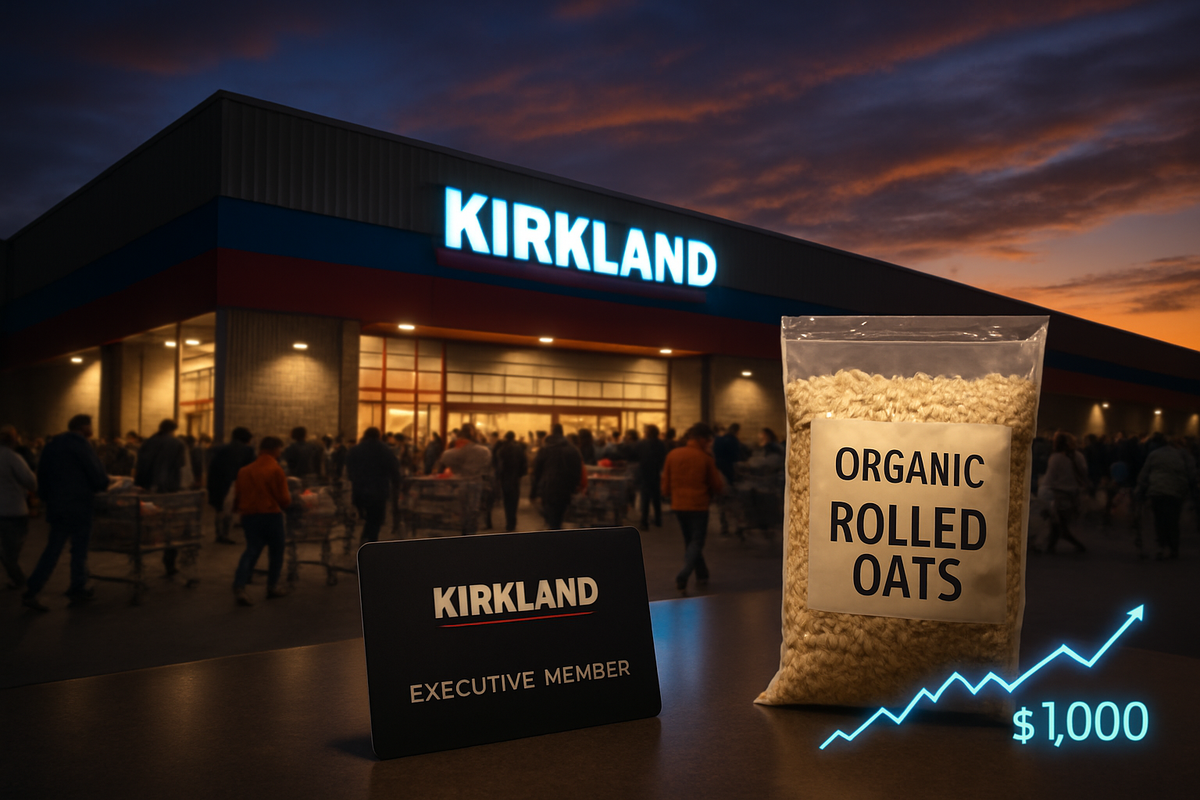
As the spring of 2026 unfolds, the American retail landscape is defined by a stark divergence in consumer behavior. While many traditional retailers are grappling with the lingering effects of "sticky" inflation and a sudden dip in consumer sentiment, Costco Wholesale Corp. (NASDAQ: COST) has emerged as the undisputed bellwether of the "flight-to-value" economy. Following a robust second-quarter earnings report released in early March, Costco’s stock has surged toward the psychological $1,000-per-share milestone, trading at approximately $972.33 as of March 23, 2026. This performance serves as a vital pulse check on a U.S. consumer that is increasingly seeking refuge in bulk-buying and private-label stability.
The company's recent data reveals a consumer base that is resilient but defensive. Even as the headline Consumer Price Index (CPI) moderated to 2.4% in February 2026, core inflation remains stubbornly high between 2.5% and 3.0%, keeping household budgets under pressure. Costco’s ability to post a 9.1% increase in net sales for the quarter—outpacing broader retail growth—suggests that the "Costco effect" is no longer just about convenience; it is a strategic financial survival tool for middle- and high-income households alike.
A Clean Beat in a Volatile Quarter
On March 5, 2026, Costco reported its fiscal second-quarter results for the period ending February 15, delivering what analysts have termed a "clean beat." The warehouse giant posted earnings per share (EPS) of $4.58, surpassing the consensus estimate of $4.55. Total revenue for the quarter reached $69.60 billion, fueled by a 7.4% jump in comparable-store sales. Perhaps most striking was the company’s digital performance; digitally enabled comparable sales surged 22.6%, a testament to the company’s aggressive multi-year push into e-commerce and home delivery services.
The timeline leading to this surge was marked by tactical adjustments. In late 2024, Costco implemented its first membership fee hike in seven years, raising the Gold Star membership to $65 and the Executive tier to $130. By early 2026, those hikes have proven to be a non-issue for the company’s loyal base. In the second quarter, membership fee income jumped 13.6% to $1.355 billion. The company now boasts 82.1 million paid households, with Executive members—who now enjoy new perks like monthly $10 digital credits—accounting for a staggering 76% of total worldwide sales.
However, the momentum is being tested by external shocks. In late February 2026, the outbreak of military conflict between the U.S. and Iran triggered a sudden spike in gasoline prices, causing the University of Michigan Consumer Sentiment Index to tumble to 55.5 in March. While higher gas prices typically hurt discretionary spending, they often drive increased foot traffic to Costco's fuel stations, where members hope to offset costs with discounted petrol, often staying to shop inside the warehouse afterward.
Winners and Losers in the Value War
The current retail environment is creating a clear "bifurcation" between winners and losers. Walmart Inc. (NYSE: WMT) stands alongside Costco as a primary winner, leveraging its massive scale to attract higher-income shoppers who are "trading down" from premium grocers. Walmart's 24% global e-commerce growth and its high-margin advertising business, Walmart Connect, have made it a formidable challenger to Costco's dominance. Similarly, BJ’s Wholesale Club Holdings, Inc. (NYSE: BJ) has benefited from the regional migration to wholesale models, though it lacks the massive international footprint and private-label prestige of Costco’s Kirkland Signature brand.
Conversely, Target Corp. (NYSE: TGT) continues to face structural headwinds. In its most recent holiday quarter, Target reported a 1.5% decline in comparable sales, struggling to move discretionary categories like apparel and home decor as consumers prioritize essentials. The "Target guest," once known for impulse purchases of trendy goods, is now showing signs of fatigue under the weight of core inflation. Even Amazon.com, Inc. (NASDAQ: AMZN), while dominant in logistics, is seeing increased competition from Costco’s improved digital logistics, as consumers find that bulk-buying online through a membership model often yields a lower per-unit cost than Amazon's individual-item pricing.
Traditional grocery chains are also feeling the heat. As Costco expands its fresh food and pharmacy offerings, it is cannibalizing the market share of regional supermarket players who cannot match the wholesale pricing on staples. The success of the Kirkland Signature brand, which now rivals major national brands in quality perception, has further eroded the leverage of traditional consumer packaged goods companies.
The Significance of the "Kirkland Economy"
Costco’s performance is more than just a corporate success story; it is a reflection of a broader shift in American consumerism toward "defensive luxury." The historical precedent for this trend can be found in the 2008 financial crisis, where wholesale clubs were among the few sectors to thrive. In 2026, the trend has evolved into a permanent fixture of the economy. The rise of the "Kirkland Economy" indicates that the American middle class has structurally adjusted its spending to favor volume and predictability over variety and convenience.
This event also highlights the increasing importance of membership-based recurring revenue in the retail sector. As traditional retailers struggle with volatile margins, Costco’s $5 billion-plus annual membership revenue provides a massive cushion that allows the company to keep prices low on high-volume items. This creates a "virtuous cycle" that competitors find difficult to break. Furthermore, the 22.6% growth in digital sales suggests that Costco is successfully bridging the gap between old-school brick-and-mortar loyalty and the modern expectation for seamless omnichannel shopping.
From a regulatory standpoint, Costco’s growth and the consolidation of retail power into a few giants like Walmart and Amazon may attract renewed scrutiny from the Federal Trade Commission (FTC). However, for now, the company remains a political "safe haven" due to its reputation for high employee wages and consumer-friendly pricing, which differentiates it from other mega-retailers during periods of high inflation.
The Road to $1,000 and Beyond
In the short term, investors are laser-focused on whether Costco can sustain its momentum if geopolitical tensions in the Middle East continue to escalate. High energy prices are a double-edged sword; they drive members to Costco’s gas pumps, but they also increase the company’s logistics and shipping costs. Analysts will be watching the March and April sales reports closely to see if the drop in consumer sentiment translates into a slowdown in the "treasure hunt" discretionary spending—non-essential items like jewelry and electronics—that historically pads Costco's margins.
Looking further ahead, the potential for a stock split is a major topic of conversation on Wall Street. With the share price nearing $1,000, a split could increase liquidity and make the stock more accessible to retail investors, though Costco’s management has historically been conservative regarding such maneuvers. The company is also expected to continue its aggressive international expansion, particularly in China and Southeast Asia, where the middle class is experiencing its own version of a "flight to value."
Strategic pivots may include a deeper integration of AI-driven supply chain management to further reduce waste and keep prices stable. As labor costs continue to rise across the U.S., Costco’s ability to maintain its high retention rates will be a key competitive advantage. The market will also be monitoring how Costco utilizes its massive cash reserves—over $10 billion—whether for further special dividends or accelerated warehouse openings.
Final Assessment: The Membership Fortress
The resilience of Costco in early 2026 underscores a fundamental truth about the current U.S. economy: value is the ultimate currency. By providing a hedge against inflation through its bulk-pricing and Kirkland Signature brand, Costco has built a "membership fortress" that appears largely impervious to the macroeconomic winds that are buffeting other retailers. The company's Q2 beat and subsequent stock rally are not just reflections of corporate efficiency, but of a consumer that has become more disciplined and loyal to brands that offer tangible savings.
Moving forward, the market remains cautiously optimistic. While Costco’s high price-to-earnings ratio (approaching 51x) suggests it is priced for perfection, the company's consistent execution provides a level of safety that is rare in today’s volatile market. Investors should watch for the impact of gas price fluctuations and any signs of cooling in the membership renewal rate, which currently sits at an industry-leading 93% in the U.S. and Canada.
In summary, Costco is the definitive winner of the 2026 retail landscape. Its performance reveals a consumer that is still willing to spend, provided they are convinced they are getting the best possible deal. As the company eyes the $1,000 mark, it stands as a monument to the power of the membership model and a clear indicator that the "flight to value" is not a temporary trend, but the new normal for the American shopper.
This content is intended for informational purposes only and is not financial advice.