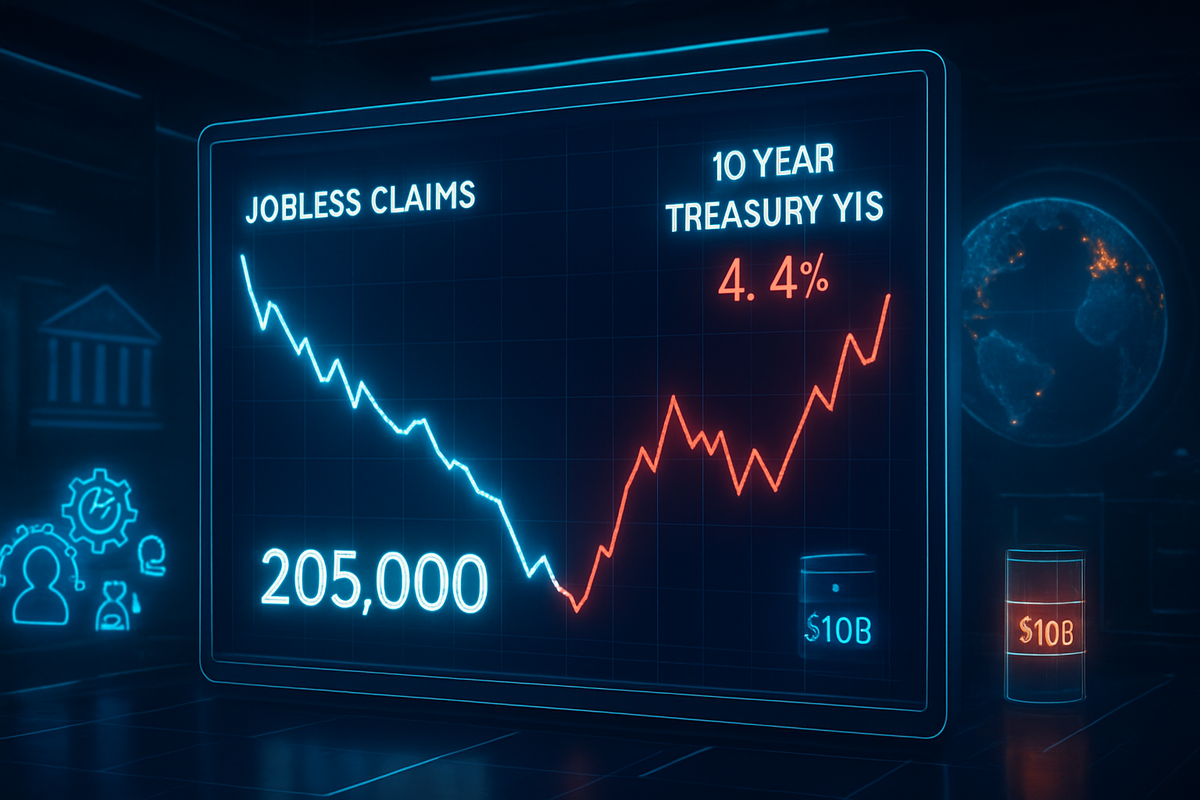
The U.S. labor market continues to defy gravity, as initial jobless claims for the week ending March 14, 2026, dropped to a surprising 205,000. This figure came in significantly lower than the 215,000 consensus estimate among Wall Street economists, signaling a "low hire, low fire" equilibrium that is keeping the labor market tight despite a broader economic slowdown. The data suggests that American firms are engaging in aggressive "labor hoarding," reluctant to trim payrolls even as job creation stalls, for fear of being caught short-handed in an increasingly volatile global economy.
The immediate market implication is a sharp hardening of the Federal Reserve’s "higher-for-longer" stance. Coming just one day after the March Federal Open Market Committee (FOMC) meeting, the data has effectively erased lingering hopes for multiple interest rate cuts this year. With the labor market refusing to crack, the central bank now has the green light to maintain restrictive policy to combat a fresh wave of energy-driven inflation. Consequently, Treasury yields have surged to eight-month highs, with the 10-year note touching 4.39%, as investors brace for a prolonged era of elevated borrowing costs.
The "Big Stay": A Labor Market in Suspended Animation
The drop to 205,000 claims marks a significant departure from the previous week’s 213,000 and underscores a phenomenon economists have dubbed "The Big Stay." Throughout early 2026, the labor market has entered a state of suspended animation. While the February non-farm payrolls report showed a surprising loss of 92,000 jobs, the lack of new claims indicates that the weakness is driven by a lack of hiring rather than a surge in layoffs. Employers, scarred by the talent shortages of the mid-2020s, appear to be holding onto existing staff at all costs, even as profit margins are squeezed by rising input prices.
This resilience was a central theme in the FOMC’s deliberations on March 18, 2026. Although the Fed, led by Chair Jerome Powell, held the federal funds rate steady at 3.50%–3.75%, the updated Summary of Economic Projections (SEP) revealed a hawkish pivot. The "dot plot" now signals just a single 25-basis-point cut for the remainder of 2026, down from the two cuts projected back in December. The jobless claims data served as a definitive exclamation point on the Fed's cautious outlook, confirming that the labor market is not yet cool enough to warrant a policy pivot.
The backdrop to this economic narrative is a sudden and severe geopolitical shock. The eruption of conflict in the Middle East in late February, specifically involving tensions with Iran and the subsequent closure of the Strait of Hormuz, has sent Brent crude oil prices soaring above $108 per barrel. This "oil shock" has reignited fears of 1970s-style stagflation, making the Fed even more wary of cutting rates. The central bank recently revised its 2026 Core PCE inflation forecast upward to 2.7%, citing the "sticky" nature of service-sector wages and the massive spike in energy costs that is beginning to filter through the supply chain.
Winners and Losers in a Rising Yield Environment
The "higher-for-longer" yield environment creates a stark divide between sectors, with financial institutions and energy giants positioned to capitalize on the shift. JPMorgan Chase & Co. (NYSE: JPM) has seen its net interest margins remain robust as the yield curve undergoes a "bear steepening," allowing the bank to earn more on its lending activities while keeping deposit costs relatively contained. Similarly, the energy sector is benefiting from the dual tailwinds of high oil prices and the Fed’s inability to cool demand. ExxonMobil Corp. (NYSE: XOM) and other integrated oil majors are seeing record cash flows as global supply chains scramble to find alternatives to blocked Middle Eastern routes.
Conversely, the tech and growth sectors are feeling the sting of rising discount rates. NVIDIA Corp. (NASDAQ: NVDA), which had been a primary driver of the equity market’s gains, saw its valuation pressured as the 10-year Treasury yield climbed toward 4.4%. High-growth companies are particularly sensitive to rising long-term yields, which reduce the present value of future earnings. Apple Inc. (NASDAQ: AAPL) also faced headwinds as the combination of high borrowing costs and inflationary pressure on consumer discretionary spending threatened to dampen demand for high-end electronics.
The real estate sector remains the most visible victim of the Fed's prolonged restrictiveness. Companies like Redfin Corp. (NASDAQ: RDFN) and Zillow Group, Inc. (NASDAQ: Z) are struggling as the average 30-year fixed mortgage rate hovers near 7.5%, effectively freezing the housing market. With fewer homeowners willing to trade in low-rate mortgages for new, high-rate loans, transaction volumes have plummeted, hurting the commissions and advertising revenue these platforms rely on. The lack of an immediate rate cut path from the Fed suggests that the "mortgage lock-in effect" will persist well into late 2026.
Fiscal Policy and the New Inflationary Normal
The current situation is complicated by a unique set of domestic policy shifts. The emergence of the Department of Government Efficiency (DOGE) and its mandate for massive federal workforce reductions has created a volatile fiscal backdrop. While thousands of federal positions are being eliminated, the resulting private-sector absorption of this labor has been slow, adding to the "low hire" sentiment. Furthermore, increased defense spending necessitated by the conflict in the Middle East is adding to the federal deficit, creating what some analysts call "fiscal dominance."
This event fits into a broader trend where historical precedents, such as the Volcker era of the early 1980s, are being re-examined. Like the early 80s, the Fed is facing an energy-driven inflation spike during a period of structural labor tightness. The current "Nike Swoosh" yield curve—inverted at the short end but steepening significantly in the 10-year and 30-year maturities—reflects market concerns that the Fed may have to keep rates high for years, not months, to truly break the inflationary cycle. The "term premium," or the extra compensation investors demand for holding long-term debt, has returned with a vengeance after a decade of dormancy.
The ripple effects extend beyond the U.S. borders. As the Fed maintains higher rates, the U.S. dollar has strengthened against a basket of currencies, placing immense pressure on emerging markets that hold dollar-denominated debt. Competitors to U.S. multinationals are finding it harder to compete as the cost of capital remains globally elevated, driven by the gravity of U.S. Treasury yields. This has led to a fragmented global economy where "higher for longer" is not just a U.S. policy, but a global financial reality.
Looking Ahead: A Summer of Volatility
In the short term, all eyes will be on the upcoming Consumer Price Index (CPI) and Personal Consumption Expenditures (PCE) data releases. If inflation continues to track toward the Fed’s revised 2.7% target—or higher—the possibility of zero rate cuts in 2026 will transition from a fringe theory to the base case. Strategic pivots are already underway in the corporate world, with many CFOs moving to extend debt maturities and shore up cash balances to weather a potential multi-year period of high capital costs.
Market opportunities may emerge in "defensive growth" sectors—companies with strong balance sheets and the ability to pass on costs to consumers. However, the risk of a "policy error" remains high. If the Fed stays too restrictive for too long, the current "low fire" environment could abruptly shift into a wave of mass layoffs as companies finally reach a breaking point. Investors should watch the "quits rate" in upcoming Job Openings and Labor Turnover Survey (JOLTS) reports; a sharp decline there would be the first sign that the labor market's resilience is finally starting to crumble.
The most likely scenario for the next six months is a period of "choppy consolidation" for the equity markets. Without the tailwind of falling rates, stock prices will need to be driven by pure earnings growth, which is difficult to achieve in an environment of $100+ oil and 4.4% yields. The market is effectively waiting for a catalyst—either a definitive cooling of the labor market or a resolution to the Middle Eastern conflict—to break out of its current range.
Conclusion: The New Economic Equilibrium
The latest jobless claims data has served as a wake-up call for those still holding out for a "dovish pivot." The 205,000 figure is more than just a data point; it is a confirmation that the U.S. labor market remains structurally tight, providing the Federal Reserve with the necessary cover to prioritize its inflation fight over economic stimulation. The "higher-for-longer" yield environment is no longer a temporary hurdle but the defining characteristic of the 2026 financial landscape.
Moving forward, the market will likely remain hypersensitive to any data that suggests a shift in the labor-inflation dynamic. For investors, the takeaway is clear: the era of "easy money" is firmly in the rearview mirror. Success in this environment will require a focus on quality, valuation, and an acute understanding of how geopolitical events directly influence domestic monetary policy. As we head into the second half of the year, the "Big Stay" in the labor market will continue to be the most critical variable to watch, as it holds the key to the Federal Reserve’s next move—or lack thereof.
This content is intended for informational purposes only and is not financial advice.