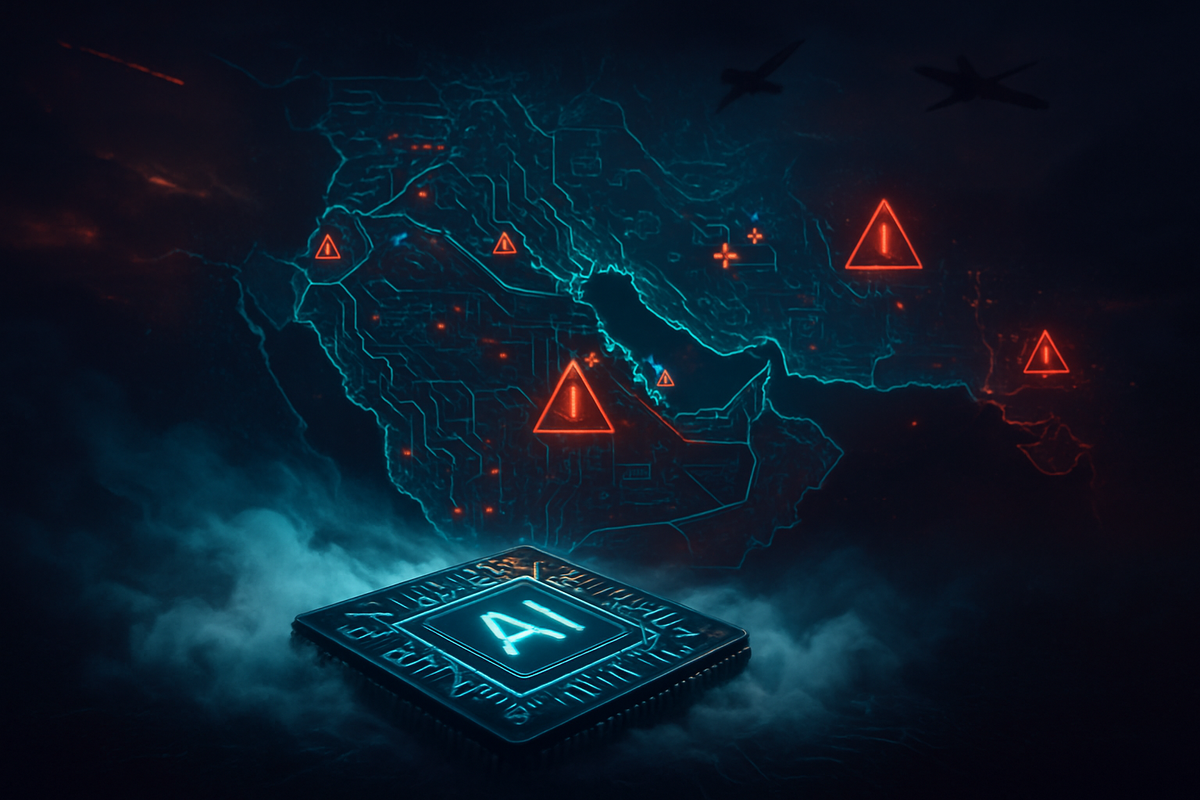
The onset of "Operation Epic Fury" on February 28, 2026, has sent shockwaves through the global financial markets, far transcending the immediate boundaries of the Middle East. What began as a targeted military intervention by a U.S.-led coalition against Iranian leadership has rapidly evolved into a systemic threat to the world’s most critical technology: the artificial intelligence (AI) semiconductor. As of March 23, 2026, the effective closure of the Strait of Hormuz and the systematic targeting of industrial gas facilities have pushed the "AI Boom" of the mid-2020s to the brink of a catastrophic supply-side collapse.
The immediate implications are staggering. For the first time since the 2021 global chip shortage, the industry is facing a synchronized disruption of both raw materials and energy-intensive manufacturing processes. With critical minerals like gallium reaching record prices and the world’s primary helium supply effectively offline, the high-performance computing sector is entering a period of forced austerity. Market analysts warn that unless a diplomatic breakthrough occurs during the current five-day strike postponement, the industry may exhaust its strategic reserves of essential industrial gases by May, potentially halting production at the world’s most advanced fabrication plants.
The 2026 Iran War: A Timeline of Manufacturing Paralysis
The current crisis traces its origins to the final days of February 2026, when a massive joint air assault successfully targeted high-level Iranian leadership, including Supreme Leader Ali Khamenei. While the coalition achieved its tactical objectives, the Iranian retaliation was swift and calculated to cause maximum economic pain. Eschewing a direct naval confrontation with the U.S. Fifth Fleet, Iran deployed thousands of "suicide drones" and precision-guided ballistic missiles aimed at the "chokepoints" of the global supply chain. By March 2, strikes had successfully disabled Qatar’s Ras Laffan LNG facility—a site responsible for nearly one-third of the world’s global helium supply.
Helium is not merely a lifting gas; it is an indispensable cooling and shielding agent for the extreme ultraviolet (EUV) lithography machines produced by ASML (NASDAQ: ASML). Without it, the world's most advanced chip factories, or "fabs," cannot operate. Simultaneously, Iranian strikes targeted the aluminum smelting infrastructure of the Persian Gulf, including Aluminium Bahrain (BHB: ALBA) and Qatar’s Qatalum. These facilities are the primary sources of byproduct gallium, a critical mineral for 5G and AI power-management chips. In less than three weeks, gallium prices have surged over 120%, currently trading above $2,100 per kilogram.
The regional chaos has also physically reached the digital infrastructure that powers AI. Major cloud providers have reported damage to regional data centers, with Amazon (NASDAQ: AMZN) confirming that its AWS hubs in the United Arab Emirates suffered "significant kinetic damage" from drone debris. While companies like Microsoft (NASDAQ: MSFT) and NVIDIA (NASDAQ: NVDA) had previously announced massive "AI Computing Hubs" in the Gulf, these projects have been placed on indefinite hold, signaling a retreat of high-tech capital from the region.
Winners and Losers: The "Scramble for Atoms"
The market reaction has been bifurcated, creating a stark divide between "offshore-dependent" giants and "onshore-resilient" players. The primary losers in this conflict are the Asian semiconductor powerhouses. Samsung Electronics (KRX: 005930) and SK Hynix (KRX: 000660) have seen their market valuations tumble as the KOSPI index shed 20% in early March. Both companies are highly sensitive to the helium shortage and the soaring cost of sulfuric acid, another critical cleaning agent whose seaborne trade has been halted by the blockade of the Strait of Hormuz. Even the industry leader, TSMC (NYSE: TSM), is facing a "double squeeze": rising energy costs for its power-hungry fabs and a looming depletion of its gas reserves.
Conversely, the crisis has accelerated a "flight to domesticity" that favors U.S.-based manufacturers and resource providers. Intel (NASDAQ: INTC) has emerged as an unlikely "safe haven" in the semiconductor space. With its heavy investment in domestic fabrication in Oregon and Arizona, and a strategic equity partnership with the U.S. government established in late 2025, Intel’s server CPU capacity is reportedly sold out through 2026. GlobalFoundries (NASDAQ: GFS) is also seeing a surge in demand as manufacturers of power-management ICs seek to move production away from the volatile Middle Eastern logistics corridor.
In the materials sector, the "winners" are those with North American and Australian assets. Industrial gas giants like Linde PLC (NASDAQ: LIN) and Air Products & Chemicals (NYSE: APD) have exercised unprecedented pricing power as spot helium prices doubled. Speculative interest has also flooded into junior miners like Pulsar Helium (TSXV: PLSR), whose domestic projects in Minnesota are now viewed as national security assets. Similarly, Alcoa (NYSE: AA) is fast-tracking gallium recovery circuits at its Australian refineries to fill the void left by the shutdown of Middle Eastern smelters.
A Fundamental Shift in the Global AI Paradigm
The significance of the 2026 Iran War extends far beyond a temporary price spike; it represents the definitive end of the "Just-in-Time" era for high-tech manufacturing. For decades, the semiconductor industry relied on a fragile, hyper-globalized network where raw minerals were mined in one continent, refined in another, and fabricated in a third. This conflict has exposed the "mineral-energy nexus" of AI—revealing that the most advanced digital intelligence still rests on a foundation of physical atoms and regional stability.
This event mirrors the 1973 Oil Crisis, but for the digital age. Just as the 1970s forced a pivot toward energy efficiency and nuclear power, the 2026 crisis is driving a "Scramble for Atoms" and a regulatory push for "Sovereign AI." Governments in the U.S. and Europe are already drafting emergency legislation to mandate 180-day strategic reserves of industrial gases and critical minerals. Furthermore, the conflict is accelerating the adoption of "AI-driven logistics" as companies like Expeditors International (NASDAQ: EXPD) use digital twins to reroute components around the conflict zone in real-time.
The ripple effects are also being felt in the regulatory sphere. The U.S. Department of Defense has reportedly invoked the Defense Production Act to prioritize helium and gallium deliveries to military-critical AI projects, effectively sidelining consumer electronics manufacturers. This prioritization could lead to a two-tier market where "Sovereign AI" projects (military and national security) receive priority over commercial AI development, potentially slowing the pace of innovation in the private sector for years.
The 90-Day Clock: What Comes Next?
In the short term, all eyes are on the five-day strike pause announced on March 20, 2026. If diplomatic efforts mediated by Oman fail to secure a reopening of the Strait of Hormuz, the industry enters the "90-day depletion zone." Most major fabs maintain a three-month buffer of essential gases. If production at Qatar’s Ras Laffan does not resume by June, a total global production standstill for high-end AI chips becomes a mathematical certainty.
Looking further ahead, we can expect a permanent strategic pivot. High-bandwidth memory (HBM) production, currently concentrated in Korea, will likely see a massive migration to the U.S. and Europe. Companies will no longer view "offshoring" as a cost-saving measure but as a catastrophic risk. The market opportunity for 2027 and beyond lies in "Silicon Independence"—technologies that can recycle industrial gases or replace scarce minerals like gallium with more abundant materials.
Potential scenarios range from a "Cold Peace" where the Middle East remains a high-risk zone for decades, to a "Bifurcated Supply Chain" where Western nations develop a completely parallel, mineral-independent ecosystem. Regardless of the outcome, the cost of doing business in AI has permanently moved higher, as the risk premium for geopolitical instability is now baked into every wafer.
Summary: A New Map for the AI Economy
The 2026 Iran War has proven that the "Cloud" is rooted in the earth. The key takeaways for investors and industry stakeholders are clear: the AI boom is not immune to kinetic warfare, and the geographic location of raw materials is just as important as the architecture of the chip. The market is moving toward a model where supply chain resilience is valued more highly than raw processing power.
Moving forward, the semiconductor landscape will be defined by "Mineral Sovereignty." Investors should closely watch for any reports regarding the repair of the Ras Laffan facility and the status of the Strait of Hormuz. The ability of the U.S. and its allies to bring domestic gallium and helium production online will be the ultimate determinant of whether the AI revolution continues or stalls. In the coming months, the most important metrics won't be "Teraflops" or "Parameter Counts," but "Metric Tons" and "Cubic Feet."
This content is intended for informational purposes only and is not financial advice.