As of March 20, 2026, the global economy stands at a precarious crossroads following the de facto closure of the Strait of Hormuz, the world’s most vital maritime energy artery. What was once a theoretical "black swan" scenario has materialized into a systemic shock, as the Islamic Revolutionary Guard Corps (IRGC) maintains a blockade that has effectively halted 20% of the world’s daily petroleum liquids and nearly 20% of its Liquefied Natural Gas (LNG) supply. The immediate implications have been a violent repricing of risk across every asset class, from surging crude futures to a catastrophic de-rating of the global aviation and logistics sectors.
The crisis, which began in earnest in late February, has seen Brent crude prices skyrocket from a stable $65 per barrel to a mid-March peak of $126, before settling near $108 following massive strategic reserve releases. For the United States, the immediate concern has shifted from inflationary "sticky" prices to a full-blown energy security emergency, with domestic gasoline prices at the pump jumping over 40% in less than three weeks. As the U.S. Navy and coalition forces attempt to clear naval mines and neutralize asymmetric threats, the financial markets are picking winners and losers in a landscape where the "efficiency" of global supply chains has been traded for the "security" of localized production.
The Escalation: Operation Epic Fury and the March Blockade
The current crisis traces its immediate roots to February 28, 2026, when a coalition led by the United States and Israel launched "Operation Epic Fury." This massive military campaign targeted Iranian nuclear facilities and command centers in response to a series of shadow-war escalations throughout late 2025. The strikes resulted in the reported death of Iran’s Supreme Leader, Ali Khamenei, an event that triggered an immediate and scorched-earth retaliatory strategy from the IRGC. On March 2, 2026, Tehran officially declared the Strait of Hormuz a "closed military zone," warning that any vessel attempting transit would be targeted.
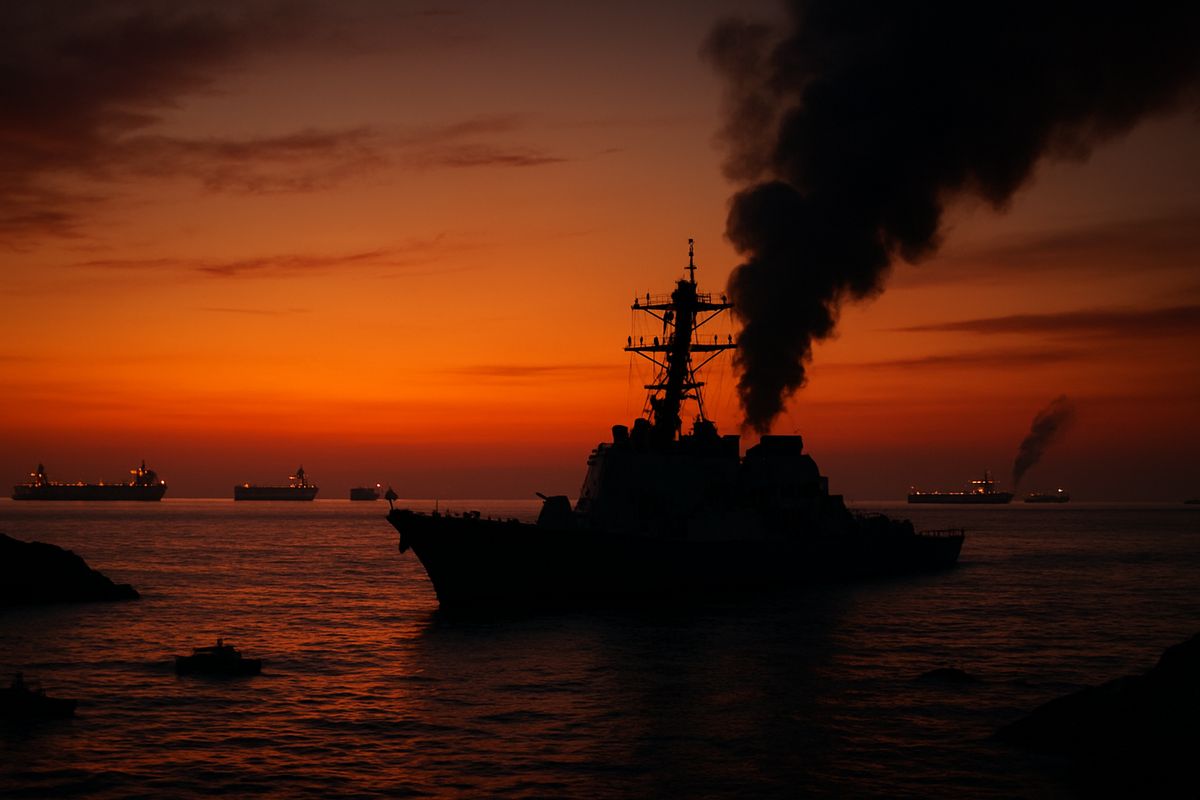
The following 18 days have seen the most intense maritime conflict since World War II. At least 21 merchant vessels have been struck by drones, missiles, or naval mines, including high-profile casualties like the Skylight and the Mayuree Naree. While the U.S. Navy has successfully neutralized several Iranian frigates, including the IRIS Dena, the persistent threat of "swarm" drone attacks and sophisticated bottom-moored mines has deterred commercial shipping. Transit through the Strait has plummeted by 95%, leaving major oil producers like Iraq, Kuwait, and the United Arab Emirates with no choice but to "shut in" production as local storage tanks reach capacity.
The reaction in the oil markets was instantaneous. Traders, fearing a protracted total blockade, pushed WTI and Brent crude into a state of "super-backwardation," where the immediate price of oil is significantly higher than future prices, reflecting the desperation of refineries to secure physical supply. This market panic was only partially mitigated by a historic 400-million-barrel coordinated release from the International Energy Agency (IEA) and the U.S. Strategic Petroleum Reserve, which has served as the only buffer preventing prices from breaching the $150 threshold.
The Financial Fallout: Winners of Security and Losers of Exposure
In the equities market, the crisis has created a stark divide between domestic energy producers and those dependent on Middle Eastern throughput. ExxonMobil (NYSE: XOM) and Chevron (NYSE: CVX) have emerged as the primary beneficiaries, with shares of ExxonMobil rising approximately 27% to hit all-time highs above $150. These "Super Majors" are being rewarded for their massive footprints in the U.S. Permian Basin and the Western Hemisphere, which are now viewed as "safe-haven" barrels immune to Persian Gulf instability. Chevron (NYSE: CVX), in particular, benefited from its 2024-2025 expansions in the Tengiz field and its strategic acquisition of Hess, which provided a diversified supply chain far from the reach of the IRGC.
The defense sector has also seen a massive re-rating. Lockheed Martin (NYSE: LMT) and RTX Corporation (NYSE: RTX) have seen their stocks surge to record levels, with RTX reporting a record-shattering $268 billion backlog as regional allies scramble for Patriot missile batteries and interceptors. Conversely, the "losers" list is led by global airlines and logistics firms. United Airlines (NASDAQ: UAL) and Delta Air Lines (NYSE: DAL) have seen their shares crater by nearly 20% as jet fuel costs nearly doubled. While Delta has a partial hedge through its ownership of the Trainer Refinery, the broader industry is facing a nightmare of soaring costs and forced rerouting.
The shipping industry has seen a more nuanced reaction. Tanker giants like Frontline plc (NYSE: FRO) and DHT Holdings (NYSE: DHT) have watched their stock prices jump as much as 60% year-to-date. As the Strait remains closed, tankers are being forced to take the long route around the Cape of Good Hope, nearly doubling the "ton-miles" required to move oil to Asia and Europe. This has created a severe shortage of available hulls, driving Very Large Crude Carrier (VLCC) spot rates to over $107,000 per day. However, firms like Shell (NYSE: SHEL) and BP (NYSE: BP) have faced significant downward pressure due to their heavy reliance on Qatari LNG and production assets in the lower Gulf, with Shell forced to declare force majeure on several international LNG contracts.
Wider Significance: A Historic Shift in Energy Policy
The 2026 Hormuz Crisis is more than a temporary price spike; it represents the definitive end of the era of "just-in-time" energy. This event mirrors the 1980s "Tanker War" but with a significantly more dangerous technological component, as cheap drones and autonomous mines have allowed Iran to maintain a blockade despite losing its traditional naval surface fleet. For the global market, this represents a structural shift toward a "Security Premium" that will likely keep oil prices elevated for years, even after the Strait is eventually reopened.
Regulatory and policy implications are already appearing. The U.S. government is facing renewed pressure to fast-track domestic drilling permits and LNG export terminals as "national security priorities." In Europe and Asia, the crisis has accelerated a desperate pivot toward nuclear energy and long-term supply agreements with North and South American producers. This event fits into a broader trend of "de-globalization," where the vulnerability of critical maritime chokepoints is forcing nations to build redundant, albeit more expensive, energy infrastructure.
Historically, the Strait of Hormuz has been used as a geopolitical lever, but the scale of the 2026 disruption is unprecedented. Unlike the 2019 "limpet mine" incidents, the current conflict involves the total cessation of traffic and the destruction of infrastructure. This has shattered the long-held market assumption that Iran would never "actually" close the Strait due to the suicidal economic consequences. In the new reality of 2026, ideological and survivalist motivations have overwritten economic rationality, a lesson that investors and policy-makers are learning at a high cost.
What Comes Next: Scenarios and Strategic Pivots
As we look toward the remainder of 2026, two primary scenarios emerge. The first is a "protracted blockade," where the IRGC maintains a persistent threat through hidden minefields and coastal mobile missile units, even after their primary naval bases are destroyed. In this scenario, the world must adapt to a "Cape-only" delivery model, keeping oil prices in the $100–$120 range indefinitely and potentially triggering a global recession. Central banks, already struggling with the tail-end of inflation from the early 2020s, may be forced to choose between raising rates to combat energy-driven inflation or cutting them to support a stalling economy.
The second scenario is a successful "Coalition Escort" program. Similar to Operation Earnest Will in the 1980s, this would involve the U.S. and its allies providing direct military escorts for every commercial tanker. While this could restore some flow, the insurance costs for such transits would remain prohibitive. Market participants should expect a massive surge in "dark fleet" activity, as sanctioned or high-risk-tolerant operators attempt to run the blockade for massive premiums, potentially using the "safe corridors" Iran has offered to China and India.
Strategic pivots will be required from energy-intensive industries. Manufacturing hubs in East Asia, particularly those without domestic reserves, will likely see a forced transition toward electrification and alternative fuels at a pace previously thought impossible. For investors, the "shale is back" narrative will dominate the 2026 investment landscape, with any company capable of increasing production in the Americas or Africa seeing sustained capital inflows.
Wrap-Up: Navigating the New Energy Reality
The closure of the Strait of Hormuz in March 2026 is a defining moment for the 21st-century economy. It has exposed the fragility of global energy markets and the limitations of conventional military power against asymmetric maritime threats. The key takeaway for the market is that the "Hormuz Risk" is no longer a tail-risk to be ignored, but a central component of every valuation model. The "security of supply" is now the single most important metric for energy companies, favoring those with geographically stable assets over those with the lowest cost of production.
Moving forward, the market will remain hyper-sensitive to any news of naval clearing operations or diplomatic back-channels. Investors should watch for the sustainability of current tanker rates and the potential for "force majeure" declarations to spread into other commodity markets. As the S&P 500 continues to grapple with the "Stagflation Signal" of 4% Treasury yields and triple-digit oil, the divergence between the energy/defense sectors and the rest of the market is expected to widen.
Ultimately, the 2026 crisis marks the transition to a more fractured, expensive, and volatile energy world. While the physical blockade may eventually be broken by military force, the psychological blockade—the loss of trust in the safety of global maritime chokepoints—will have a lasting impact on investment strategies and geopolitical alliances for a generation to come.
This content is intended for informational purposes only and is not financial advice.