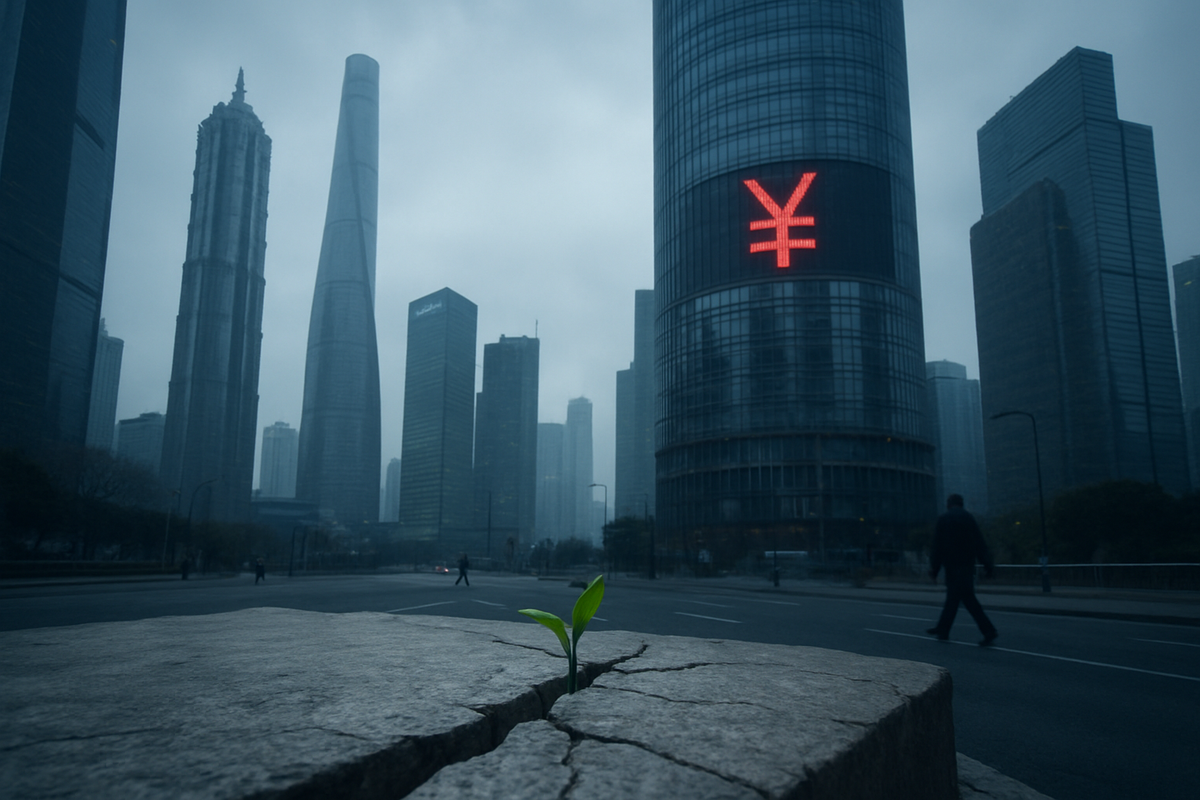
BEIJING — As of March 20, 2026, the world’s second-largest economy finds itself at a critical crossroads, haunted by the specter of "Japanification." After decades of breakneck expansion, China is currently struggling to decouple its future from a five-year-long property crisis and a persistent deflationary cycle that has seen consumer prices stagnate and producer prices tumble. With the Chinese Yuan (CNY) hovering near 6.90 against the U.S. Dollar and the nominal GDP gap with the United States widening, the narrative in global boardrooms has shifted from "when will China overtake" to "how far will China fall behind?"
The immediate implications are stark: a hollowed-out middle class is retreating from aspirational spending, forcing domestic and foreign firms into a brutal "involution"—a state of intense competition where companies burn through capital just to maintain market share. While the People’s Bank of China (PBOC) has attempted a "managed float" to stabilize the currency, the divergence between high U.S. interest rates and Beijing’s need for monetary easing has created a persistent drag on the Yuan, complicating efforts to attract foreign investment back to mainland shores.
A Five-Year Contraction: The Road to 4.5% Growth
The current economic malaise is the culmination of a decade-long reliance on real estate and infrastructure, a model that finally fractured in the early 2020s. By March 2026, the property sector—once the engine of 30% of China’s GDP—is entering its fifth consecutive year of contraction. Data for February 2026 shows property investment fell another 11.1%, following a double-digit decline in 2025. New housing starts have plunged by more than 23%, leaving local governments, which historically relied on land sales for 40% of their revenue, facing a staggering $18.9 trillion debt pile.
The timeline leading to this moment is marked by a series of "fragile stabilizations" that failed to take root. Following the initial defaults of giants like Evergrande and Country Garden in 2021-2023, the government attempted to pivot toward "new quality productive forces"—high-tech manufacturing, green energy, and artificial intelligence. However, while industrial production grew a surprising 6.3% in early 2026, the broader economy remains weighed down by negative producer prices (PPI), which have been in deflationary territory for over 32 months. This factory-gate deflation is eating into corporate margins and preventing the "wealth effect" needed to spur domestic consumption.
Key stakeholders, including Premier Li Qiang and the PBOC leadership, have signaled a shift in priorities. At the National People’s Congress earlier this month, Beijing set a 2026 GDP growth target of 4.5% to 5.0%, the lowest official goal since 1991. The PBOC has maintained a stance of "moderately easing," holding the 1-year Loan Prime Rate at 3% while injecting liquidity through ultra-long special treasury bonds. Market reactions have been muted; investors are no longer looking for "bazooka" stimulus but are instead watching for structural reforms that could address the deep-seated lack of consumer confidence.
Corporate Fallout: The Divide Between Value and Vanity
The 2026 economic landscape has created a clear divide between companies that have adapted to "value-led consumption" and those tethered to the old "aspirational" growth model. PDD Holdings (NASDAQ: PDD) has emerged as a primary beneficiary of the deflationary trend. As the "Value King," Pinduoduo’s focus on ultra-low-cost goods has allowed it to capture nearly 23% of the domestic e-commerce market, as even middle-class families "trade down" to save costs. Similarly, Xiaomi (HKG: 1810) has successfully navigated the downturn by pivoting to high-end hardware and electric vehicles, with its EV division reporting a 47% revenue surge as it eats into the market share of traditional luxury automakers.
Conversely, foreign giants that once viewed China as a bottomless well of growth are now in retreat. Tesla (NASDAQ: TSLA) has seen its Chinese market share erode to roughly 8.2% as of early 2026, struggling against the vertical integration of local rivals like BYD (HKG: 1211), which surpassed Tesla in total EV sales last year. In the consumer sector, Starbucks (NASDAQ: SBUX) is currently finalizing the sale of a 60% stake in its China operations to private equity firms, effectively moving to a licensed model to escape the "price wars" fueled by local competitors like Luckin Coffee.
The luxury sector is perhaps the hardest hit by the "falling behind" narrative. LVMH (EPA: MC) and Kering (EPA: KER) have reported significant sales declines in the Greater China region, as the "aspirational" buyer—the entry-level luxury consumer—has virtually disappeared in the face of wage stagnation and declining property values. Even Apple (NASDAQ: AAPL), while maintaining resilient unit sales, has been forced to offer aggressive discounts and join the "price war" to move inventory, a move that has historically been contrary to its premium brand strategy but is now a necessity in the 2026 retail environment.
The Japanification of the Dragon: Global Ripple Effects
The significance of China’s current struggle lies in its striking resemblance to Japan’s "Lost Decades" of the 1990s. The "Japanification" of the Chinese economy—characterized by a debt-fueled property bubble burst, an aging population, and persistent deflation—is no longer a theoretical risk but a present reality. This shift has massive implications for global trade; as Chinese factories face overcapacity and low domestic demand, they are "exporting deflation" by flooding global markets with cheap goods, leading to increased trade tensions and protective tariffs from the U.S. and the European Union.
Historically, China was the primary engine of global growth, contributing nearly a third of the world's GDP expansion. In 2026, that engine is sputtering. The nominal GDP gap with the U.S. has widened significantly; while the U.S. economy sits at approximately $25.5 trillion, China’s nominal GDP has stagnated around $18 trillion. This widening gap suggests that China may never achieve its long-predicted goal of becoming the world's largest economy in nominal terms, a psychological blow that is reshaping geopolitical alliances and supply chain strategies.
Industrial giants like BASF (ETR: BAS) and Volkswagen (XETRA: VOW3) are caught in a "capital trap." Having invested billions in "In China, for China" production hubs, they now face 32 months of falling producer prices. These firms are seeing their margins evaporate as domestic "zombie firms"—unprofitable but state-supported entities—keep production levels high and prices artificially low to maintain employment, regardless of profitability.
The Path Forward: Strategic Pivots and New Normals
In the short term, the market expects the PBOC to continue its gradual easing, with potential cuts to the Reserve Requirement Ratio (RRR) later in 2026. However, the long-term outlook depends on whether Beijing can successfully transition from an investment-led model to a consumption-led one. This requires a "strategic pivot" that includes strengthening the social safety net to encourage households to spend rather than save for a rainy day—a difficult task given the current local government debt crisis.
Potential scenarios for the remainder of 2026 and into 2027 include a "L-shaped" recovery, where growth stabilizes at a low level (3-4%) but deflation persists. For corporations, the adaptation required is clear: localizing supply chains and competing on "value" rather than "status." We may see more Western firms following the lead of Starbucks, selling majority stakes in their China units to local partners who better understand the price-sensitive, high-speed nature of the current market.
Conclusion: Watching the "New Quality" Transition
As we move through the first half of 2026, the key takeaway is that the "China growth story" has fundamentally changed. The era of double-digit expansion is long gone, replaced by a painful structural adjustment. The "falling behind" narrative is not just about GDP numbers; it is about a loss of momentum in the face of deep-seated demographic and financial hurdles. For investors, the "China trade" is no longer a broad-based bet on the rising middle class but a surgical exercise in identifying "value" plays like PDD Holdings or "AI-first" conglomerates like Alibaba (NYSE: BABA).
Moving forward, the market will be hyper-focused on the 15th Five-Year Plan's implementation and whether the state’s focus on "new quality productive forces" can offset the drag from the "old economy." Investors should watch for signs of "structural reflation"—a rise in core CPI that isn't just driven by holiday spending or energy costs. Until then, the world’s second-largest economy remains in a state of fragile transition, struggling to reclaim its place as the undisputed leader of global growth.
This content is intended for informational purposes only and is not financial advice.