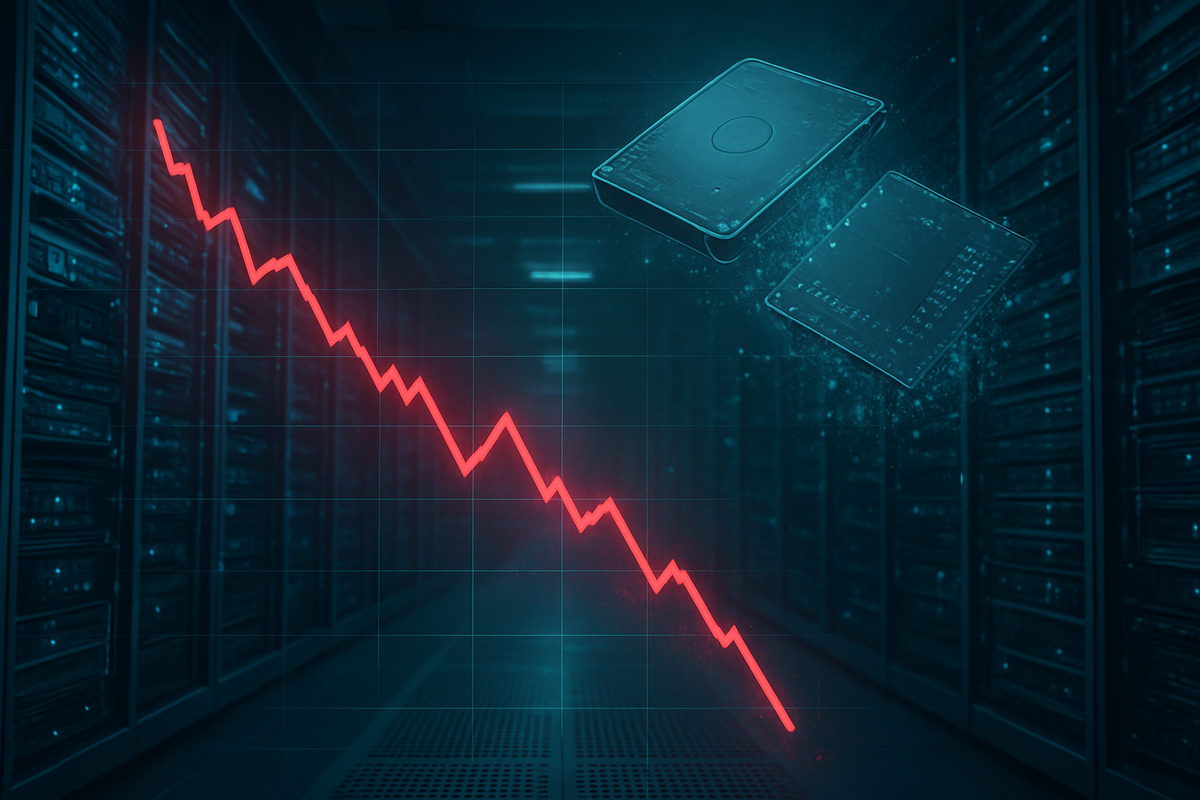
The high-flying storage sector faced a cold reality check on March 20, 2026, as shares of Western Digital (NASDAQ: WDC) and its recently spun-off counterpart, SanDisk Corporation (NASDAQ: SNDK), suffered significant selling pressure. Despite a multi-year "Storage Supercycle" driven by the insatiable appetite for artificial intelligence data lakes, a convergence of a high-profile corporate scandal in the hardware space and a broader institutional rotation out of growth stocks triggered a sharp correction.
The downturn marks a stark pivot from the record-breaking performance seen earlier in the week. While the underlying demand for mass-capacity hard drives and enterprise-grade flash memory remains at historic highs—with manufacturers reporting lead times exceeding 50 weeks—the technical and psychological factors of the market took precedence today. As the 10-year Treasury yield climbed to 4.37%, investors began questioning whether the hardware "gold rush" had reached a temporary ceiling.
The Perfect Storm: A Timeline of the March Correction
The decline of Western Digital (NASDAQ: WDC) and the broader hardware index can be traced back to a series of events culminating on Friday morning. On March 17, 2026, Western Digital hit an all-time high of $314.92, buoyed by optimistic guidance from an investor conference where management projected earnings per share to exceed $20 by 2028. However, this bullishness quickly evaporated as a "sell-the-news" sentiment took hold, exacerbated by a lack of new immediate catalysts to justify further upside.
The volatility reached a breaking point on March 20, 2026, when news broke of the arrest of Wally Liaw, a co-founder of Super Micro Computer (NASDAQ: SMCI). Liaw was charged in a massive $2.5 billion smuggling ring that allegedly utilized shell companies to divert restricted AI servers containing high-end GPUs to sanctioned entities. The scandal sent Super Micro’s stock plummeting over 28%, creating a contagion effect that dragged down the entire hardware sector. Investors, fearing tighter regulatory scrutiny and potential export freezes, began liquidating positions in storage and memory leaders like Western Digital and Seagate Technology (NASDAQ: STX).
Adding to the selling pressure for SanDisk (NASDAQ: SNDK) was the finalization of Western Digital’s "divorce" from its flash business. Western Digital executed a $3.17 billion secondary offering of its remaining 5.8 million shares in SanDisk this week. While the move was strategically sound—allowing Western Digital to aggressively pay down debt and transition into a pure-play enterprise HDD leader—the influx of SanDisk shares into the open market created a temporary supply glut that weighed heavily on the newly standalone company’s stock price.
Shifting Tides: Winners and Losers in the March Rotation
In the immediate aftermath of the hardware sell-off, the clear losers are the legacy and AI-integrated hardware firms. Super Micro Computer (NASDAQ: SMCI) remains at the center of the storm, facing not only a massive loss in market capitalization but also a long-term reputational and legal crisis. Seagate Technology (NASDAQ: STX) and Micron Technology (NASDAQ: MU) also saw their share prices dip by 4% to 5%, as the market ignored Micron’s blowout Q2 earnings of $12.20 per share in favor of safe-haven assets.
However, the day’s events highlighted a massive sector rotation that benefited "Physical Reality" assets. As tech stocks retreated, the Energy and Materials sectors saw substantial inflows. Investors, wary of the "Software-mageddon" caused by autonomous AI agents like Anthropic’s "Claude Cowork"—which many fear will dismantle the traditional per-seat licensing models of software giants—have begun moving capital into tangible industries. Energy companies, in particular, have seen a 25% year-to-date increase as the physical power requirements of AI data centers become a more certain bet than the fluctuating valuations of the hardware manufacturers themselves.
Samsung (KRX: 005930) also found itself in a transitional phase, losing ground on March 20 after announcing it would exit the low-margin SATA SSD market to focus exclusively on High-Bandwidth Memory (HBM). While this strategic pivot is expected to pay off in the long term, the immediate exit from a traditional product line added to the sense of instability within the storage hardware ecosystem.
Industry Significance: The End of the AI Hardware Hype?
This event represents a significant maturation of the AI cycle. The "Storage Supercycle" is no longer a rising tide that lifts all boats; instead, it has entered a phase where governance, geopolitical risk, and macroeconomic headwinds carry equal weight to technological innovation. The smuggling scandal involving Super Micro has reignited a fierce debate over the enforceability of export controls and the security of the global tech supply chain, likely leading to more stringent oversight and higher compliance costs for companies like Western Digital.
Furthermore, the broader market is grappling with a shift from "digital growth" to "tangible hedging." Historically, tech rotations have occurred when valuations outpace the realistic pace of implementation. With Western Digital and Seagate reporting they are effectively "sold out" for the remainder of 2026, the market is no longer pricing in future demand—which is already at max capacity—but is instead reacting to the rising cost of capital and the threat of new 15% global tariffs. This mirror-image of the 2000 dot-com bubble's middle phase suggests that while the utility of the technology is real, the financial instruments surrounding it are undergoing a necessary "de-risking."
The Road Ahead: Strategic Pivots and Scenarios
In the short term, Western Digital and SanDisk will likely remain volatile as the market digests the secondary offering and the legal fallout from the Super Micro case. Investors should look for Western Digital to utilize its newly cleaned balance sheet to accelerate the development of its 40TB+ Heat-Assisted Magnetic Recording (HAMR) drives, which are crucial for the next generation of cloud architecture. The "pure-play" strategy will be put to the test as they focus on the high-margin, high-capacity enterprise market.
In the long term, the storage sector must navigate a landscape of "capacity constraints versus cost." If manufacturers cannot expand production quickly enough to meet the 2027 demand forecasts, the scarcity might lead to even higher margins, potentially decoupling the stock prices from the broader tech sector’s malaise. Conversely, any slowdown in the adoption of large language models (LLMs) would leave these companies with massive capital expenditure bills and overextended production lines.
Market Wrap-up and Investor Outlook
The decline on March 20, 2026, serves as a poignant reminder that even in a "Supercycle," the path is rarely linear. The core takeaway for investors is that the storage hardware business is currently a victim of its own success; with demand maxed out and lead times stretched, the market has turned its focus toward external risks such as interest rates and regulatory scandals.
Moving forward, the storage market will likely be defined by "execution over expectation." Investors should closely monitor the Federal Reserve’s stance on the 10-year yield and the impending Supreme Court rulings on hardware tariffs. While the fundamental demand for data storage is an undeniable pillar of the 21st-century economy, the stocks of the companies building that infrastructure are currently undergoing a healthy, albeit painful, recalibration.
This content is intended for informational purposes only and is not financial advice.