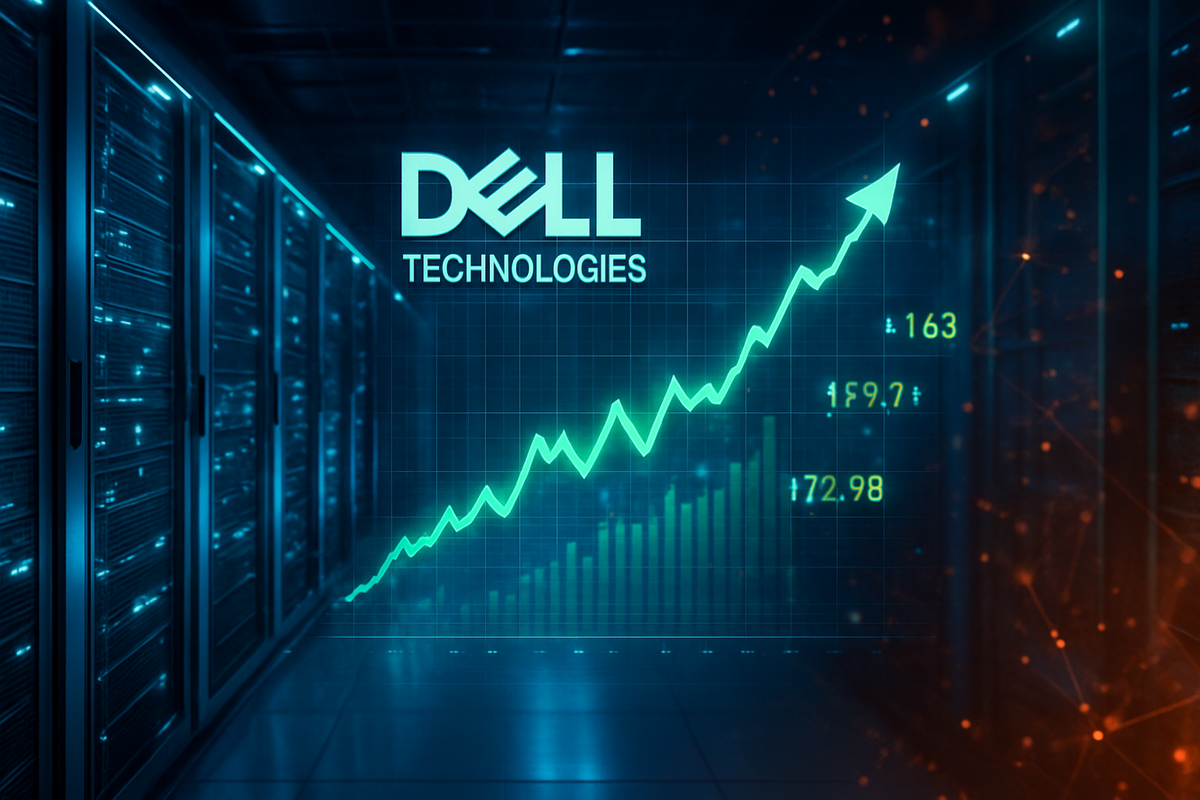
In a period marked by "violent internal restructuring" across the technology sector, Dell Technologies (NYSE: DELL) has emerged as a beacon of stability and growth. On March 20, 2026, shares of the Texas-based hardware giant rose by 5.97%, closing in a range of $163.72 to $166.06. This rally comes at a time when the broader Nasdaq and S&P 500 indices have faced their fourth consecutive week of losses, driven by geopolitical tensions and persistent inflation.
The surge in Dell’s valuation highlights a significant shift in investor sentiment, as the market rotates away from speculative software ventures toward tangible "AI hardware" infrastructure. As Dell’s strategic pivot into the "AI Factory" era gains momentum, the company is proving that demand for high-performance computing and AI-enabled hardware is not only resilient but accelerating, even as other tech sub-sectors falter.
The 'Safe Haven' Rotation: Dell Capitalizes on Competitor Turmoil
The primary catalyst for Dell’s impressive gains on March 20 was a massive investor rotation triggered by a crisis at one of its chief rivals. Super Micro Computer (NASDAQ: SMCI) saw its shares plummet by 27% on the same day following federal indictments of its associates related to the illegal smuggling of AI servers to restricted regions. This governance crisis at SMCI led institutional investors to scramble for a "cleaner, safer" alternative, with Dell Technologies (NYSE: DELL) being the primary beneficiary.
Beyond the immediate market shift, Dell’s fundamentals have provided a solid floor for its stock price. The company entered its 2027 fiscal year with a record $43 billion backlog for AI-optimized servers. In the fourth quarter of fiscal 2026 alone, AI server revenue reached a staggering $8.95 billion, representing a 342% increase year-over-year. This growth is underpinned by the "Infrastructure Solutions Group" (ISG), which has successfully positioned Dell as the architect of modern enterprise data centers.
The timeline leading to this moment has been defined by Dell's aggressive transition from a legacy PC manufacturer to a full-stack AI provider. Over the past 30 days, the stock has rallied 35%, bringing its year-over-year returns to over 60%. Market analysts suggest that Dell’s $11.5 billion cash reserve and its ability to offer massive vendor financing have allowed it to secure large-scale contracts that smaller, more volatile competitors simply cannot service.
Winners and Losers in the AI Hardware Super-Cycle
The current market environment has clearly demarcated winners and losers in the hardware space. Dell Technologies (NYSE: DELL) stands at the forefront of the winners, alongside semiconductor partners like NVIDIA (NASDAQ: NVDA) and storage giants like Micron (NASDAQ: MU). As memory and storage prices surged by nearly 95% in early 2026, Dell’s massive scale allowed it to maintain a healthy 18% gross margin by securing components through long-term contracts, while smaller players struggled with supply chain costs.
In contrast, Super Micro Computer (NASDAQ: SMCI) has become the most visible loser of the current cycle, facing an existential crisis due to regulatory and legal headwinds. Similarly, HP Enterprise (NYSE: HPE) has struggled to keep pace with Dell’s momentum. While HPE remains a significant player, its reported AI backlog of approximately $5 billion as of early 2026 pales in comparison to Dell’s $43 billion. This disparity has led many analysts to view the enterprise AI market as increasingly consolidated under Dell’s "AI Factory" umbrella.
Lenovo (HKG: 0992) remains a strong contender in the Asian and European markets, but Dell continues to maintain a dominant lead in the lucrative U.S. enterprise sector. The "losers" in this scenario also include many traditional Software-as-a-Service (SaaS) companies. This "SaaS-pocalypse" has seen investors flee software firms with high valuations and move capital into hardware companies that produce the physical infrastructure required to run generative AI models.
The Rise of Sovereign AI and the Global Significance
The resilience of Dell Technologies (NYSE: DELL) fits into a broader global trend known as "Sovereign AI." Governments and national entities are increasingly seeking to build proprietary data centers to secure their own intelligence assets and ensure data residency. Dell has positioned itself as the preferred partner for these "Sovereign AI" initiatives, providing integrated systems of servers, storage, and liquid cooling sold as a unified "factory" for enterprise and national intelligence.
This shift mirrors historical precedents where hardware providers become the "picks and shovels" of a gold rush. However, the current "AI hardware super-cycle" is unique in its scale. Unlike the dot-com bubble, where infrastructure often preceded demand, the current demand for AI compute—driven by massive Large Language Models (LLMs)—is outstripping supply. This has turned hardware into a "commodity in shortage," providing Dell and its peers with unprecedented pricing power.
The ripple effects of Dell's success are also being felt in the consumer market. The "AI PC" refresh cycle is now in full swing. By March 2026, over 55% of Dell’s commercial laptop shipments were AI-enabled, featuring Neural Processing Units (NPUs) capable of 40–50 trillion operations per second. These devices, including the high-end XPS 14 and 16 models, allow AI tasks to run locally, addressing enterprise concerns regarding privacy and cloud latency.
Future Outlook: The $50 Billion AI Revenue Target
Looking ahead, Dell Technologies (NYSE: DELL) has set ambitious targets that suggest the current rally may be the beginning of a sustained growth phase. Management has projected $50 billion in AI-related revenue for the 2027 fiscal year, which would represent a 100% increase over the previous year's already record-breaking figures. Short-term, the company is expected to continue benefiting from the "AI PC" replacement cycle as businesses retire aging fleets in favor of NPU-equipped workstations.
However, challenges remain. The surging cost of DRAM and NAND flash storage remains a potential headwind for margins if Dell cannot fully pass these costs to customers. Furthermore, as "Edge AI"—the practice of running AI workloads on local hardware—becomes more common, Dell will need to innovate rapidly in its "Client Solutions Group" (CSG) to maintain its edge over competitors like Apple (NASDAQ: AAPL) and Lenovo.
Potential strategic pivots may involve deeper integration with proprietary AI software layers. While Dell has historically been a hardware-first company, the "AI Factory" model suggests a future where Dell provides the managed services and software orchestration tools required to run these complex systems, potentially opening up recurring revenue streams that could further stabilize its valuation.
Summary and Investor Takeaways
Dell’s 6% gain on March 20, 2026, is a testament to the company’s successful transformation into an AI infrastructure powerhouse. By capitalizing on the governance failures of competitors and the robust demand for both AI servers and AI-enabled PCs, Dell has navigated a period of intense tech volatility with remarkable resilience. The core takeaway for the market is that the hardware super-cycle is far from over; it is moving from a phase of speculative builds to one of industrial-scale deployment.
Moving forward, the market will be closely watching Dell’s ability to fulfill its massive $43 billion backlog amidst rising component costs. Investors should also monitor the progress of "Sovereign AI" contracts, as these high-margin, large-scale deployments could provide the next leg of growth for the ISG division. While the broader tech market remains volatile, Dell’s position as a "safe harbor" for AI investment makes it a critical stock to watch in the coming months.
This content is intended for informational purposes only and is not financial advice.