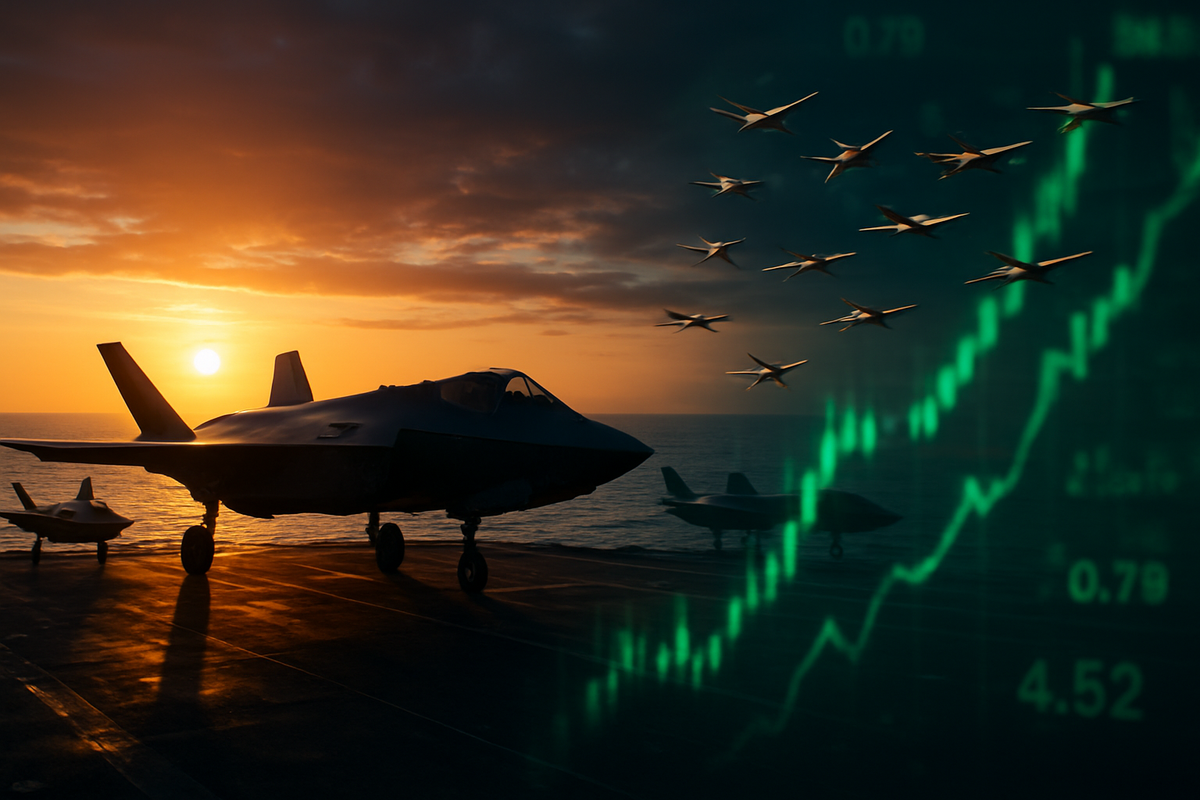
The global defense sector witnessed a seismic shift on March 2, 2026, as markets reacted to the most significant escalation in Middle Eastern hostilities in decades. Following a weekend of precision "decapitation" strikes by a U.S.-Israeli coalition against Iranian leadership—dubbed "Operation Roaring Lion"—shares of traditional defense titans reached record highs. Investors, anticipating a massive surge in procurement for a "rearmament supercycle," flocked to the stability of established contractors, signaling a pivot toward high-intensity conflict readiness.
While the broader defense index climbed, the market reaction revealed a sharp divergence between the established "Primes" and emerging specialized firms. As the Pentagon moves toward a proposed $1.5 trillion defense budget, the contrast between the steady gains of multi-domain giants and the operational volatility of tactical drone manufacturers has become the focal point for Wall Street analysts.
The Decapitation of Tehran: A Timeline of Escalation
The military action that culminated on March 1, 2026, was the result of a long-simmering conflict that began in earnest during the "Twelve-Day War" of June 2025. During that initial phase, Israel launched "Operation Rising Lion," targeting Iranian nuclear facilities at Natanz and Fordow. Although a fragile ceasefire held for several months, the collapse of nuclear negotiations in early February 2026, coupled with a domestic uprising within Iran, set the stage for the current kinetic phase.
On February 28, 2026, coordinated strikes targeted a high-level leadership summit in Tehran. By the evening of March 1, Iranian state media confirmed the death of Supreme Leader Ayatollah Ali Khamenei. The immediate aftermath saw Iran retaliate with a barrage of ballistic missiles directed at U.S. assets in Qatar and Bahrain, alongside the strategic closure of the Strait of Hormuz. This closure sent Brent crude prices surging 10% to nearly $79 per barrel, adding an energy crisis to the geopolitical firestorm. The Pentagon responded by deploying the USS Gerald R. Ford and USS Abraham Lincoln carrier strike groups, marking the largest naval buildup in the region since 2003.
The Safe Havens: Lockheed Martin and RTX Corp
For investors seeking a "safe haven" amid the chaos, Lockheed Martin (NYSE: LMT) emerged as the primary beneficiary. Shares of the defense behemoth jumped between 4% and 7% on March 2, hitting record highs near $698. The F-35 Lightning II played a central role in the initial waves of the strikes, reinforcing the aircraft's status as the backbone of modern air superiority. With the U.S. and its allies expected to accelerate F-35 deliveries and sustainment contracts, Lockheed's long-term order backlog appears more robust than ever.
Similarly, RTX Corp (NYSE: RTX) saw its stock price climb between 3.8% and 6.6% as the conflict underscored the critical importance of missile defense. RTX's Patriot and THAAD (Terminal High Altitude Area Defense) systems were instrumental in intercepting Iranian retaliatory strikes over Israel and U.S. bases. Furthermore, the company secured major contracts in February 2026 to ramp up production of the Tomahawk cruise missile, which was the primary weapon utilized in the "decapitation" strikes. For the Primes, the conflict is not just a tactical success but a validation of their multi-billion dollar platform strategies.
The Outlier: AeroVironment’s Paradox of Growth
In contrast to the steady ascent of the giants, AeroVironment (NASDAQ: AVAV) presented a far more complex picture for investors. While the company’s stock initially skyrocketed 19% due to the massive demand for its Switchblade loitering munitions—which have become a staple of modern asymmetric warfare—it simultaneously faced a brutal "headline risk" that saw intraday plunges. The primary drag on AeroVironment is the ongoing friction from its $4.1 billion acquisition of BlueHalo in May 2025.
Despite the heightened demand for its hardware, AeroVironment reported a collapse in gross margins, falling from 39% to a mere 22% in early 2026. This decline was attributed to a shift toward lower-margin service revenue and significant intangible amortization from the BlueHalo deal. Compounding these issues, the U.S. Space Force recently announced a re-competition of the $1.4 billion Satellite Communications Augmentation Resource (SCAR) program—a contract BlueHalo had previously secured. This uncertainty, paired with negative operating margins of -5.85% and the upcoming retirement of CFO Kevin McDonnell, has left AeroVironment's stock with a volatility profile nearly four times higher than its larger peers.
Industry Trends and Historical Precedents
The current conflict fits into a broader trend of "dual-track" defense spending. On one track, the Pentagon is doubling down on traditional heavy platforms (LMT, RTX) for large-scale deterrence. On the other, it is rapidly integrating low-cost, high-attrition autonomous systems (AVAV). However, the market is beginning to realize that "winning" a war in the field does not always translate to winning on the balance sheet for smaller contractors. The integration of BlueHalo into AeroVironment serves as a cautionary tale of how rapid M&A in the defense sector can lead to "indigestion" even during a period of record demand.
Historically, this moment mirrors the early 2000s, where traditional contractors enjoyed years of steady growth following the onset of the War on Terror. However, the 2026 landscape is defined by higher interest rates and a focus on "capital efficiency" that did not exist twenty years ago. Investors are now more discerning, rewarding companies with strong cash flows and buyback programs while penalizing those with high P/E ratios (AVAV currently sits near 90x) and execution slips.
The Road Ahead: Market Opportunities and Challenges
Looking forward, the short-term outlook is dominated by the proposed $1.5 trillion defense budget currently circulating through Congress. If passed, this would represent the largest peacetime (or near-wartime) military expenditure in U.S. history. For Lockheed Martin and RTX, the focus will remain on scaling production to meet this demand while managing supply chain bottlenecks that have plagued the industry since the mid-2020s.
For AeroVironment, the next six months are critical. The company must prove it can successfully integrate BlueHalo’s technological edge without further eroding its margins. A strategic pivot toward more profitable software-defined capabilities may be necessary to satisfy a market that is increasingly wary of "growth at any cost." The upcoming re-competition of the SCAR contract will be a bellwether for the company’s ability to compete in the high-stakes world of Space Force procurement.
Conclusion: What Investors Should Watch
The strikes on Iran have fundamentally altered the risk-reward calculus for the defense sector. The key takeaway for March 2, 2026, is the resurgence of the "Big Five" contractors as the preferred vehicles for geopolitical risk. Lockheed Martin and RTX Corp have demonstrated that in times of extreme volatility, scale and stability are the most valued commodities.
In the coming months, investors should closely watch the progress of the $1.5 trillion budget and any further retaliatory actions from Tehran that could disrupt global energy markets. For those tracking the "disruptors" like AeroVironment, the focus must be on margin recovery and the resolution of the SCAR contract dispute. While the "rearmament supercycle" is undoubtedly underway, the market is currently favoring the titans over the innovators until the latter can prove their operational resilience.
This content is intended for informational purposes only and is not financial advice.