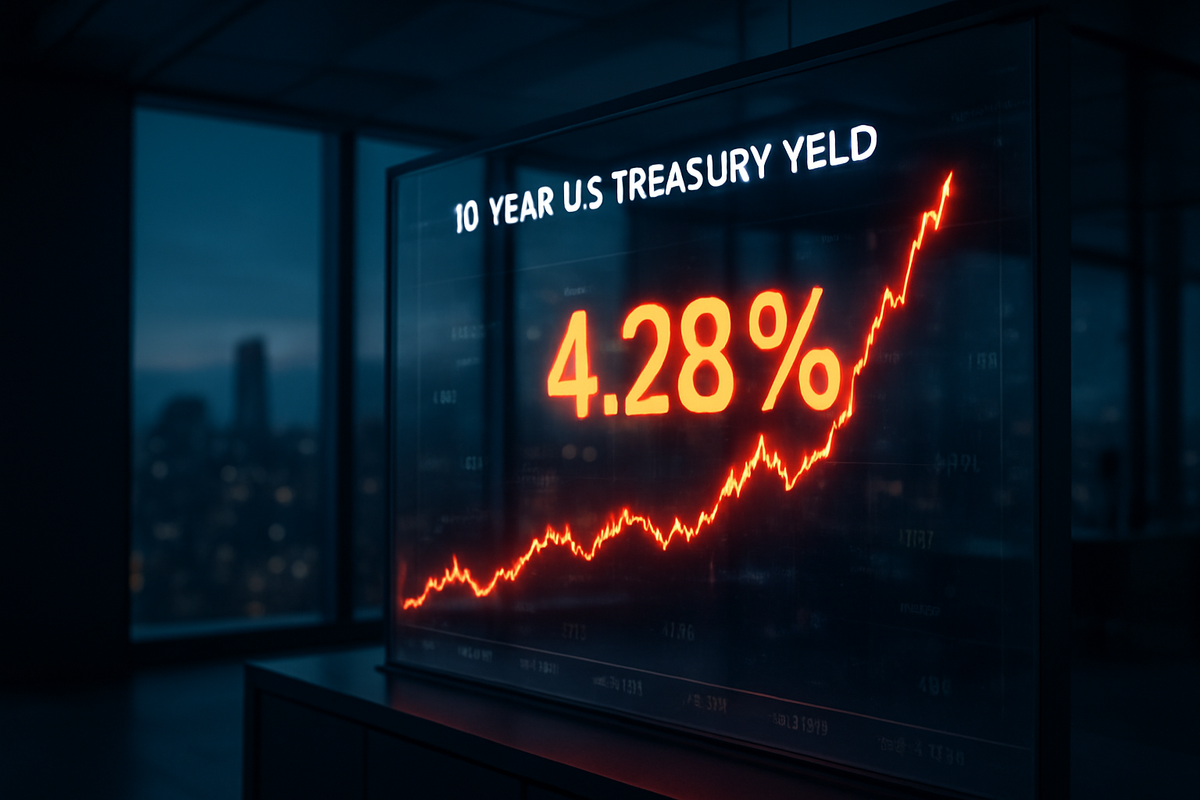
The financial landscape shifted dramatically today, March 19, 2026, as the 10-year US Treasury yield surged to 4.28%, its highest level in over a year. This sharp move higher has sent shockwaves through the credit markets, abruptly ending a period of relative stability and forcing investors to recalibrate their expectations for the Federal Reserve's next move. For months, the consensus was a "higher-for-longer" pause, but today's technical breakout suggests a far more hawkish reality is taking hold as inflationary pressures refuse to dissipate.
The immediate implications of this yield spike are already being felt across the economy. Borrowing costs for everything from 30-year mortgages to small business lines of credit have ticked higher in tandem with the benchmark rate. More strikingly, the derivatives market has begun to price in a reality many thought was a relic of the past: traders are now assigning a 10% probability to a Federal Reserve rate hike in the coming months, a stark reversal from the rate-cut optimism that characterized the start of the year.
The Catalyst: A Perfect Storm of Inflation and Geopolitics
The surge to 4.28% did not happen in a vacuum. It follows a 48-hour window of intense volatility triggered by a series of hotter-than-expected economic prints. On March 17, the Bureau of Labor Statistics released Consumer Price Index (CPI) data showing a second consecutive month of acceleration, with Core PCE—the Fed's preferred inflation gauge—sticking stubbornly at 3.1%. When combined with a fresh spike in global energy prices due to ongoing supply chain disruptions in the Middle East, the "inflation is cooling" narrative was effectively dismantled.
The timeline of this yield climb began in early February when the 10-year note sat comfortably below 4.0%. However, as the "no landing" economic scenario became more likely, the yield curve began to steepen. By early this morning, a massive sell-off in the bond market pushed the 10-year yield through the psychological 4.25% resistance level, eventually settling at 4.28%. Market participants, including major institutional desks at firms like Goldman Sachs and Morgan Stanley, noted that the velocity of the move caught many "duration-heavy" portfolios off guard, leading to a cascade of stop-loss orders that further fueled the spike.
Key stakeholders, including Federal Reserve officials who have spent the last quarter signaling a "cautious wait-and-see" approach, are now under immense pressure. Federal Reserve Chair Jerome Powell’s upcoming public remarks are being scrutinized for any hint that the "pause" could turn into a "pivot back to hikes." The initial market reaction was a sea of red across equity indexes, particularly in sectors sensitive to the cost of capital, as the 10-year yield—often called the "risk-free rate"—reset the discount rate for every asset class in the world.
Winners and Losers: From Big Banks to Homebuilders
The rise in yields has created a stark bifurcation in the equity markets. The banking sector stands out as a primary beneficiary, as a steeper yield curve typically translates to improved Net Interest Margins (NIM). JPMorgan Chase & Co. (NYSE: JPM) saw its stock price resilient today, as the bank can now reprice its lending products at these higher benchmarks while its massive deposit base remains relatively low-cost. Similarly, Bank of America Corp. (NYSE: BAC) is expected to see a significant lift in interest income from its vast portfolio of floating-rate loans and cash reserves, with analysts projecting a double-digit earnings boost if yields hold these levels through the quarter.
Conversely, the housing sector is facing a severe headwind. Homebuilders like D.R. Horton, Inc. (NYSE: DHI) and Lennar Corp. (NYSE: LEN) have seen their shares come under intense pressure. With the 10-year yield at 4.28%, average 30-year fixed mortgage rates are once again knocking on the 7.0% door. To maintain sales volume, these builders are being forced to offer expensive "mortgage rate buydowns," which directly erode their gross margins. Lennar recently reported that incentives now account for nearly 14% of their average sales price, a cost that becomes increasingly unsustainable as the benchmark yield continues to climb.
The technology sector is also grappling with the "valuation gravity" of higher rates. High-growth giants like Microsoft Corp. (NASDAQ: MSFT) and Apple Inc. (NASDAQ: AAPL) saw their shares retreat as investors recalculated the present value of their future cash flows using the higher 4.28% discount rate. Even Nvidia Corp. (NASDAQ: NVDA), the darling of the AI boom, was not immune to the volatility; while its demand remains robust, the broader market's de-risking move suggests that even the strongest growth stories face valuation compression when the risk-free rate rises so abruptly.
A Fundamental Shift in Market Dynamics
This event represents more than just a bad day for bonds; it signifies a potential shift in the "post-inflation" era. Throughout late 2025, the market was operating under the assumption that the inflation fight was largely won and that the Fed would eventually "normalize" rates lower. Today’s 4.28% yield suggests that "normal" may be much higher than previously thought. This fits into a broader trend of "sticky inflation" caused by structural labor shortages and the massive capital expenditures required for the global energy transition and AI infrastructure.
The ripple effects are particularly concerning for the Commercial Real Estate (CRE) sector. Companies like Prologis, Inc. (NYSE: PLD) and American Tower Corp. (NYSE: AMT) must now contend with a "refinancing wall" of debt that was issued during the low-rate years of the early 2020s. For the office sector, represented by players like SL Green Realty Corp. (NYSE: SLG), the 4.28% yield is a double-edged sword: it not only makes refinancing existing debt more expensive but also pushes capitalization rates higher, further depressing property valuations in an already struggling market.
Historically, moves of this magnitude in the Treasury market have often preceded broader economic cooling or financial "breaks." Comparing today’s event to the rate spikes of 2023, the key difference is that the economy today is still growing at a 2.4% clip. This "no landing" scenario—where growth stays strong but inflation refuses to hit the 2% target—creates a policy nightmare for the Fed, as it may be forced to hike rates into a cooling labor market to prevent an inflationary spiral.
The Road Ahead: Hikes, Cuts, or a Long Plateau?
In the short term, all eyes are on the Federal Open Market Committee (FOMC). If inflation data for the rest of March remains hot, the 10% probability of a rate hike currently priced in by traders could easily double or triple. Strategically, corporations are likely to accelerate debt issuance in the coming weeks to lock in rates before they climb further, potentially creating a "front-running" effect that keeps upward pressure on yields. For many firms, the pivot will involve a shift from aggressive expansion toward balance sheet preservation and debt reduction.
Longer term, the 4.28% yield may become the new floor rather than the ceiling. If the US government continues to run significant deficits, the increased supply of Treasury bonds will require higher yields to attract buyers, especially as foreign central banks diversify away from US debt. This creates a scenario where the "bond vigilantes" return to the market, demanding higher premiums for the long-term risks of fiscal instability and persistent price increases.
Investors should prepare for continued volatility as the market searches for a new equilibrium. Market opportunities may emerge in "cash-rich" companies that can self-fund their growth without relying on expensive debt markets. However, the challenge remains for the broader index, which has been buoyed by the hope of lower rates. If the 10-year yield consolidates above 4.30%, we may see a more prolonged rotation out of growth and into defensive "value" plays that can weather a high-cost capital environment.
Market Outlook and Final Thoughts
The rise of the 10-year Treasury yield to 4.28% on March 19, 2026, marks a critical inflection point for the global economy. It serves as a stark reminder that the era of "easy money" is not coming back any time soon and that inflation remains a formidable foe. The sudden pricing of a 10% hike probability by traders underscores the fragile nature of the current market sentiment and the potential for a hawkish surprise from the Federal Reserve later this year.
Moving forward, the primary metric for investors to watch will be the "real yield"—the Treasury yield minus expected inflation. If real yields continue to rise, the pressure on equities and real estate will only intensify. The market is currently in a state of "price discovery," trying to determine if the 4.28% level is a temporary spike or the beginning of a move toward 5%.
As we navigate the coming months, the resilience of the US consumer and the stability of the corporate credit markets will be the ultimate tests. For now, the "valuation gravity" of 4.28% is the dominant force in the market. Investors should remain vigilant, keep an eye on upcoming PCE data, and be prepared for a Fed that may be forced to choose between price stability and economic growth in a way it hasn't had to in years.
This content is intended for informational purposes only and is not financial advice.