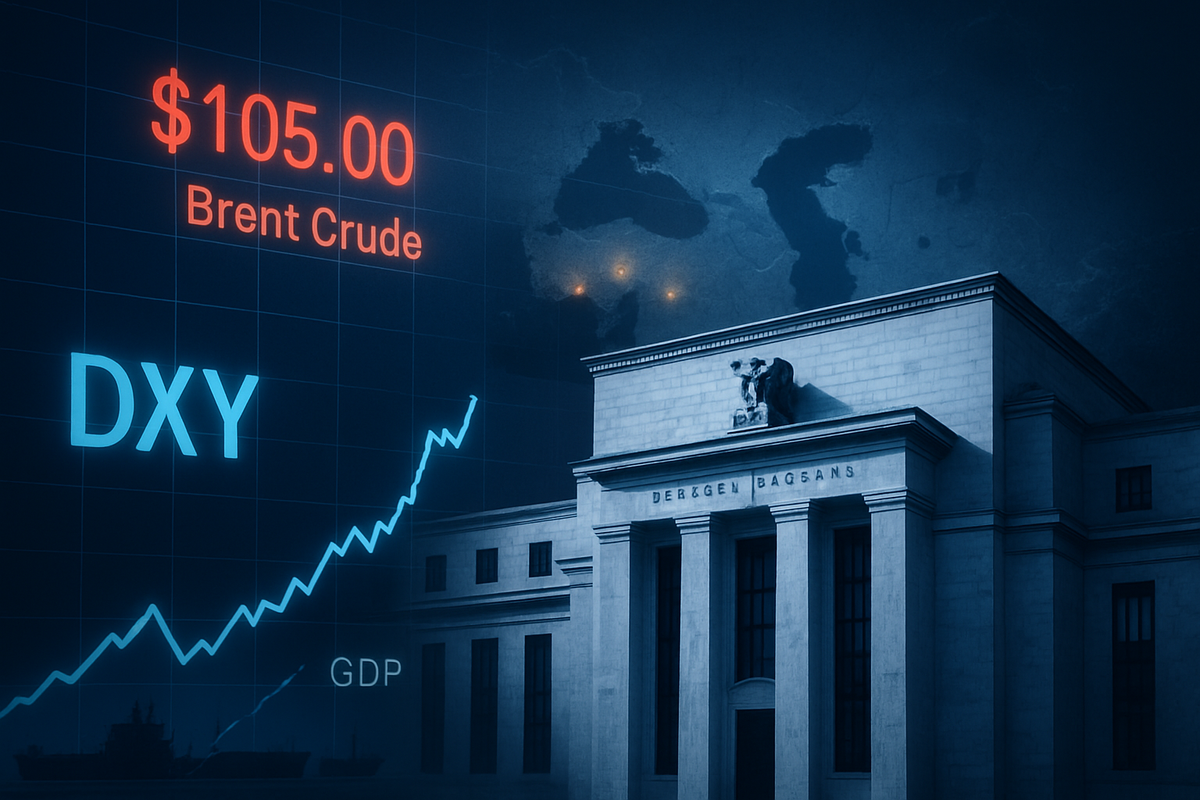
The Federal Reserve concluded its two-day policy meeting on March 19, 2026, opting to maintain the federal funds rate at 3.50%–3.75%. While the decision to pause was widely anticipated, the accompanying Summary of Economic Projections (SEP) and Chair Jerome Powell’s post-meeting commentary delivered a sobering "hawkish hold" that has sent shockwaves through the financial markets. The central bank significantly raised its inflation forecasts for the remainder of the year, citing the recent military escalation in the Middle East and the resulting surge in global energy prices as primary drivers of renewed price instability.
The immediate implications are clear: the long-awaited "pivot" to a series of rate cuts has been effectively deferred. With Brent crude oil currently trading north of $105 per barrel and the U.S. Dollar Index (DXY) surging past the 104 mark, the Fed finds itself in a precarious balancing act. Policymakers are now forced to confront a "stagflation-lite" environment where slowing economic growth is coupled with stubbornly high costs, complicating the path toward a "soft landing" and leaving investors to recalibrate their expectations for the second half of 2026.
Middle East Conflict Upends the Fed’s Disinflation Narrative
The FOMC meeting took place against a backdrop of geopolitical chaos. The launch of "Operation Epic Fury" in late February—a major military campaign involving U.S. and Israeli forces in response to regional threats—led to the strategic closure of the Strait of Hormuz. This blockade effectively removed a significant portion of the world’s daily oil supply from the market, causing energy prices to skyrocket. This "energy shock" has directly bled into the Fed’s latest projections, with headline Personal Consumption Expenditures (PCE) inflation for 2026 now revised upward to 2.7%, compared to the 2.4% projected just three months ago.
Leading up to this week’s meeting, market participants had hoped for a more dovish stance, but the "sticky" nature of core PCE—which also rose to 2.7%—proved too persistent for the committee to ignore. The updated "dot plot" reveals a stark shift in sentiment; fourteen of the nineteen FOMC participants now project either zero or only one rate cut for the entire year, a dramatic departure from the multiple cuts envisioned at the end of 2025. This move suggests that the Fed is prioritizing the fight against energy-driven inflation over concerns about a cooling labor market.
The meeting was also marked by a sense of transition. Chair Jerome Powell, whose term ends in May 2026, faced intense questioning regarding the future of the central bank's independence. With Kevin Warsh widely expected to succeed him, the "hawkish hold" is seen by many as a final effort by the Powell-led Fed to anchor inflation expectations before a potential change in leadership. The transition has added a layer of institutional uncertainty, as investors wonder if a new Chair will maintain the current "higher-for-longer" trajectory or succumb to political pressure to ease as GDP growth slows toward 1.4%.
Corporate Winners and Losers in a High-Cost Environment
The Fed’s hawkish stance and the spike in energy costs have created a bifurcated market. In the energy and defense sectors, the current crisis has acted as a catalyst for growth. Companies like Devon Energy (NYSE: DVN) and EQT Corp (NYSE: EQT) have seen their valuations jump as they are increasingly viewed as essential providers of domestic energy, particularly as AI data centers demand more reliable power. Similarly, defense titans Lockheed Martin (NYSE: LMT) and Northrop Grumman (NYSE: NOC) are reporting record backlogs and surging share prices as the Middle East conflict intensifies global demand for advanced weaponry and surveillance systems.
Conversely, the aviation and logistics sectors are bearing the brunt of the energy price spike. Major carriers such as United Airlines (NASDAQ: UAL) and Delta Air Lines (NYSE: DAL) saw their shares tumble over 20% following the Fed’s announcement, as jet fuel prices climbed to $3.95 per gallon. The increased cost of operations, paired with a stronger U.S. Dollar that makes international travel more expensive for foreign tourists, has severely dampened the outlook for the travel industry. Logistics giant FedEx (NYSE: FDX) also faced heavy selling pressure as fuel surcharges began to erode margins and global trade volumes showed signs of softening.
In the industrial space, the "Physical Economy" surge continues to benefit infrastructure-focused firms despite the macro headwinds. GE Vernova (NYSE: GEV) and Eaton Corp (NYSE: ETN) remain resilient, buoyed by multi-year contracts for grid modernization and energy efficiency projects. However, the tech sector remains a mixed bag. While Nvidia (NASDAQ: NVDA) continues to defy gravity due to the unrelenting demand for AI infrastructure, many Software-as-a-Service (SaaS) companies have experienced significant drawdowns as higher interest rates diminish the present value of their future earnings, leading to a "valuation reset" across much of the high-growth tech landscape.
The Significance of ‘Stagflation-Lite’ and a Dominant Dollar
The broader significance of the March 18-19 meeting lies in the emergence of a "stagflation-lite" narrative. This environment is characterized by growth that is fast enough to keep unemployment relatively stable at 4.4%, but slow enough to feel stagnant when compared to the post-pandemic boom. The Fed’s willingness to hold rates steady despite a slowing GDP reflects a historical precedent set during the 1970s—a cautionary tale of what happens when a central bank eases too early in the face of an oil shock. By maintaining a hawkish posture, Powell is signaling that the "inflation ghost" of fifty years ago still haunts the halls of the Eccles Building.
Furthermore, the renewed strength of the U.S. Dollar is creating a ripple effect across global commodity markets. As the DXY pushes past 104, commodities priced in dollars—such as copper and aluminum—have become prohibitively expensive for non-U.S. buyers. This has led to a "demand postponement" in major emerging markets, further straining global supply chains. Industrial metals, which reached record highs in early 2026, are now seeing inventories build up on the London Metal Exchange as buyers wait for a currency reprieve that may not come until the Middle East conflict de-escalates.
The policy implications extend beyond the U.S. borders. The Fed’s "higher-for-longer" stance is forcing other central banks, particularly the European Central Bank and the Bank of Japan, into difficult positions. If they cut rates to support their own flagging economies, they risk further devaluing their currencies against the dollar, which would only import more inflation through higher energy costs. This synchronized global struggle highlights the return of "geopolitics as a macro-driver," where military movements in the Persian Gulf dictate the monthly budgets of households in the American Midwest.
What Lies Ahead: Navigating a Volatile 2026
In the short term, market participants should prepare for heightened volatility as the "stagflation-lite" data continues to roll in. The key metric to watch will be the monthly PCE reports for April and May; if energy prices do not stabilize, the "one cut" currently priced into the 2026 dot plot could vanish entirely, leading to a "no-cut" year. Corporations will likely pivot toward aggressive cost-cutting and efficiency measures to protect margins, a trend that may lead to a cooling of the labor market by late summer, potentially giving the Fed the "slack" it needs to eventually ease.
Longer term, the strategic shift toward energy independence and grid resilience will likely accelerate. The Middle East conflict has served as a brutal reminder of the risks associated with global energy dependence, likely fueling more investment into domestic nuclear, natural gas, and renewable infrastructure. For the markets, the "AI-Energy Nexus" will remain a dominant theme, where the companies that can solve the dual challenge of high computing power and high energy costs will emerge as the new market leaders.
Market Outlook and Final Thoughts
The Federal Reserve’s March 2026 meeting marks a turning point in the post-inflation era. By opting for a "hawkish hold," the Fed has sent a clear message: the mission is not yet accomplished. The energy shock has introduced a new variable that threatens to unwind years of progress in price stability, and the central bank is prepared to sacrifice growth in the near term to prevent a permanent reset of inflation expectations.
Moving forward, the market will remain hyper-sensitive to two factors: the duration of the conflict in the Middle East and the policy leanings of the incoming Fed leadership. While the "stagflation-lite" environment presents significant challenges, it also offers a sorting mechanism that separates high-quality, cash-flow-positive companies from those reliant on cheap credit. For the coming months, the mantra for investors should be "caution and quality," as the era of easy money remains a distant memory in the face of a complex and volatile global landscape.
This content is intended for informational purposes only and is not financial advice.