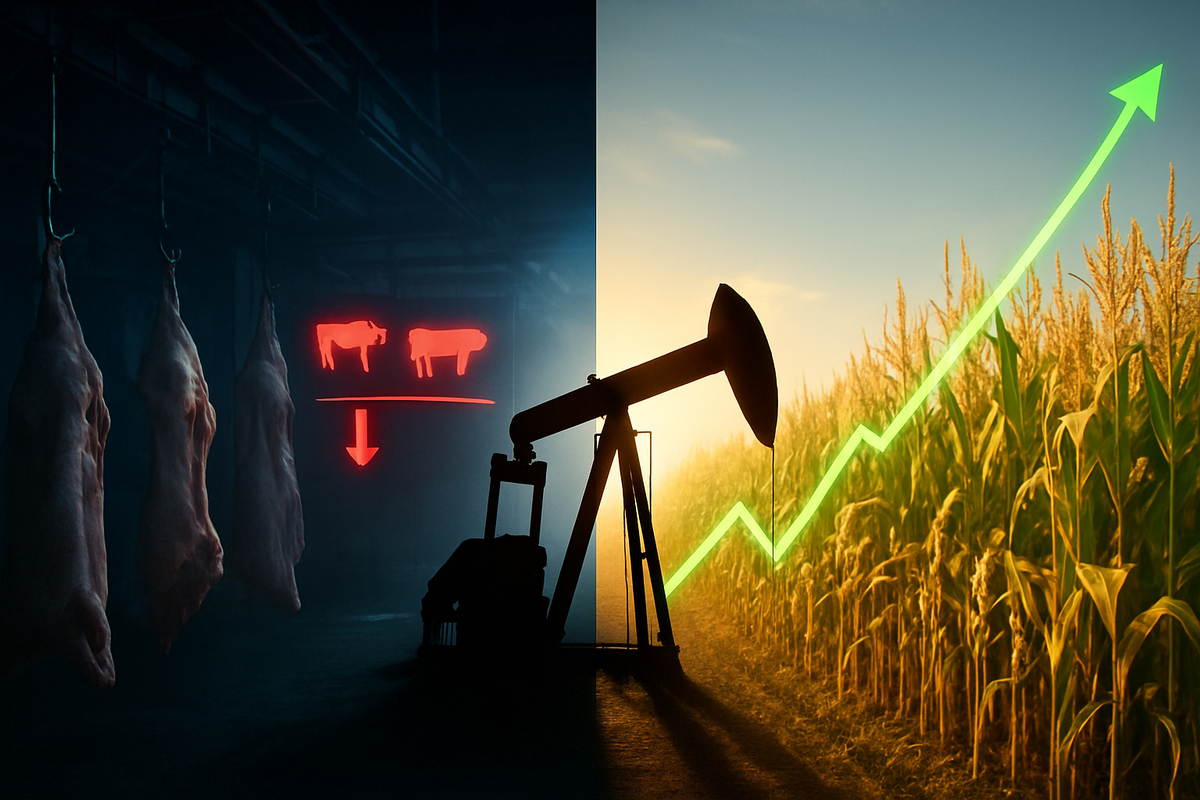
As the first quarter of 2026 draws to a close, the agricultural markets are grappling with a perplexing divergence that has left analysts and investors scrambling for a new playbook. In a reversal of traditional seasonal trends, wholesale livestock prices for cattle and hogs have begun to soften significantly, even as the cost of the grains required to feed them—specifically corn and oats—surges to multi-month highs. This "Protein Paradox" is reshaping the financial landscape for some of the world’s largest food producers and highlights a growing disconnect within the global supply chain.
The primary catalyst for this anomaly is not a sudden surplus of animals, but rather a systemic energy shock that is acting as a de-facto tax on the global consumer. With Brent crude oil prices flirting with $150 per barrel following recent geopolitical escalations in the Middle East, the cost of processing, transporting, and refrigerating meat has skyrocketed. This has created a pincer movement for the industry: while the "input cost surge" makes it more expensive than ever to bring a steak to market, the "demand destruction" caused by high energy prices at the pump is forcing consumers to trade down to cheaper proteins or staple grains, leaving meatpackers with inventory they can only move by cutting wholesale prices.
A Tale of Two Markets: The 2026 Agricultural Divergence
The current market environment, as of March 18, 2026, marks a stark departure from the bullish livestock cycle seen throughout much of 2025. Leading up to this moment, the U.S. cattle herd had hit a 75-year low, a factor that historically would have guaranteed record-high prices for producers. However, the sudden spike in diesel and natural gas prices over the last sixty days has disrupted the logic of scarcity. Freight and logistics costs have climbed by an estimated 20% since February, creating a regional glut in certain processing hubs as the cost of moving livestock to distant plants becomes prohibitive.
Key stakeholders, including the United States Department of Agriculture (USDA) and major regional cooperatives, have noted an uptick in "panic culling." High feed costs—driven by the aforementioned grain rally—are forcing many ranchers to liquidate herds early rather than face the mounting expense of finishing cattle on record-high corn. This has resulted in a temporary surge in slaughter rates, further depressing near-term futures contracts for live cattle and lean hogs. While the long-term supply remains tight, the immediate market reaction has been one of retreat, with April and June contracts for lean hogs dipping into the $0.94 range as of mid-March.
In contrast, the grains complex is thriving on the back of the very energy crisis that is hobbling livestock. Corn and oats are seeing a resurgence in demand, not just for feed, but as critical components of the biofuel and staple-food sectors. Corn futures have rallied as high oil prices boost the profitability of ethanol, while oats recently touched a 28-week high near $353.20 per bushel. This rally is compounded by a global shortage of nitrogen-based fertilizers, a direct byproduct of the natural gas price spikes, which has clouded the outlook for the upcoming planting season and sent speculative buyers flocking to grain futures.
Industry Impact: Winners and Losers in the Feed-to-Meat Pipeline
The divergence between livestock and grains is creating a challenging environment for pure-play meat processors. Tyson Foods (NYSE: TSN) has found itself particularly exposed to this "corn-cost shock." As its favorable 2025 feed hedges expire, the company is being forced to purchase corn and soymeal at spot prices that are significantly higher than anticipated. Combined with softening demand for its premium beef and pork lines, Tyson’s margins are under severe compression, leading to a bearish outlook from many Wall Street analysts who previously expected a recovery in 2026.
Similarly, Hormel Foods (NYSE: HRL) is navigating its "Transform & Modernize" era under significant pressure. While the company has managed to beat some earnings expectations by prioritizing margin over volume, the reality at the retail level is more somber. Sales volumes for its flagship meat products have declined as consumers shift their spending toward more economical options. JBS S.A. (OTC: JBSAY) has fared slightly better due to its vast geographical diversification; while its North American beef operations are struggling, strong performance in its poultry segments—specifically Pilgrim’s Pride (NASDAQ: PPC)—and its Brazilian exports are providing a much-needed buffer against the U.S. demand slump.
On the other side of the ledger, the major grain traders and processors are emerging as the relative winners of this shift. Bunge Global (NYSE: BG) has outperformed its peers following its strategic merger with Viterra, allowing it to move grain more efficiently through global trade routes disrupted by the energy crisis. Bunge recently raised its long-term earnings outlook, buoyed by the high volatility in oilseed and grain prices. Archer-Daniels-Midland (NYSE: ADM) also remains a key player to watch; although it faces thinning margins in traditional grain crushing, its heavy investment in biofuels and nutrition is paying off as the energy-starved market hunts for alternative fuel sources.
The Broader Significance of the Protein Paradox
The current situation fits into a broader trend of "inflationary bifurcation," where the cost of production and the price the consumer is willing to pay are no longer moving in tandem. Historically, a rise in grain prices would eventually lead to a rise in meat prices as producers passed costs along. However, the 2026 energy crisis has broken this link. Because energy is such a dominant factor in the modern consumer's budget, the "demand floor" for meat has dropped faster than producers can adjust their pricing models.
This shift has significant ripple effects for the entire food industry. Competitors in the plant-based and alternative protein sectors, who were struggling just two years ago, are seeing a renewed interest as the price gap between animal protein and grain-based staples narrows. Furthermore, the regulatory environment is shifting. With food security becoming a top-tier political issue in an election year, there is increasing talk in Washington about subsidized fertilizer programs or emergency interventions in the energy markets to prevent a full-scale collapse of the domestic livestock industry.
The historical precedent for this can be found in the 2008 commodities boom, but with a modern twist. In 2008, high oil prices pushed up all commodities simultaneously. In 2026, the complexity of the global supply chain and the sensitivity of the post-pandemic consumer have created a more nuanced, and perhaps more dangerous, environment where some sectors of agriculture are left behind while others soar.
Navigating the Road Ahead: What Comes Next?
In the short term, the livestock market is likely to remain under pressure until energy prices stabilize or the "panic culling" phase of the cycle concludes. If oil remains near $150 per barrel, we may see a more permanent shift in consumer habits, with beef and pork becoming luxury items rather than daily staples. Meat processors will likely need to engage in more aggressive strategic pivots, potentially accelerating plant closures or shifting focus toward value-added, lower-cost poultry products to protect their bottom lines.
For the grains market, the primary challenge will be sustainability. If corn prices remain too high for too long, they will eventually kill their own demand by bankrupting the livestock producers who are their primary customers. Market participants should watch for a potential "correction by destruction," where the lack of livestock demand eventually forces grain prices back down to earth. However, as long as the biofuel mandate remains strong and energy prices are high, the floor for corn and oats is likely to remain elevated.
Opportunities may emerge in the ag-tech sector, specifically for companies focusing on feed efficiency and alternative fertilizers. As the cost of traditional inputs becomes untenable, the market will reward innovations that allow producers to do more with less. Investors should also keep a close eye on the South American harvest, as any shortfall there could turn the current "grains rally" into a full-scale global shortage.
Summary and Market Outlook
The "Protein Paradox" of March 2026 serves as a stark reminder that in the modern economy, energy prices are the ultimate arbiter of value. The softening of livestock prices in the face of rising grain costs is a clear signal of demand destruction at the consumer level, driven by a global energy tax that is shrinking discretionary income. While grain traders like Bunge Global and ADM are currently benefiting from the volatility, the meat processing sector, led by Tyson and Hormel, is facing one of its most difficult margin environments in recent memory.
Moving forward, the market is likely to remain bifurcated. Investors should watch for the USDA's upcoming planting intentions report and any cooling in the Brent crude market as potential turning points. For now, the agricultural complex is a house divided, and the path to a more balanced market likely requires a significant de-escalation of the energy pressures that are currently holding both the consumer and the producer in a vice grip. The lasting impact of this event may well be a permanent restructuring of the American dinner plate, with grains and poultry taking center stage at the expense of traditional red meats.
This content is intended for informational purposes only and is not financial advice.