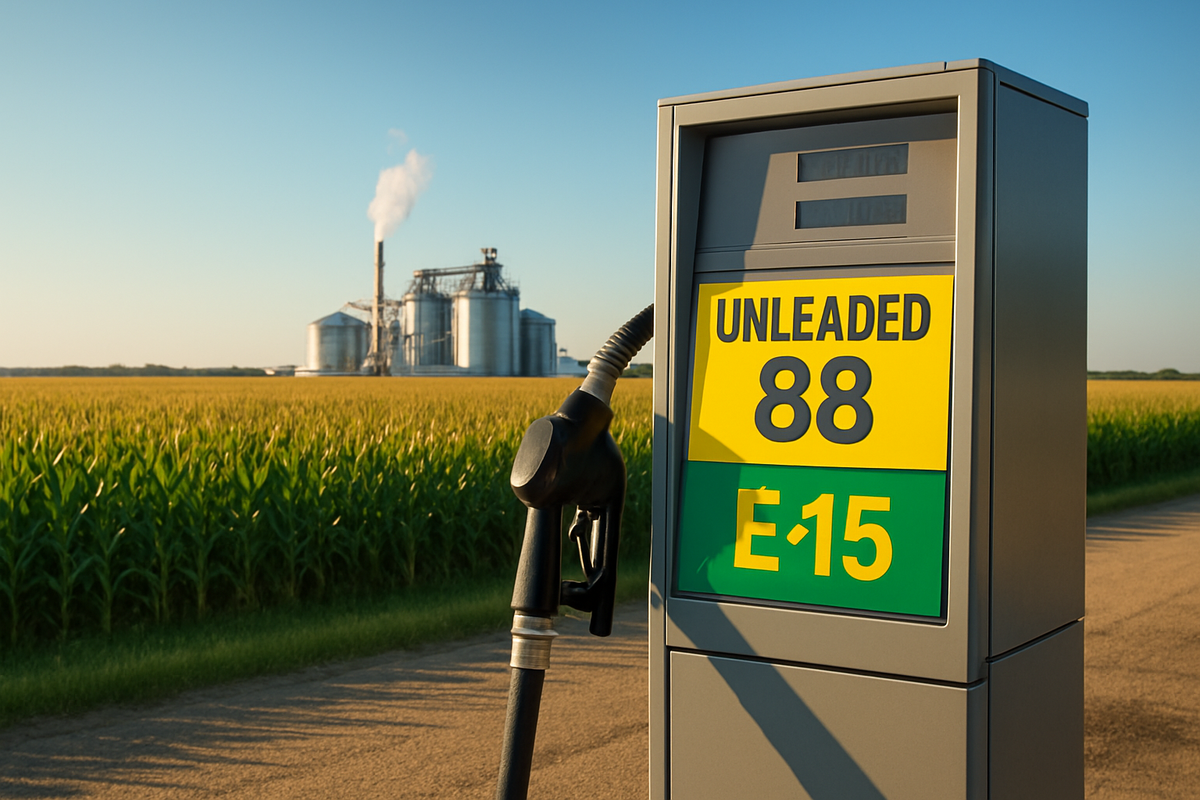
As of mid-March 2026, the American energy landscape is grappling with a sudden and severe "structural shock" triggered by escalating conflict in the Middle East. With Brent crude oil prices breaching $120 per barrel following the closure of the Strait of Hormuz on February 28, national average gasoline prices in the United States have surged by 80 cents in less than 30 days. In response to this volatility, the Renewable Fuels Association (RFA) has intensified its lobbying efforts to unlock the nation’s unused ethanol capacity, positioning E15—a 15% ethanol-blended fuel—as an immediate economic relief valve for consumers and a vital support system for the domestic agricultural economy.
The push for expanded E15 access, often marketed as "Unleaded 88," aims to provide a lower-cost alternative at the pump while simultaneously absorbing a massive surplus of corn from the record-breaking 2025 harvest. As the Biden-Trump transition era gives way to new energy policies under the current administration, the RFA is urging the Environmental Protection Agency (EPA) to issue an emergency waiver that would allow year-round sales of the higher-blend fuel across all 50 states, effectively bypassing the traditional summertime restrictions that have long plagued the industry.
The Scramble for Lower-Cost Fuel
The current crisis traces its roots to late February 2026, when geopolitical tensions between Israel, the U.S., and Iran culminated in a maritime blockade of the world’s most critical oil artery. By March 18, 2026, the global supply disruption has forced energy analysts to recalibrate their forecasts, with some predicting $150-per-barrel oil if the blockade persists. This spike has left American drivers facing prices near $3.70 per gallon, a level not seen in years, and has prompted RFA CEO Geoff Cooper to issue a direct appeal to EPA Administrator Lee Zeldin and the National Energy Dominance Council. The RFA argues that E15 is currently selling for 10 to 50 cents less per gallon than standard E10, offering a tangible "geopolitical discount" to inflation-weary households.
The timeline leading to this moment has been one of regulatory frustration followed by a sudden sense of urgency. Throughout 2025, the ethanol industry operated with nearly 2 billion gallons of unused production capacity as domestic consumption lagged behind a record 16.5-billion-gallon production year. At the same time, American corn farmers harvested a staggering 17 billion bushels, leading to a surplus that has driven commodity prices to six-year lows. By early March 2026, many farmers reported losses exceeding $0.85 per bushel due to high input costs for fertilizer and fuel—costs that have only worsened with the Middle East conflict.
Key stakeholders, including the National Corn Growers Association and several Midwestern governors, have formed a coalition to pressure the federal government. On March 6, 2026, seven governors sent a joint letter requesting an emergency nationwide waiver for the 2026 summer driving season, citing "extreme and unusual fuel supply circumstances." While the EPA has acknowledged the need for regulatory certainty, it has yet to issue a blanket waiver, leaving the industry in a state of high-stakes anticipation as the April 28 implementation date for the "Midwest Rule" approaches.
Market Winners and the Ag-Energy Divide
The expansion of E15 access has created a clear divergence in the fortunes of several publicly traded companies. One of the primary beneficiaries is Green Plains Inc. (NASDAQ: GPRE), which has seen its stock rally 65% year-to-date as of March 2026. The company has successfully pivoted toward "biorefining technology," commissioning carbon capture equipment that allows it to benefit from the 45Z Clean Fuel Production tax credit. Management has guided for at least $188 million in Adjusted EBITDA from these carbon initiatives alone in 2026, as the demand for low-carbon E15 surges.
Similarly, Archer-Daniels-Midland (NYSE: ADM) is positioned to capitalize on the market volatility. While ADM faced a difficult 2025, its massive global merchandising and logistics network has proven invaluable during the Hormuz crisis. Analysts note that ADM typically sees higher near-term profits during energy shocks, and the company has issued 2026 adjusted EPS guidance of $3.60 to $4.25, bolstered by a projected $100 million tailwind from the 45Z tax credit tied to ethanol demand. Valero Energy (NYSE: VLO) has also emerged as a winner in this high-priced environment. Despite regulatory pressures leading to the planned closure of its Benicia refinery in April 2026, Valero’s ethanol segment reported record operating income in late 2025, and its refining margins have expanded significantly as diesel crack spreads hit $64 per barrel this month.
On the retail side, Casey’s General Stores (NASDAQ: CASY) has leveraged its "rural moat" to maintain strong fuel margins. By aggressively adopting E15 as its standard "Unleaded 88" offering, Casey’s has been able to provide a lower-cost option that maintains store traffic even as gas prices rise. However, the picture is less optimistic for meat producers like Tyson Foods (NYSE: TSN). Tyson is currently facing a "margin squeeze" as high oil prices incentivize more ethanol blending, which in turn supports corn prices that serve as feed for livestock. Tyson missed its Q1 2026 earnings estimates and expects its beef segment to remain in the red for fiscal 2026 due to these rising feed costs and tight cattle supplies.
A Shifting Regulatory Landscape
The push for E15 fits into a broader industry trend of "energy decoupling," where the U.S. seeks to insulate its domestic economy from foreign supply shocks. The current situation echoes the oil crises of the 1970s, but with a modern twist: the U.S. now has the agricultural and refining capacity to replace a significant portion of imported oil with domestically produced biofuels. The RFA estimates that nationwide E15 adoption could displace half of the oil currently imported from OPEC nations, which totaled over 314 million barrels in 2025.
Regulatory implications are centered on the "Midwest Rule," which is set to allow eight states (including Iowa, Illinois, and Nebraska) to sell E15 year-round on a permanent basis starting April 28, 2026. While this is a victory for the "Corn Belt," it creates a logistical patchwork for refiners and fuel retailers. The Nationwide Consumer and Fuel Retailer Choice Act, reintroduced in Congress in February 2026, seeks to provide a permanent federal solution, but it remains stalled in the Senate. Historically, the EPA has used its "emergency" powers to bridge these legislative gaps, and the current Middle East crisis provides the most compelling justification for such a move in recent history.
Potential ripple effects extend to the automotive and infrastructure sectors. As E15 becomes more common, fuel retailers are forced to upgrade storage tanks and dispensers, a move that benefits equipment manufacturers but places a burden on smaller, independent stations. Furthermore, the "food vs. fuel" debate has been reinvigorated, as meat producers and environmental groups argue that diverting record amounts of corn to fuel tanks could eventually lead to higher grocery bills, even if it lowers costs at the gas pump.
The Road Ahead: Summer 2026 and Beyond
In the short term, all eyes are on the April 28 deadline. If the EPA does not issue a nationwide waiver before then, the U.S. will enter the 2026 summer driving season with a fractured fuel market where E15 is legal in some states and prohibited in others. This could lead to localized supply shortages and further price volatility. Strategic pivots are already underway; ethanol producers are increasingly focusing on the carbon intensity (CI) of their fuel, as lower CI scores lead to higher subsidies under the 45Z tax credit framework, which becomes a major market driver in 2026.
Long-term, the success of the E15 push could pave the way for E30 or even higher blends as the "Renewable Volume Obligations" (RVOs) are re-evaluated for the late 2020s. However, the industry must navigate the challenge of an aging vehicle fleet and the slow but steady rise of electric vehicles. Scenario planning suggests that if the Middle East conflict is resolved quickly, the urgency for E15 may wane, potentially leaving ethanol producers with over-expanded capacity. Conversely, a prolonged conflict could cement ethanol's role as a cornerstone of U.S. energy security.
Market opportunities will likely emerge for companies specializing in carbon capture and sequestration (CCS), as these technologies are the primary way for ethanol producers to lower their CI scores. For fuel retailers, the ability to market "Unleaded 88" as a premium but lower-priced product will be a key differentiator in a high-inflation environment.
Assessing the 2026 Fuel Transition
The push for E15 expansion in March 2026 represents more than just a policy debate; it is a critical intervention in a domestic economy threatened by global instability. The key takeaways for the market are the clear benefits to diversified ag-processing giants like ADM and pure-play biorefiners like Green Plains, contrasted with the headwinds facing protein producers like Tyson Foods. The "Midwest Rule" beginning in late April will serve as the first major test of whether the U.S. fuel infrastructure can handle a large-scale shift toward higher ethanol blends.
As we move forward, the market should watch for two major catalysts: a potential nationwide emergency waiver from EPA Administrator Lee Zeldin and the outcome of the Senate’s deliberations on the Nationwide Consumer and Fuel Retailer Choice Act. Both would provide the regulatory certainty that the industry has craved for a decade. While the Middle East crisis has brought significant pain to the pump, it has also provided the ethanol industry with its most significant opportunity for growth since the inception of the Renewable Fuel Standard.
Investors should remain focused on the "crush spread"—the difference between the cost of corn and the price of ethanol—as well as the ongoing developments in the Strait of Hormuz. In this environment, energy independence is no longer a political slogan; it is a market-moving reality that is reshaping the American agricultural and energy sectors in real-time.
This content is intended for informational purposes only and is not financial advice.