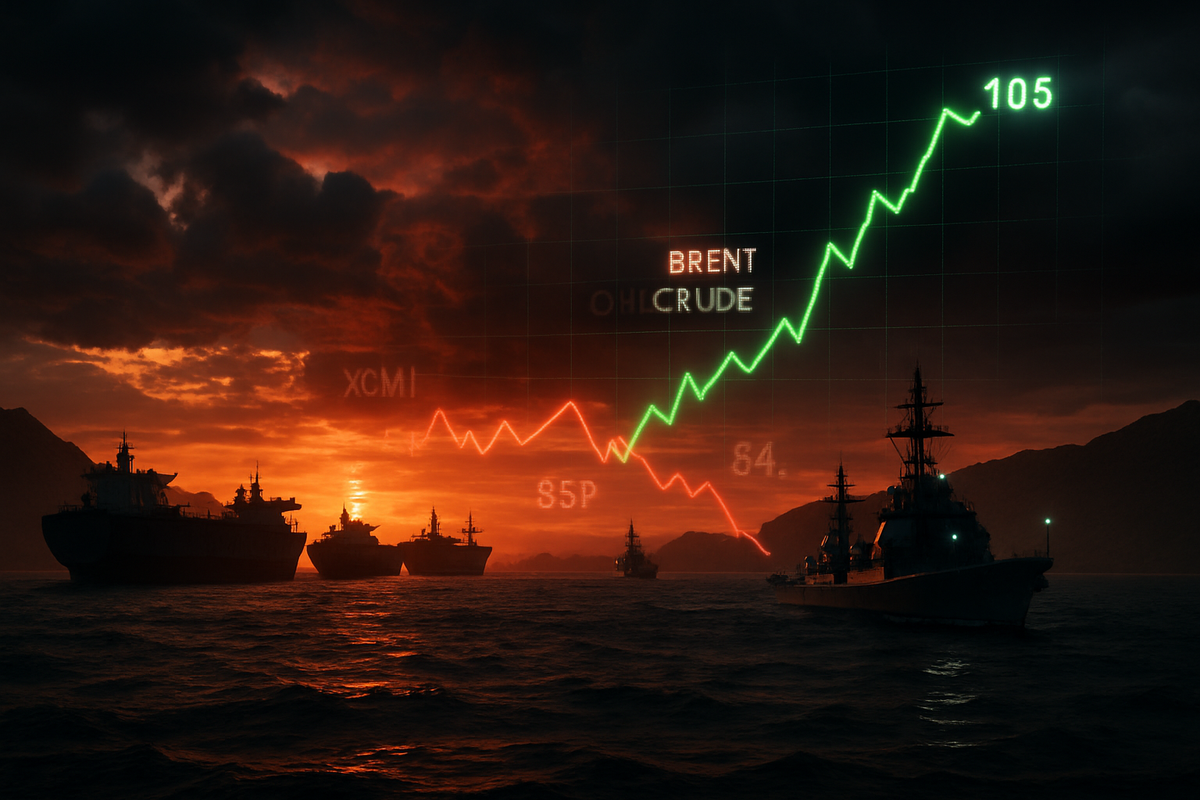
As of March 18, 2026, global financial markets are reeling from the most significant military escalation in the Middle East in a generation. Following the total closure of the Strait of Hormuz by Iranian forces, Brent crude oil prices have surged to $104.76 per barrel, a level not seen in years, sparking fears of a prolonged inflationary spiral. The blockade of the world’s most vital energy chokepoint has sent shockwaves through Wall Street, with the CBOE Volatility Index (INDEXCBOE:VIX) spiking nearly 20% this week as investors scramble to price in a "war premium" that shows no signs of dissipating.
The immediate implications are stark: a massive "risk-off" migration has seen billions of dollars flow out of growth-oriented tech stocks and into defensive havens. While the energy and aerospace sectors are seeing record-breaking intraday gains, the broader S&P 500 and Dow Jones Industrial Average (INDEXDJX:.DJI) are grappling with extreme intraday swings. For the average consumer, the conflict is manifesting at the pump, where gasoline prices are projected to rise by 30% in the coming fortnight, potentially stifling the fragile post-2025 economic recovery.
A Chokepoint Under Siege: The Path to March 18
The current crisis traces its roots back to late 2025, following the definitive collapse of diplomatic efforts regarding Iran’s nuclear "breakout" capacity. Tensions reached a breaking point on February 28, 2026, with a series of coordinated tactical strikes—collectively known as "Operation Epic Fury"—targeting Iranian enrichment facilities and command centers. The subsequent chaos within the Iranian leadership led to a fragmented but aggressive retaliatory posture by the Islamic Revolutionary Guard Corps (IRGC), culminating in the mid-March declaration of a "maritime exclusion zone" spanning the entire 21-mile width of the Strait of Hormuz.
This blockade has effectively trapped over 20 million barrels of oil per day—approximately 20% of global consumption—inside the Persian Gulf. By March 13, shipping insurance premiums for tankers in the region had surged by 400%, leading major logistics firms to suspend all transit. The timeline of the past two weeks has been characterized by high-stakes naval maneuvering and drone skirmishes, leaving hundreds of commercial vessels stranded and creating a global supply vacuum that even the International Energy Agency’s emergency reserve releases have failed to fill.
The key players in this geopolitical drama extend beyond the combatants. Saudi Arabia and the United Arab Emirates are facing immense pressure to activate bypass pipelines, while China, a major consumer of Iranian and Gulf oil, has expressed "grave concern," further complicating the diplomatic landscape. The initial market reaction was one of pure panic; on the day the Strait was officially declared closed, the Dow Jones Industrial Average saw a single-day drop of over 500 points before bargain hunters and energy bulls stepped in to stabilize the floor.
Winners and Losers in a High-Octane Economy
In the wake of the $104.76 Brent crude peak, the stock market has split into two distinct camps. The clear "winners" are the domestic energy titans and defense contractors. Exxon Mobil (NYSE: XOM) and Chevron (NYSE: CVX) have seen their share prices climb to multi-year highs as the market rewards companies with significant non-Gulf production. Investors view these "Supermajors" as safer bets, benefiting from increased margins on their Permian Basin and Atlantic offshore assets. Similarly, the defense sector has become a primary beneficiary of the conflict. Lockheed Martin (NYSE: LMT) and RTX Corporation (NYSE: RTX) have seen a surge in demand for missile defense systems and advanced munitions, as Western allies move to replenish stocks and bolster regional security in the Middle East.
Conversely, the "losers" list is dominated by fuel-sensitive industries, most notably the airlines. Delta Air Lines (NYSE: DAL) and American Airlines (NASDAQ: AAL) have both seen their valuations plummet by more than 15% since the start of March. The combination of soaring jet fuel costs—which represent nearly a quarter of operating expenses—and the massive disruption of international flight paths over Middle Eastern airspace has created a "double whammy" for the aviation sector. Shipping and logistics firms are also under fire, as the increased cost of maritime transport ripples through global supply chains, threatening to reignite the shipping-led inflation that plagued the early 2020s.
Regional Conflict and the Global Economic Pivot
This conflict is more than a temporary spike in commodity prices; it represents a fundamental shift in global energy security. For years, the industry trend has been a slow transition toward renewables, but the March 2026 crisis has forced a brutal re-evaluation of fossil fuel dependency. The closure of the Strait of Hormuz highlights the "fragility of the transition," where a lack of redundant energy infrastructure makes the global economy hyper-vulnerable to regional instability. This event mirrors the 1973 oil embargo and the 2022 invasion of Ukraine, yet the scale of the disruption in 2026 is arguably greater due to the interconnected nature of modern "just-in-time" supply chains.
The ripple effects are reaching far beyond oil. Natural gas prices have also seen a sympathetic rise, affecting utility companies and heavy manufacturing. Regulatory and policy implications are looming large, as the U.S. government considers emergency measures, including a potential ban on certain fuel exports to prioritize domestic supply. Historically, such interventions have led to market distortions that take years to unwind. Furthermore, the conflict is likely to accelerate the "onshoring" trend, as corporations realize that relying on distant, geopolitically sensitive chokepoints is a risk that can no longer be hedged with financial instruments alone.
Strategic Pivots and the Road Ahead
Looking forward, the short-term outlook depends entirely on the duration of the Hormuz blockade. If the U.S. Navy and its allies attempt a "freedom of navigation" operation to forcibly clear the Strait, markets may react with even greater volatility in the face of a potential direct naval war. However, a successful clearing of the lanes could lead to a massive "relief rally" where Brent could drop $20 in a single trading session. In the long term, we expect to see a massive strategic pivot toward domestic energy production in the West and a renewed, almost desperate, push for nuclear and renewable energy sources to decouple from Middle Eastern volatility.
Market opportunities may emerge in the form of "distressed assets" in the tech and consumer discretionary sectors, provided the conflict does not escalate into a global recession. Strategic adaptations will be required for any company with a high carbon footprint, as the cost of "carbon-intensive logistics" is now being priced not just by regulators, but by the threat of kinetic warfare. Investors should prepare for a "high-for-longer" scenario regarding both interest rates and energy prices, as the Federal Reserve will likely be forced to keep rates elevated to combat the inflationary pressure of $100+ oil.
Navigating the New Market Reality
The events of March 18, 2026, serve as a stark reminder that geopolitical risk is the ultimate "black swan" for financial markets. The closure of the Strait of Hormuz and the subsequent rise of Brent oil to $104.76 have fundamentally altered the investment landscape for the remainder of the year. The key takeaways for investors are clear: diversification into energy and defense has proven to be a vital hedge, while the vulnerability of the transportation and consumer sectors remains high.
Moving forward, the market will be hypersensitive to any news of diplomatic breakthroughs or military de-escalation. Investors should keep a close watch on the VIX and the daily reports from the Persian Gulf. The lasting impact of this "Iran War" will likely be a permanent "security premium" attached to global energy prices and a accelerated shift toward regional energy independence. In the coming months, the ability of the S&P 500 to maintain its support levels will depend on whether corporate earnings can withstand the twin pressures of high energy costs and geopolitical uncertainty.
This content is intended for informational purposes only and is not financial advice.