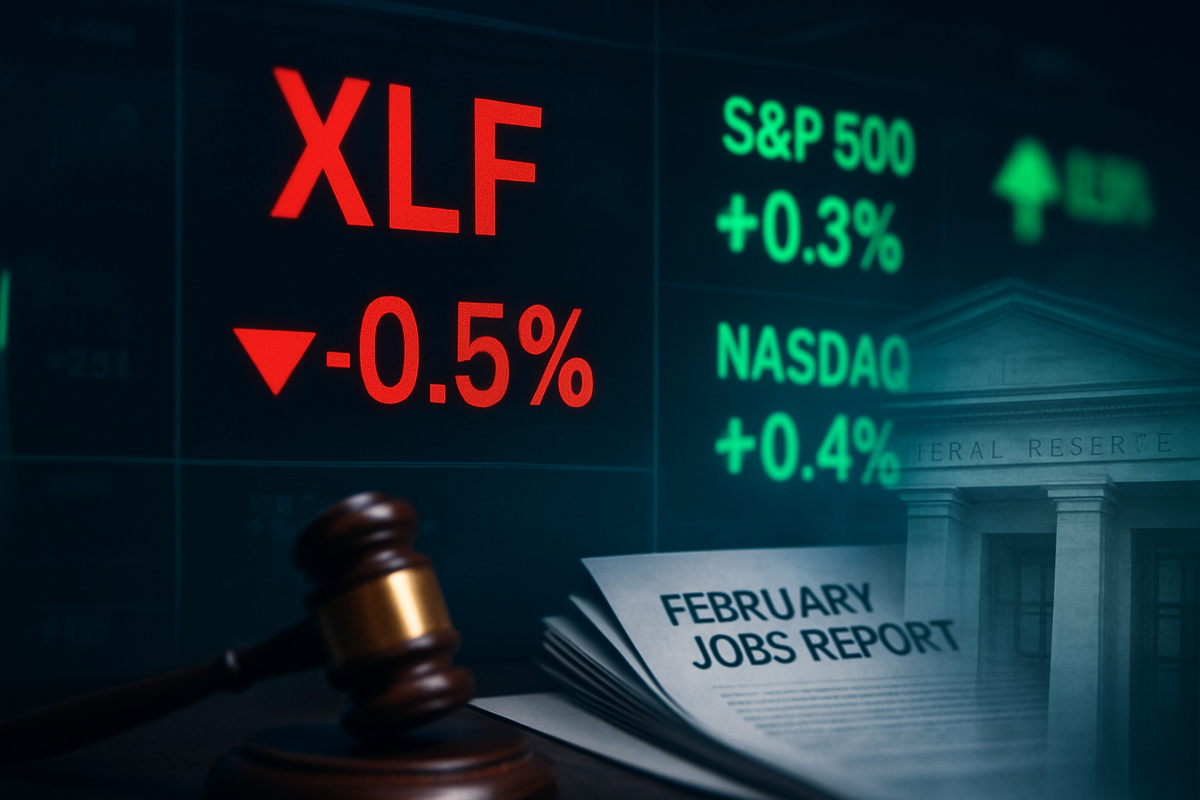
In a striking divergence on Wall Street, the financial sector emerged as a notable laggard during Tuesday’s trading session. On March 10, 2026, the Financial Select Sector SPDR Fund (NYSEARCA:XLF) slipped 0.5%, even as the broader S&P 500 climbed 0.42% and the tech-heavy Nasdaq Composite pushed deeper into record territory. This decoupling highlights a growing rift in investor sentiment, where growth-oriented sectors continue to ride the wave of artificial intelligence optimism while the "engine" of the economy—the banking sector—stalls under the weight of macroeconomic uncertainty.
The immediate implications of this slide are twofold: it signals a cooling of the "reflation trade" that dominated much of late 2025 and suggests that the banking industry is bracing for a potential "hard landing." With the Federal Reserve caught between a cooling labor market and stubborn inflation, bank stocks are finding it difficult to maintain momentum, leading to a technical breakdown in the XLF that has many analysts eyeing a deeper correction.
Economic Headwinds and Policy Paralysis
The weakness in financials on March 10 is the culmination of a volatile week that began with a shocking labor market update. On Friday, March 6, the Bureau of Labor Statistics reported a loss of 92,000 nonfarm jobs for February, a staggering reversal from the 130,000 jobs added in January. This "jobs miss" caught the market off guard, as consensus estimates had predicted a gain of 60,000. For the banking sector, a shrinking workforce raises immediate red flags regarding credit quality and loan demand, as rising unemployment historically leads to higher default rates in consumer and commercial loan portfolios.
Further complicating the picture is the extreme uncertainty surrounding the Federal Reserve's upcoming policy meeting on March 17–18. Markets are currently paralyzed by a "hawkish pause" fear; despite the weak jobs data, core inflation remains "sticky" between 2.4% and 2.8%, well above the Fed's 2.0% target. Adding to the tension is a looming leadership transition at the central bank. The recent nomination of Kevin Warsh to succeed Jerome Powell has introduced a new layer of volatility, as traders attempt to price in his "Warshian" philosophy—a strategy that may favor aggressive quantitative tightening even while contemplating front-loaded rate cuts to support the labor market.
Industry reactions have been swift and defensive. Major institutions have begun preemptive cost-cutting measures to protect their balance sheets. Morgan Stanley (NYSE: MS) recently announced a reduction of 2,500 jobs, or roughly 3% of its global workforce, citing a need for greater efficiency in a high-cost environment. This move was followed by reports that Goldman Sachs Group Inc. (NYSE: GS) is preparing its own round of layoffs, targeting middle-office and engineering roles that were aggressively staffed during the post-pandemic boom.
Identifying the Winners and Losers in a Shifting Landscape
In this bifurcated environment, the "money center" giants are facing unique pressures. JPMorgan Chase & Co. (NYSE: JPM) saw its shares underperform on March 10 as it tested its 200-day moving average. Investors are increasingly concerned about the bank’s massive $20 billion annual technology spend, much of which is dedicated to AI scaling. While these investments are seen as long-term winners, the short-term impact on the bank's efficiency ratio is weighing on the stock, especially as Net Interest Margin (NIM) compression begins to bite.
Bank of America Corp. (NYSE: BAC) and Citigroup Inc. (NYSE: C) are also feeling the squeeze from non-traditional competitors. The rise of private credit has begun to eat into the traditional corporate lending business of these behemoths, leaving them more dependent on volatile trading and investment banking fees. Citigroup, currently in the midst of a multi-year turnaround, remains a high-volume "show-me" story for investors, but it failed to catch any bid during the broader market rally on Tuesday.
Conversely, a few bright spots have emerged within the regional banking space, though they are the exception rather than the rule. Fifth Third Bancorp (NASDAQ: FITB) and Five Star Bancorp (NASDAQ: FSBC) have managed to maintain positive momentum, with the latter boasting a strong price-to-book valuation of 1.95x. These smaller players are benefiting from localized economic strength and a more nimble approach to interest rate hedging, which has allowed them to avoid the massive unrealized losses on bond portfolios that have plagued larger peers like U.S. Bancorp (NYSE: USB).
A Wider Significance: The Yield Curve and Industrial Shifts
The lagging performance of the XLF is not just a statistical anomaly; it is a reflection of a broader structural shift in the U.S. economy. The persistent inversion—or near-inversion—of the yield curve in early 2026 has fundamentally challenged the traditional banking model of "borrowing short and lending long." As the Fed maintains high short-term rates to combat inflation, banks are forced to pay more for deposits while seeing limited upside in long-term loan yields, leading to the dreaded NIM compression.
Historically, the banking sector serves as a lead indicator for the health of the broader economy. The fact that XLF has broken through its critical support level of $50.90 suggests that smart money is hedging against a potential recession in the latter half of 2026. This trend mirrors the "pre-recessionary" bank stumbles of 2007 and late 2019, where financial stocks began to roll over months before the broader indices peaked.
Furthermore, the sector's pivot toward AI-driven automation while simultaneously conducting mass layoffs signals a "changing of the guard" in financial services. Regulators and policymakers are closely watching this transition. The nomination of a new Fed Chair often brings a shift in regulatory appetite, and there are concerns that a more "Warshian" Fed might push for higher capital requirements to ensure stability during the transition, further limiting the ability of banks to return capital to shareholders via buybacks and dividends.
Looking Ahead: The Road to the March FOMC Meeting
In the short term, all eyes remain fixed on the March 17–18 FOMC meeting. The market is currently split, with roughly 47% of traders pricing in a "hold" and 53% betting on a 25-basis-point cut. A "hold" decision could be disastrous for bank stocks in the near term, as it would signal that the Fed is more concerned about inflation than the deteriorating jobs market, likely leading to further selling in the XLF.
Longer-term, the financial sector may need to undergo a significant strategic pivot. If the "hard landing" scenario gains more traction, banks will likely shift their focus from growth and AI expansion to credit monitoring and loss mitigation. We may also see a renewed wave of consolidation in the regional banking sector, as institutions like PNC Financial Services (NYSE: PNC) look to acquire smaller competitors to gain scale and offset rising technology costs.
Market participants should also watch for the "ripple effect" from geopolitical tensions. With oil prices surging due to instability in the Middle East, the Fed’s job becomes exponentially harder. If energy prices stay high, the "stagflation" word—low growth combined with high inflation—will move from a whisper to a shout on trading floors, a scenario that has historically been the worst-case outcome for financial stocks.
Summary and Investor Outlook
The underperformance of the financial sector on March 10, 2026, serves as a sobering reminder that a rising tide does not always lift all boats. While technology and growth stocks have found a way to decouple from interest rate anxieties, banks remain tethered to the reality of the Federal Reserve's balance sheet and the health of the American worker. The 0.5% drop in the XLF, while seemingly small, represents a significant technical breakdown and a warning shot to investors who may be overly optimistic about a "soft landing."
Moving forward, the market is likely to remain in a defensive posture regarding financials until there is more clarity from the central bank. Investors should prioritize quality and balance sheet strength over "turnaround" stories. The key takeaways from today are clear: the jobs miss has introduced a new level of credit risk, and the Fed’s leadership transition has added a layer of unpredictability that markets loathe.
In the coming months, watch the 10-year Treasury yield and the upcoming earnings calls for the major money center banks. If the yield curve remains uncooperative and the Fed stays hawkish despite a weakening labor market, the financial sector's "laggard" status may become a permanent fixture of the 2026 market landscape.
This content is intended for informational purposes only and is not financial advice.