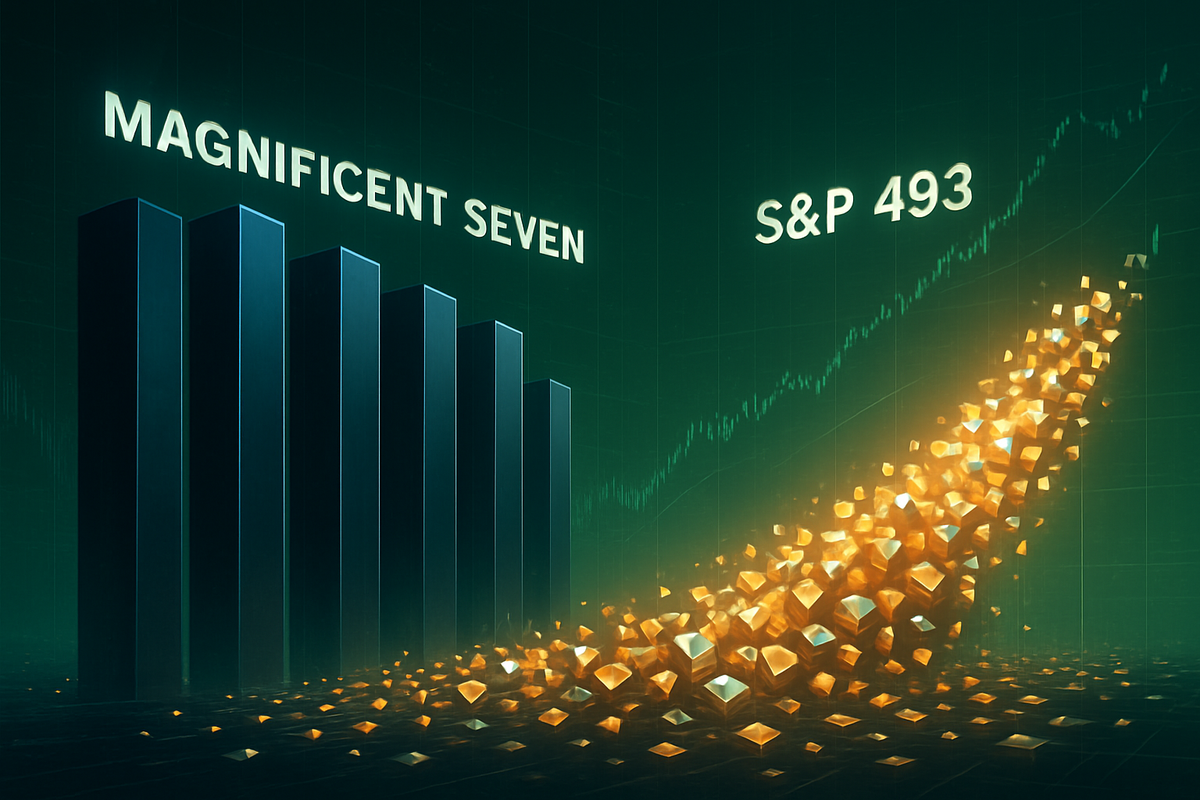
The long-standing dominance of the "Magnificent Seven" has finally met its match. In a week that market historians may look back on as the definitive end of the "two-speed" market, the S&P 493—the cohort of stocks in the benchmark index excluding the seven largest tech titans—has staged a massive breakout. While the mega-cap giants remained largely stagnant, mid-cap stocks posted a blistering 4.4% gain over the last five trading days, signaling a fundamental shift in investor appetite and a broadening of the bull market that many analysts had deemed impossible just a year ago.
This "Great Convergence" represents more than just a temporary rotation; it is a structural realignment of the U.S. equity landscape. As the earnings growth gap between high-flying tech and the rest of the market narrows to its thinnest margin in years, capital is flooding into sectors that were previously left for dead. With mid-caps now trading at record highs and the broader S&P 500 showing signs of "universal participation," the era of narrow leadership appears to be over, giving way to a more balanced and potentially more sustainable economic expansion.
Market Breakout: The Week the 493 Woke Up
The specific catalyst for this week’s dramatic divergence was a "perfect storm" of fundamental data and policy tailwinds that hit the tape in early February 2026. While the S&P 500 and the Nasdaq 100 hovered within 0.2% of their opening prices for the week, the S&P MidCap 400 (NYSEARCA:MDY) surged by 4.4%. This marks one of the widest margins of weekly outperformance for mid-caps relative to large-caps in the last two decades.
The timeline leading to this moment began in July 2025 with the passage of the "One Big Beautiful Bill Act" (OBBBA). This sweeping legislation provided permanent extensions to corporate tax cuts and, crucially, restored interest expense deductibility. This was a massive boon for the mid-cap and industrial sectors, which typically carry higher debt loads than the cash-rich tech giants. By the time Q4 2025 earnings began rolling in this January, the results were undeniable: the S&P 493's earnings growth accelerated to a robust 9%, while the growth of the Magnificent Seven—including Nvidia (NASDAQ: NVDA) and Microsoft (NASDAQ: MSFT)—began to decelerate from the triple-digit and high double-digit highs seen in 2024.
Market participants have reacted with a "risk-forward" posture. The ISM Manufacturing index recently crossed back into expansion territory, providing the fundamental "green light" for cyclical stocks. Traders who had spent 2023 and 2024 hiding in the safety of mega-cap balance sheets are now rotating aggressively into the "Other 493," hunting for value in a market where mid-caps still trade at a significant discount—roughly 14x forward earnings compared to the 22x seen in the top-heavy large-cap indices.
The Winners and Losers of the Rotation
The primary winners in this new regime are the "AI Phase 2" beneficiaries—companies that are not necessarily building the AI hardware, but are using it to revolutionize their own operations. Industrial behemoths like Caterpillar (NYSE: CAT) have seen their shares surge as they integrate autonomous AI tech into global mining fleets, with 2026 EPS growth projected at a staggering 15%. Similarly, the financial sector is seeing a renaissance. Goldman Sachs (NYSE: GS) and JPMorgan Chase (NYSE: JPM) have reported record-high M&A backlogs, as mid-sized companies use their newly buoyant stock prices as currency for acquisitions.
On the other side of the coin, the "Magnificent Seven" are facing a "valuation reality check." While companies like Apple (NASDAQ: AAPL) and Alphabet (NASDAQ: GOOGL) remain highly profitable, their stock performances have turned "flat" as investors demand even higher growth rates to justify their premium multiples. Tesla (NASDAQ: TSLA), in particular, has struggled to maintain its pace as the broader automotive sector—boosted by lower interest rates—begins to offer more competitive value propositions to investors.
Materials and Utilities are also emerging as surprise winners. With the OBBBA bill incentivizing domestic manufacturing, demand for raw materials has spiked. Companies within the S&P 493 that focus on domestic infrastructure are seeing a level of institutional interest that was previously reserved for cloud computing stocks. This rotation is effectively punishing the "concentration risk" that had defined passive index investing for the past three years.
Broadening the Horizon: Wider Significance
This event fits into a broader industry trend of "Economic Normalization." For years, the market was bifurcated: a few tech companies grew while the rest of the economy struggled with high rates and stagnant demand. The current broadening of the bull market suggests that the "AI productivity boost" is finally hitting the bottom lines of non-tech companies. Historically, such shifts often follow periods of intense technological innovation; just as the late 1990s tech bubble eventually gave way to a broader value-stock rally in the early 2000s, the 2024-2025 AI surge is now feeding into a wider industrial and financial recovery.
The ripple effects are global. As the U.S. market broadens, international investors are returning to the S&P 500, no longer fearing that a single tech miss could take down the entire index. Furthermore, the regulatory environment is shifting. With the OBBBA bill now in full effect, the policy focus has moved from aggressive antitrust scrutiny of "Big Tech" toward supporting domestic industrial expansion. This policy tailwind acts as a floor for the S&P 493, making them more attractive on a risk-adjusted basis than the potentially over-regulated mega-caps.
Comparisons to the post-2000 era are frequent, but analysts point out a key difference: the 493 aren't just "cheaper," they are actually growing. In 2024, the earnings gap between the Mag 7 and the 493 was a cavernous 30 percentage points. By early 2026, that gap is projected to shrink to just 3 to 4 points. This "Great Convergence" of earnings makes the rotation a fundamental necessity rather than a speculative whim.
Looking Ahead: The Next Phase of the Bull Market
In the short term, the market may face some volatility as funds continue to rebalance away from concentrated tech positions. However, the long-term outlook for a broadening bull market is historically positive. A market supported by 500 stocks is inherently more stable than one supported by seven. We expect to see a surge in "active management" performance, as stock-pickers find fertile ground in the mid-cap space—a segment of the market that was largely ignored during the passive-investing boom of the early 2020s.
Strategic pivots will be required for institutional portfolios. The "buy and hold" strategy for the Nasdaq 100 is being challenged by "equal-weight" strategies that capture the growth of the S&P 493. Market opportunities are now emerging in "secondary" tech hubs and industrial heartlands. The biggest challenge for investors moving forward will be identifying which members of the 493 have the operational leverage to turn this 4.4% weekly gain into a multi-year trend.
Conclusion: A New Era of Participation
The "Great Convergence" of February 2026 marks a turning point where the S&P 493 stepped out of the shadow of the Magnificent Seven. The 4.4% weekly gain in mid-caps is a clarion call that the bull market has evolved. No longer a "top-heavy" fragile structure, the market is now underpinned by a wider array of sectors, from financials and industrials to materials and utilities, all benefiting from a mix of favorable fiscal policy and AI-driven efficiency.
Moving forward, investors should watch for the continued narrowing of the EPS growth gap. If the S&P 493 can maintain double-digit growth while the Magnificent Seven settles into a steady, albeit slower, pace, the rotation could have years of runway. The significance of this event cannot be overstated: the stock market is finally reflecting the broader strength of the U.S. economy, rather than just the success of its seven largest companies.
This content is intended for informational purposes only and is not financial advice.