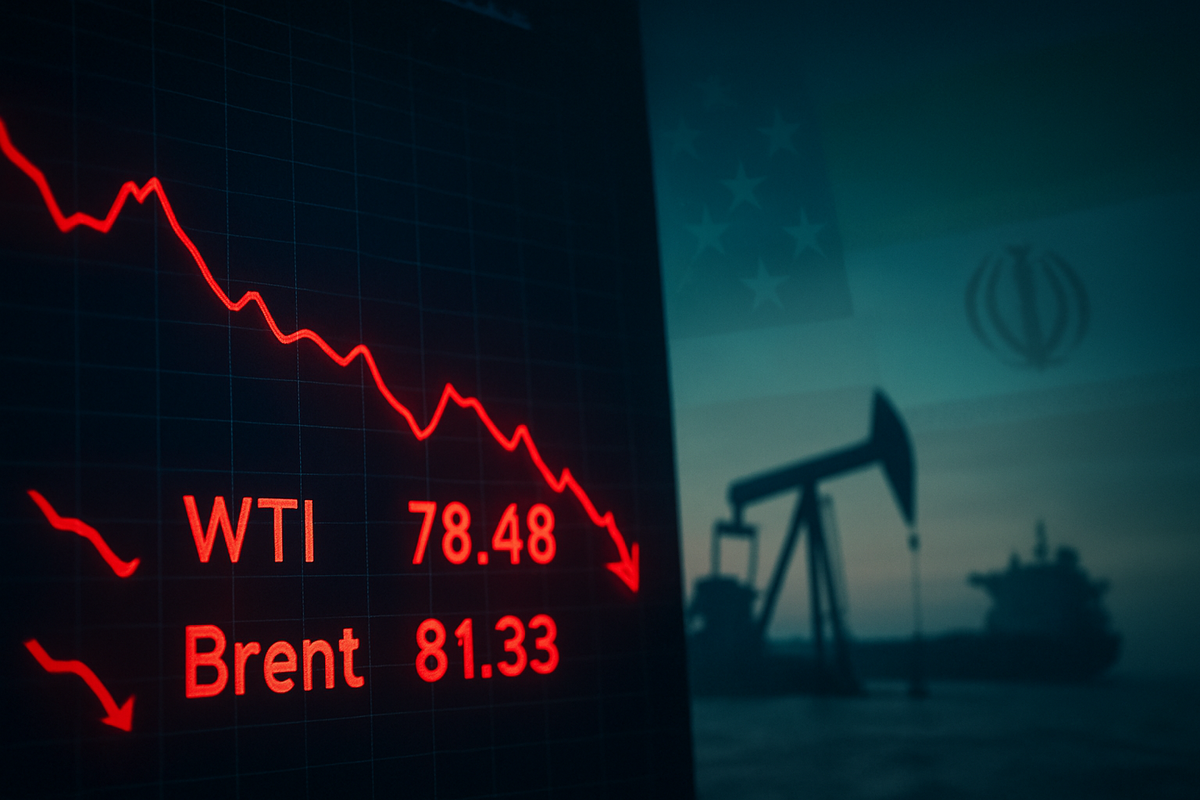
Global energy markets experienced a seismic shift this week as crude oil prices plummeted by more than 5%, effectively wiping out the "war premium" that had defined the start of the year. The sudden decline was triggered by a dual-pronged catalyst: a significant diplomatic de-escalation between the United States and Iran and a strategic decision by the OPEC+ alliance to pause planned production hikes through March. As of February 9, 2026, the market is grappling with a new reality where geopolitical fears are being replaced by the looming specter of a massive global supply surplus.
The immediate implications are far-reaching, providing a much-needed reprieve for fuel-heavy industries while casting a shadow over the profitability of major oil producers. While the diplomatic breakthrough in Oman remains tentative, the mere prospect of Iranian oil returning to an already crowded market has sent traders scurrying to reprice risk. For consumers, the slump signals potentially lower costs at the pump and cheaper airfare, but for the energy sector, it marks the beginning of what many analysts are calling a "bearish super-cycle" for 2026.
A Perfect Storm: Diplomatic Breakthroughs and Production Discipline
The sell-off began in earnest on Monday, February 2, 2026, when West Texas Intermediate (NYSE: WTI) futures dropped 5.5% to settle at $61.61 per barrel, while Brent crude fell 5.2% to $65.69. The catalyst was a series of optimistic signals from the Trump administration, suggesting that Iran was "seriously talking" about a deal to limit its nuclear program in exchange for the relaxation of oil sanctions. This sentiment was bolstered on Friday, February 6, during high-level talks in Muscat, Oman, where a U.S. delegation—notably including Special Envoy Steve Witkoff and Navy Adm. Brad Cooper—met with Iranian Foreign Minister Abbas Araghchi. While no formal treaty was signed, the absence of military live-fire exercises in the Strait of Hormuz provided a critical relief valve for maritime insurance and shipping costs.
Adding to the downward pressure was a pivotal meeting of OPEC+ leadership. On February 1, the alliance, led by Saudi Arabia and Russia, announced they would maintain a planned pause in oil output hikes for March 2026. While the move was intended to support prices by preventing further oversupply, the market interpreted the decision as a defensive maneuver against "seasonally weak demand" and a projected global surplus of 3.5 million barrels per day (bpd). Rather than sparking a rally, the OPEC+ announcement confirmed the group’s anxiety over a glut, leaving the market to focus on deteriorating fundamentals.
The slump was further exacerbated by domestic economic shifts in the United States. The nomination of Kevin Warsh as the next Federal Reserve Chairman buoyed the U.S. Dollar, making dollar-denominated oil more expensive for international buyers. Simultaneously, a newly announced trade deal between the U.S. and India—which incentivizes New Delhi to swap Russian crude for American exports—suggested a major realignment of global supply chains that could further saturate the market with U.S.-sourced energy.
Divergent Fortunes: Winners and Losers in the New Price Regime
The 5% price correction has created a sharp divide on Wall Street, with the transportation and logistics sectors emerging as the primary beneficiaries. United Airlines (NASDAQ: UAL) saw its stock surge nearly 5% following the price drop, as the airline industry stands to save billions in jet fuel expenses. Similarly, Delta Air Lines (NYSE: DAL) and American Airlines (NASDAQ: AAL) reported strong gains, with Delta nearing an all-time high as investors bet on expanding profit margins during the busy spring travel season.
Logistics giants also capitalized on the lower input costs. UPS (NYSE: UPS) and FedEx (NYSE: FDX) both traded significantly higher, with UPS highlighting that lower diesel costs would directly improve its 2026 free-cash-flow guidance of $6.5 billion. The travel sector’s optimism extended to the seas as well; Carnival Corporation (NYSE: CCL) witnessed an 8.1% rally, given that cruise operators are among the most fuel-intensive businesses in the global economy.
Conversely, the energy sector faced a difficult week. Pure upstream producers like ConocoPhillips (NYSE: COP) and Occidental Petroleum (NYSE: OXY) were hit hardest, falling 2.5% and 3.0% respectively, as their revenues are directly tied to the fluctuating price of WTI. Integrated majors like ExxonMobil (NYSE: XOM) and Chevron (NYSE: CVX) showed more resilience due to their refining and chemical segments, which benefit from lower feedstock costs, but still saw their shares dip as the value of their vast international production portfolios was downgraded. Perhaps most vulnerable are the oilfield service providers; Halliburton (NYSE: HAL) and SLB (NYSE: SLB) fell between 2.8% and 3.5% on fears that a sustained price drop below $60 would lead to immediate cuts in North American drilling and exploration budgets.
The Structural Shift: Beyond Geopolitics
The current slump is not merely a reaction to headlines but a reflection of deep structural changes in the global energy landscape. The IEA and World Bank have warned that 2026 could see the largest supply surplus since the 2020 pandemic. This is driven by several factors, including the continued expansion of production in Guyana and Brazil, and the surprising resilience of U.S. output despite a cooling rig count. Furthermore, the rapid adoption of electric vehicles in China has finally begun to flatten demand growth in the world’s largest oil importer, removing a primary engine of price appreciation.
Historically, OPEC+ has been able to manage these surpluses through production cuts, but the current strategy appears to be shifting. There is a growing consensus that the alliance is moving toward a "market share defense" strategy, similar to the 2014-2016 period. By gradually rolling back voluntary cuts, OPEC+ is signaling that it may no longer be willing to subsidize high-cost U.S. shale producers by keeping prices artificially high. This tension between low-cost Middle Eastern production and higher-cost American shale is likely to define the energy market for the remainder of the decade.
The regulatory environment is also playing a role. The Trump administration’s "drill, baby, drill" policy, combined with more favorable permitting processes, has ensured that domestic supply remains robust even in a lower-price environment. However, if Brent crude averages the $56 per barrel predicted by some analysts for late 2026, many marginal U.S. shale plays may become economically unviable, potentially forcing a wave of consolidation among smaller independent producers.
The Road Ahead: What to Watch in March and Beyond
In the short term, all eyes will return to Muscat, Oman. While the February 6 talks ended without a breakthrough, a second round of negotiations is expected within the next ten days. If a concrete framework is established that allows for even a partial return of Iranian barrels—estimated at up to 1 million bpd currently sidelined by sanctions—the floor for oil prices could drop toward the mid-$50s. Investors should also monitor the U.S. Department of Energy’s actions regarding the Strategic Petroleum Reserve (SPR); any move to refill the reserve at these lower prices could provide a temporary floor for WTI.
Long-term, the energy sector must prepare for a "lower for longer" scenario. Strategic pivots are already underway, with many traditional oil companies increasing their investments in carbon capture and hydrogen technologies to diversify away from pure crude exposure. For the broader market, the lower energy costs act as a disinflationary force, potentially giving the Federal Reserve more room to navigate interest rate policy as they balance growth with price stability.
Market Wrap-Up and Investor Outlook
The early February slump in oil prices marks a critical turning point for 2026. The evaporation of the geopolitical risk premium, combined with a cautious but ultimately bearish OPEC+ stance, has shifted the market's focus from supply security to oversupply management. The key takeaway for investors is the massive "transfer of wealth" currently occurring from the energy production sector to the consumer and transportation sectors.
Moving forward, the market will likely remain volatile as it reacts to every diplomatic signal from the Middle East. However, the fundamental backdrop of a 3.5 million bpd surplus suggests that any rallies will be short-lived. Investors should watch for the results of the next round of US-Iran talks and the March OPEC+ monitoring meeting. If the de-escalation holds and the surplus continues to build, the energy sector may be entering a prolonged period of consolidation, while the broader economy enjoys the tailwinds of cheaper energy.
This content is intended for informational purposes only and is not financial advice.