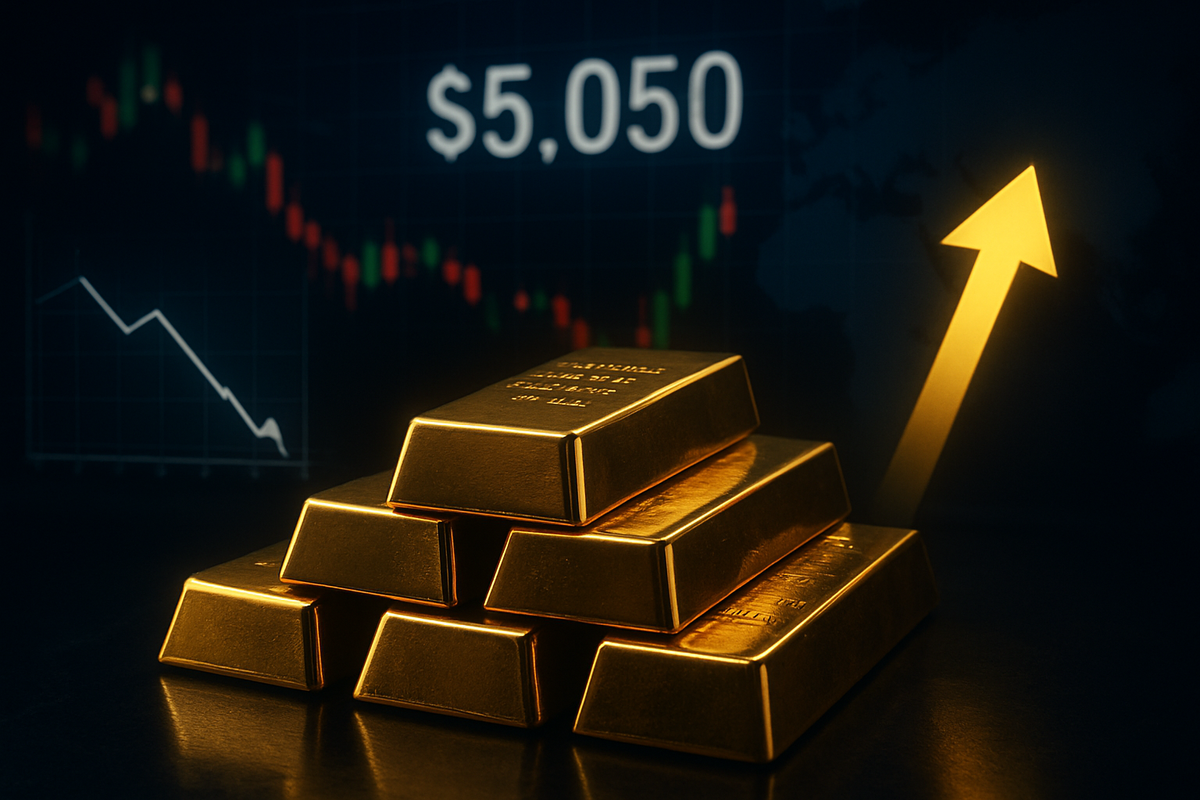
In a historic start to the trading week, gold futures surged 1.4% in early Monday trade on February 9, 2026, touching a record high of approximately $5,050 an ounce. The rally was ignited by reports that Chinese financial regulators have begun instructing domestic lenders to aggressively scale back their holdings of U.S. Treasury securities, triggering a massive flight to safe-haven assets across global markets.
This latest spike marks a definitive shift in the global financial order, as the world’s second-largest economy pivots away from the U.S. dollar-denominated "paper assets" in favor of physical bullion. The move has sent shockwaves through the bond markets, while simultaneously cementing gold's position as the ultimate hedge against geopolitical and fiscal instability.
The Dragon Retreats: Inside the 1.4% Monday Surge
The catalyst for Monday’s 1.4% jump was a series of verbal instructions issued by the People’s Bank of China (PBOC) and the National Financial Regulatory Administration (NFRA). These regulators reportedly urged major state-owned and commercial banks to limit new purchases of U.S. debt and gradually pare down existing positions. The move is framed as an effort to mitigate "concentration risk" amid a ballooning U.S. national debt that has now surpassed $34 trillion, leading to fears of long-term fiscal instability in Washington.
This development follows a volatile period for the precious metal. After reaching an intra-day peak of nearly $5,600 in late January 2026 due to heightened tensions in the Arabian Sea, gold saw a brief "flash crash" correction as margin calls forced some traders to liquidate positions. However, the $5,000 level has emerged as a formidable psychological and technical support floor. Monday's climb to $5,050 represents a "structural bid" where institutional buyers are no longer just speculating on price action but are fundamentally reallocating their reserves.
Market participants have been watching China's holdings of U.S. Treasuries with bated breath, as they have now fallen to an 18-year low of approximately $680 billion. This divestment has been paired with 14 consecutive months of gold reserve expansion by the PBOC, which now holds nearly 74.15 million ounces of the yellow metal. The rotation from U.S. debt to gold appears to be a coordinated strategy to insulate the Chinese economy from potential "weaponization" of the dollar and Western-led sanctions.
Winners and Losers in the New Gold Era
The primary beneficiaries of this historic price environment are the major gold producers, whose margins have expanded exponentially. Newmont (NYSE: NEM), the world’s largest gold mining company, has seen its free cash flow reach record levels, allowing it to aggressively reduce debt and hike dividends. With the "All-In Sustaining Cost" (AISC) for many top-tier miners remaining well below $2,000, a gold price of $5,050 translates into unprecedented profitability.
Barrick Gold (NYSE: GOLD) has similarly outperformed the broader S&P 500, with analysts pointing to its strategic focus on Tier-1 assets and its secondary exposure to copper, which is also benefiting from a broader commodities boom. Other significant winners include Agnico Eagle Mines (NYSE: AEM) and Kinross Gold (NYSE: K), the latter of which has posted triple-digit returns over the past year as investors seek leveraged exposure to the price of bullion.
On the exchange-traded fund (ETF) front, the SPDR Gold Shares (NYSEARCA: GLD) has seen its largest weekly inflows in years as retail and institutional investors scramble to "buy the dip" following the early February correction. Meanwhile, the VanEck Gold Miners ETF (NYSEARCA: GDX) has become a favorite for those looking to capitalize on the operational leverage of mining companies. Conversely, the "losers" in this scenario are the traditional holders of long-duration U.S. Treasuries, who are seeing the value of their holdings pressured by the sudden lack of Chinese demand and the resulting upward pressure on yields.
A Broader Trend of De-Dollarization
The current surge in gold is not an isolated event but a milestone in the broader "de-dollarization" trend. For years, analysts have warned that the excessive use of the U.S. dollar as a geopolitical tool would eventually lead to a search for alternatives. China’s decision to move its banks away from U.S. debt is the most significant step yet in this direction, and it is being closely watched by other BRICS nations—including India and Brazil—who have also been active sellers of U.S. Treasuries over the past 12 months.
Historically, the U.S. Treasury market has been the deepest and most liquid "risk-free" market in the world. However, the perception of "risk-free" is changing. When the PBOC rotates into gold, it is choosing a hard asset with no counterparty risk over a debt instrument that is subject to the fiscal policies of a foreign government. This shifts the global reserve hierarchy, placing gold back at the center of the international monetary system, a role it hasn't held with such prominence since the collapse of the Bretton Woods system.
This trend has significant implications for U.S. monetary policy. As foreign demand for Treasuries wanes, the Federal Reserve may be forced to step in as the buyer of last resort to keep interest rates from spiraling upward, potentially reigniting inflationary pressures. This creates a feedback loop that only serves to make gold more attractive to investors looking to preserve purchasing power.
What Lies Ahead: The $5,000 Floor
Looking forward, the short-term trajectory for gold appears to be one of consolidation around the $5,000 to $5,100 range. While the January peak of $5,600 showed that the market can become overextended, the current price acceptance at $5,050 suggests that the "easy money" phase of the rally is over, replaced by a steady, structural accumulation phase. Central banks are expected to remain net buyers for the foreseeable future, providing a "floor" that was previously unthinkable.
Investors should watch for any further regulatory announcements from Beijing or other emerging market capitals. If the divestment from U.S. Treasuries accelerates, gold could easily test the $6,000 mark by the end of 2026. Conversely, any cooling of geopolitical tensions or a significant pivot in U.S. fiscal policy—such as a credible plan to address the national deficit—could slow the rally, though most analysts believe the structural shift is now irreversible.
Summary and Market Outlook
The climb to $5,050 an ounce represents a "coming of age" for the modern gold market. Driven by Chinese regulatory pressure to divest from U.S. debt, the rally underscores a growing lack of confidence in traditional fiat reserves and a return to the safety of hard assets.
Moving forward, the market will likely see increased volatility as it adjusts to this new high-price environment. Investors should keep a close eye on the performance of major miners like Newmont and Barrick Gold, as well as the flow of funds into ETFs like GLD and GDX. The key takeaway is clear: the era of gold as a "dead asset" is officially over, and its role as a cornerstone of the global financial system has been firmly reinstated.
This content is intended for informational purposes only and is not financial advice