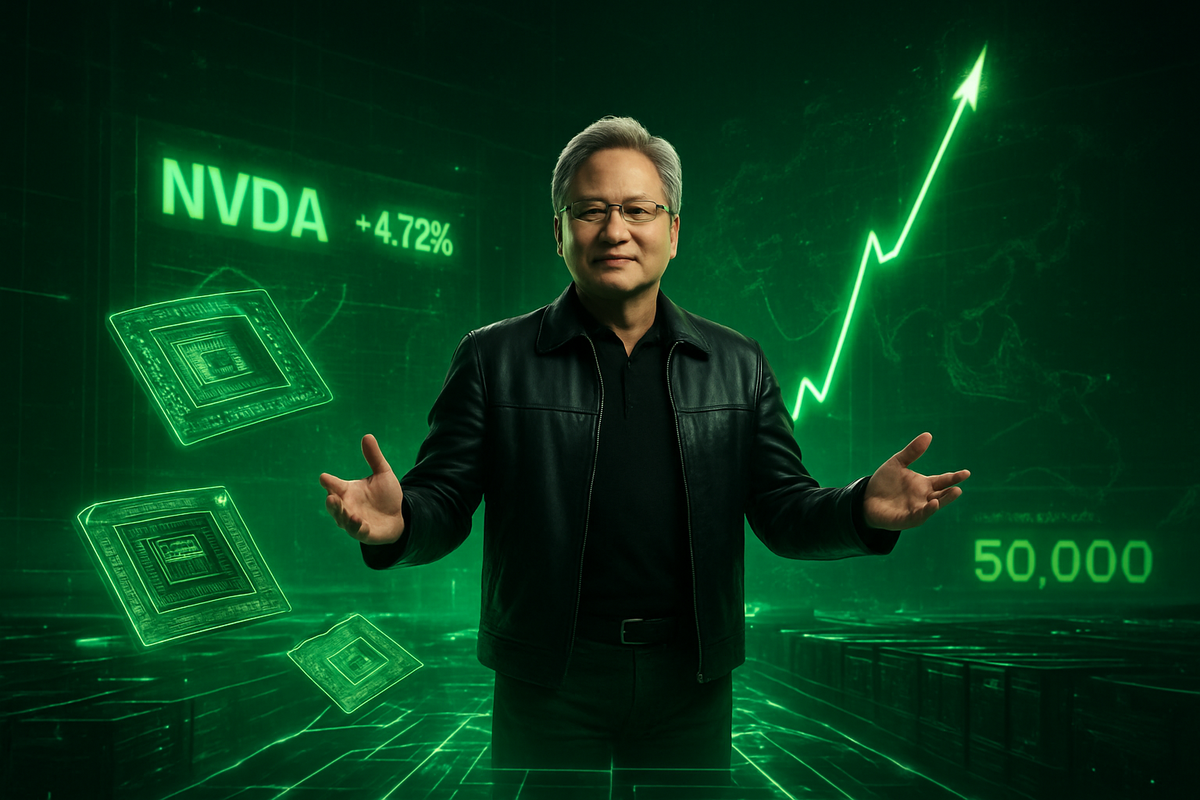
In a historic session for Wall Street, shares of Nvidia (NASDAQ: NVDA) surged more than 8% on Friday, February 6, 2026, breathing new life into the global technology trade. The rally was ignited by a high-stakes television appearance by CEO Jensen Huang, who declared that the demand for artificial intelligence infrastructure has reached a fever pitch and is "going through the roof." The surge added hundreds of billions of dollars in market capitalization to the chip giant, effectively ending a period of sideways trading and reaffirming Nvidia's role as the primary engine of the modern economy.
The ripples of Nvidia’s move were felt across the broader indices, most notably pushing the Dow Jones Industrial Average above the psychological 50,000 barrier for the first time in history. The PHLX Semiconductor Sector Index (NASDAQ: SOX) also rode the wave, jumping nearly 6% to close at 7,947. Huang’s comments served as a powerful rebuttal to critics who had suggested the AI investment cycle was nearing a peak, instead painting a picture of a world only just beginning to grasp the scale of the transition to "Agentic AI" and sovereign data computing.
The explosive rally began in early morning trading after Jensen Huang appeared on CNBC’s Squawk Box to discuss the state of the industry. Huang described the current moment as a definitive "inflection point," where AI is shifting from an experimental curiosity into a fundamental utility for every industry from healthcare to heavy manufacturing. "We are witnessing the largest infrastructure buildout in human history," Huang stated during the interview. "The demand for Blackwell and our upcoming Vera Rubin platform is sky-high as nations and corporations realize that compute power is the new natural resource."
The timing of the surge follows several weeks of market anxiety regarding the massive capital expenditure budgets of the world’s largest tech companies. However, Nvidia’s stock price—which closed the day at approximately $185.65—was bolstered by news that the company had finalized a landmark $20 billion investment in OpenAI. This strategic move effectively transforms Nvidia from a mere "arms dealer" to a founding financier of the next generation of AI models, ensuring that the road to Artificial General Intelligence (AGI) remains firmly paved with Nvidia’s proprietary silicon and NVLink interconnects.
Market participants reacted with immediate fervor. By mid-day, trading volume for Nvidia was nearly double its 30-day average. The broader market sentiment was lifted not just by the stock’s appreciation, but by Huang’s insistence that the "profitable tokens" generated by AI deployments are already providing a clear return on investment (ROI) for "hyperscalers." This commentary quelled fears of an "AI bubble" and prompted a massive short-covering rally across the semiconductor sector.
The primary beneficiary of the day’s events was, unsurprisingly, Nvidia itself, which saw its market capitalization stabilize between $4.2 trillion and $4.5 trillion. However, the "Huang Effect" extended far beyond a single ticker. Advanced Micro Devices (NASDAQ: AMD) saw its shares climb 8% as investors bet that the total addressable market (TAM) for AI chips is expanding fast enough to support multiple winners. Networking giant Broadcom (NASDAQ: AVGO) and custom-chip specialist Marvell Technology (NASDAQ: MRVL) also posted gains of over 5%, fueled by the demand for the high-speed connectivity required to link tens of thousands of GPUs together in massive data centers.
On the other side of the ledger, the news presented a complicated landscape for the "Hyperscalers." While Meta Platforms (NASDAQ: META), Amazon (NASDAQ: AMZN), Microsoft (NASDAQ: MSFT), and Alphabet (NASDAQ: GOOGL) all saw their stock prices rise in sympathy with the tech rally, the staggering $650 billion in combined annual capex forecast for 2026 remains a point of contention for some value-oriented investors. These companies are now locked into an expensive technological arms race where the cost of entry is soaring, potentially pressuring short-term margins in exchange for long-term dominance.
Software companies that have struggled to monetize AI may also find themselves under increased pressure. As Nvidia and the hardware providers capture the lion's share of the initial spending, "SaaS" (Software as a Service) firms are being forced to prove that they can turn these expensive "compute tokens" into recurring revenue. Those who cannot adapt to the "Agentic AI" workflows described by Huang may find themselves sidelined by newer, AI-native startups.
Huang’s comments on February 6, 2026, highlight a significant shift in the global geopolitical and economic landscape: the rise of "Sovereign AI." By describing AI compute as a "fundamental utility," Huang is signaling a move toward a world where every nation-state will feel compelled to own and operate its own AI infrastructure to protect its data, culture, and economic security. This represents a massive diversification of Nvidia’s customer base, moving beyond just a handful of Silicon Valley titans to include national governments across Europe, Asia, and the Middle East.
This event also draws historical parallels to the early days of the internet and the buildout of the global telecommunications fiber network in the late 1990s. While some analysts fear a repeat of the dot-com crash, the 2026 rally is supported by far more robust earnings and cash flows than the speculative fervor of 1999. Nvidia’s profit margins remain at record highs, and the demand is driven by tangible enterprise workflows rather than mere retail speculation.
Furthermore, the introduction of the Vera Rubin architecture—the successor to the Blackwell series—points to a quickening of the technological treadmill. With NVLink 6 promising speeds of 400Gbps, Nvidia is effectively widening its "moat" by making it increasingly difficult for competitors to match the integrated performance of its hardware-software stack. This creates a regulatory challenge, as policymakers in Washington and Brussels continue to scrutinize the near-monopoly status of Nvidia in the high-end GPU market.
Looking ahead, the market will be laser-focused on the rollout of the Vera Rubin platform in the second half of 2026. The transition from Blackwell to Rubin is expected to be the most complex in Nvidia's history, requiring seamless integration of the Vera CPU and Rubin GPU. If Nvidia can execute this transition without the supply chain bottlenecks that occasionally plagued the Blackwell launch, the company could see further valuation expansion toward the elusive $5 trillion mark.
The next short-term hurdle will be the quarterly earnings reports from the "Big Four" cloud providers. Investors will be looking for concrete evidence that the $650 billion in capital expenditure is translating into top-line revenue growth in their cloud divisions. Any sign that the ROI is slowing could reignite the volatility that Nvidia’s surge temporarily silenced. Additionally, the development of "Agentic AI"—autonomous systems that can perform multi-step tasks without human intervention—will be the key narrative to watch, as it represents the next major unlock for AI demand.
Strategic pivots will also be necessary for Nvidia's competitors. As Nvidia moves deeper into the software and venture capital space (as seen with the OpenAI deal), companies like AMD and Intel will need to find niche markets or form deep alliances with hardware-agnostic software developers to remain competitive in a world increasingly dominated by the Nvidia ecosystem.
The events of February 6, 2026, mark a watershed moment for the financial markets. Nvidia’s 8% surge was more than just a daily price fluctuation; it was a powerful re-validation of the AI thesis that has dominated the mid-2020s. By dragging the Dow Jones past 50,000 and lifting the SOX index to new heights, Nvidia has once again proven to be the indispensable cornerstone of the global equity market.
Investors should walk away with a clear understanding that the AI cycle is not slowing down; it is evolving. The shift from simple generative models to "Agentic AI" and "Sovereign AI" infrastructure represents a new chapter of growth that could last for the remainder of the decade. However, the sheer scale of the investment—evidenced by the $650 billion hyperscaler capex—means that the stakes have never been higher.
Moving forward, the key metrics to watch will be the "token-to-revenue" efficiency of the major cloud providers and the successful launch of the Vera Rubin architecture. While Nvidia’s dominance seems unshakeable for now, the intensity of the "arms race" it has fueled will continue to create both massive opportunities and significant risks for the broader market.
This content is intended for informational purposes only and is not financial advice.