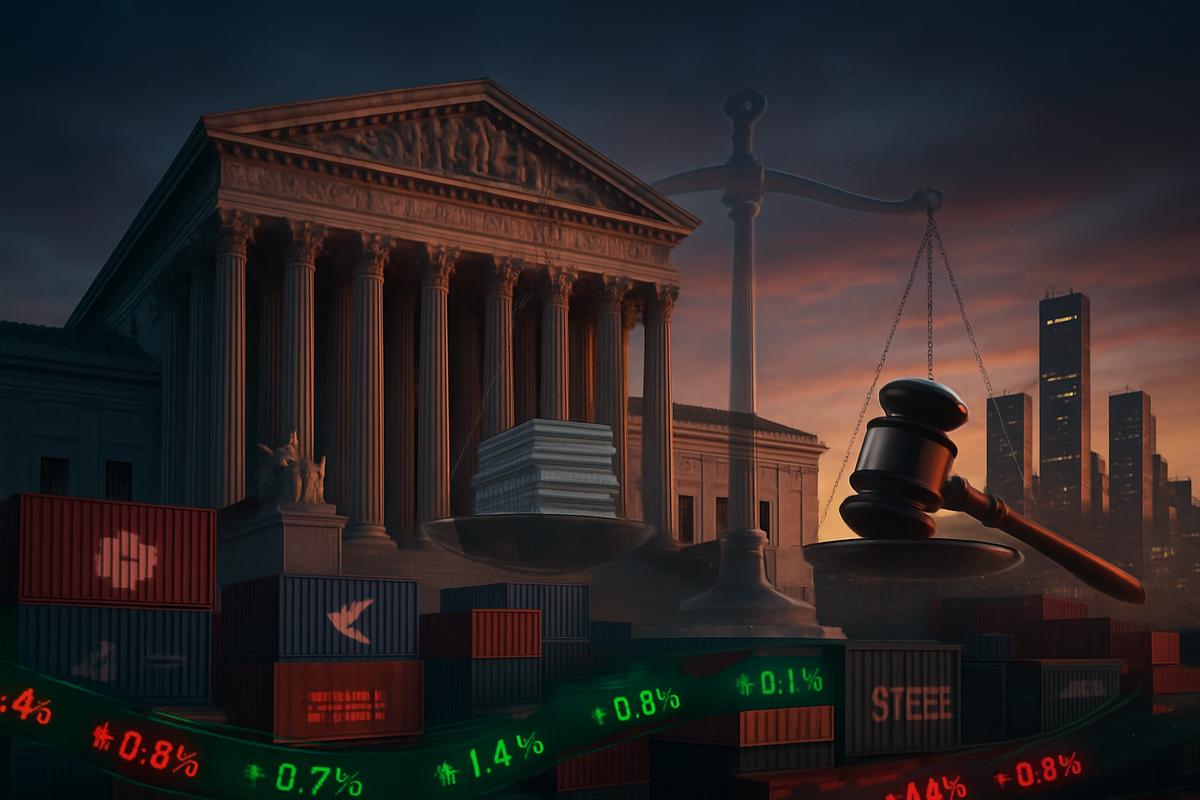
In a landmark decision that has sent shockwaves through global markets and corporate boardrooms alike, the U.S. Supreme Court (SCOTUS) ruled on February 20, 2026, that the administration’s sweeping "Universal Baseline Tariff" was unconstitutional. The 6–3 ruling in Learning Resources, Inc. v. Trump held that the executive branch overstepped its authority by using the International Emergency Economic Powers Act (IEEPA) to bypass Congress and impose a 10% global levy on all imports. The decision effectively dismantles the centerpiece of the 2025 "Liberation Day" trade agenda, which had reshaped international supply chains over the past year.
The immediate implications of the ruling are twofold: a massive potential refund liability for the U.S. Treasury—estimated at upwards of $175 billion—and an immediate pivot by the White House to "replacement tariffs." Within hours of the court’s announcement, the administration invoked Section 122 of the Trade Act of 1974 to impose a temporary 15% global import surcharge. While the SCOTUS ruling provides a legal victory for importers, the new "Plan B" tariffs ensure that the era of protectionist trade policy remains firmly in place, albeit under a different legal framework.
The Legal Showdown and the "Plan B" Pivot
The path to this constitutional showdown began in early 2025, when the administration declared national emergencies regarding the trade deficit and the fentanyl crisis. Invoking the broad powers of the IEEPA, the President bypassed traditional legislative routes to impose a 10% universal baseline tariff and "reciprocal" duties reaching as high as 46% on specific countries. This "Liberation Day" policy was met with immediate legal challenges from a coalition of small business importers and multinational giants, led by Learning Resources, Inc., a manufacturer of educational toys.
Writing for the majority, Chief Justice John Roberts emphasized that Article I, Section 8 of the Constitution vests the "power to lay and collect taxes, duties, imposts and excises" exclusively in Congress. The Court applied the "Major Questions Doctrine," asserting that a policy of such vast economic and political significance requires explicit and clear congressional authorization—which the IEEPA, a 1977 statute intended for targeted sanctions and asset freezes, does not provide. While the ruling struck down the universal baseline program, it notably left intact tariffs imposed under Section 232 (National Security) and Section 301 (Unfair Trade Practices), as those statutes contain specific delegations of power from the legislative branch.
The administration’s reaction was swift and defiant. By the evening of February 20, the U.S. Trade Representative (USTR) announced the new 15% surcharge under Section 122, a "strategic placeholder" designed to address balance-of-payments deficits. Unlike the previous indefinite program, Section 122 is strictly time-limited to 150 days unless extended by an act of Congress. This has created a "July Cliff," as markets now anticipate a summer of intense legislative maneuvering and potential new "Section 301" investigations into specific industries like semiconductors and chemicals.
Impact on S&P 500 Heavyweights
The ruling has created a bifurcated reality for S&P 500 companies, with "importer" giants seeing a temporary relief rally while "domestic-focused" industrials remain insulated. Apple Inc. (AAPL:NASDAQ), which paid an estimated $3.3 billion in IEEPA-related tariffs throughout 2025, saw its shares rise as analysts began factoring in multi-billion dollar refunds. However, the 15% Section 122 replacement means the tech giant must still navigate high costs for its globally integrated supply chain. Similarly, NVIDIA (NVDA:NASDAQ) experienced a boost in sentiment; while still facing the new 15% surcharge, it is a significant reprieve from the 32% "reciprocal" duties previously applied to advanced AI hardware components sourced from overseas.
Retailers like Walmart Inc. (WMT:NYSE) and Target Corp. (TGT:NYSE) face a more complex landscape. Walmart, which has used its immense scale to force suppliers to absorb 2025's tariff costs, saw its stock dip 2.7% as investors realized the company might not see an immediate margin expansion. Target, with its higher reliance on discretionary imported home goods and less pricing power than its larger rival, remains a "volatility play." Both companies are now leading a massive legal push in the U.S. Court of International Trade to secure the $175 billion in back-payments owed by the Treasury, a process that could take years of litigation.
Conversely, domestic manufacturing stalwarts like Nucor Corp. (NUE:NYSE) and Caterpillar Inc. (CAT:NYSE) have remained resilient. Nucor has actually benefited from the continued existence of Section 232 steel tariffs, which the SCOTUS ruling did not touch. For Caterpillar, which faced nearly $2 billion in tariff-related headwinds in 2025, the ruling is a massive liquidity signal. The prospect of a refund for past duties provides the heavy-machinery giant with significant capital to reinvest in its domestic data center power-generation segment, which has seen surging demand due to the AI boom.
Wider Significance and Historical Context
The broader significance of this ruling cannot be overstated; it marks a pivotal shift in the "separation of powers" regarding economic policy. By invoking the Major Questions Doctrine, the Supreme Court has signaled that the executive branch can no longer use broad, decades-old emergency statutes as a "blank check" for trade wars. This aligns with recent judicial trends seeking to curb the administrative state, but it also creates a significant "policy vacuum" that Congress—currently deeply divided—is ill-equipped to fill.
Historically, this event is being compared to the 1930s battles over the Smoot-Hawley Tariff Act, though in reverse. While Smoot-Hawley was a legislative overreach, the 2025-2026 tariff saga represents an executive overreach checked by the judiciary. The "ripple effect" on global trade partners is equally profound. Major exporters to the U.S., including Canada and Mexico, may see this ruling as a window to renegotiate terms before the 150-day Section 122 window expires in July. However, the administration’s immediate pivot to "replacement tariffs" suggests that "protectionism" is no longer an emergency measure but a permanent fixture of U.S. industrial policy.
Furthermore, the "refund crisis" poses a unique fiscal challenge. If the U.S. Treasury is forced to return $175 billion in collected duties, it could significantly widen the federal deficit or force an emergency tax measure. This creates a potential "fiscal cliff" that could coincide with the expiration of the replacement tariffs in July, creating a "perfect storm" of economic uncertainty for the second half of 2026.
Looking Ahead: The July Cliff and Strategic Pivots
Looking ahead, the next five months will be a period of "rolling uncertainty" as the July 2026 expiration of the Section 122 surcharge approaches. Companies will likely initiate massive "strategic pivots," accelerating the reshoring of manufacturing to avoid being caught in the next wave of industry-specific Section 301 investigations. We may see a surge in M&A activity as larger firms acquire domestic suppliers to insulate their margins from future tariff fluctuations.
There is also the high probability of a "legislative showdown." A "Tariff Refund Act of 2026" has already been proposed in Congress to manage the $175 billion liability, but it faces a potential presidential veto. Investors should watch for "sector-specific" trade deals. The administration may offer exemptions from the 15% surcharge to companies that hit specific "domestic investment" targets, effectively turning trade policy into a tool for industrial planning.
In the long term, this ruling may actually lead to more targeted and permanent trade barriers. Rather than a single 10% "blunt instrument," the USTR is already preparing surgical "Section 301" investigations into electronics, chemicals, and automotive parts. While more legally durable, these targeted tariffs could be even higher than the baseline 10%, leading to a fragmented market where some sectors thrive under protectionism while others struggle with permanent cost increases.
A New Era of Trade Litigaton
The February 2026 SCOTUS ruling is a landmark victory for the constitutional principle of "Power of the Purse," but it offers little immediate relief for the global supply chain. While the invalidation of the Universal Baseline Tariff provides a legal blueprint for future challenges, the administration's pivot to Section 122 "replacement tariffs" demonstrates that the political will for protectionism remains undeterred by judicial setbacks.
For investors, the key takeaways are the $175 billion refund potential and the "July Cliff" of 2026. Companies with the legal resources to navigate the Court of International Trade, such as Apple (AAPL:NASDAQ) and Costco Wholesale Corp. (COST:NASDAQ), may eventually see a significant capital injection from refunds. However, the broader market remains in a defensive posture, as "uncertainty" remains the dominant theme for any company with significant international operations.
Moving forward, the market will be hyper-focused on the USTR’s new investigations and the legislative battle over refunding past duties. The period of "unilateral" trade policy may be over, but the era of the "trade war" has simply entered a more complex, legally scrutinized, and surgical phase. Investors should remain vigilant, watching for which sectors are singled out for permanent duties as the temporary Section 122 surcharge nears its expiration this summer.
This content is intended for informational purposes only and is not financial advice.