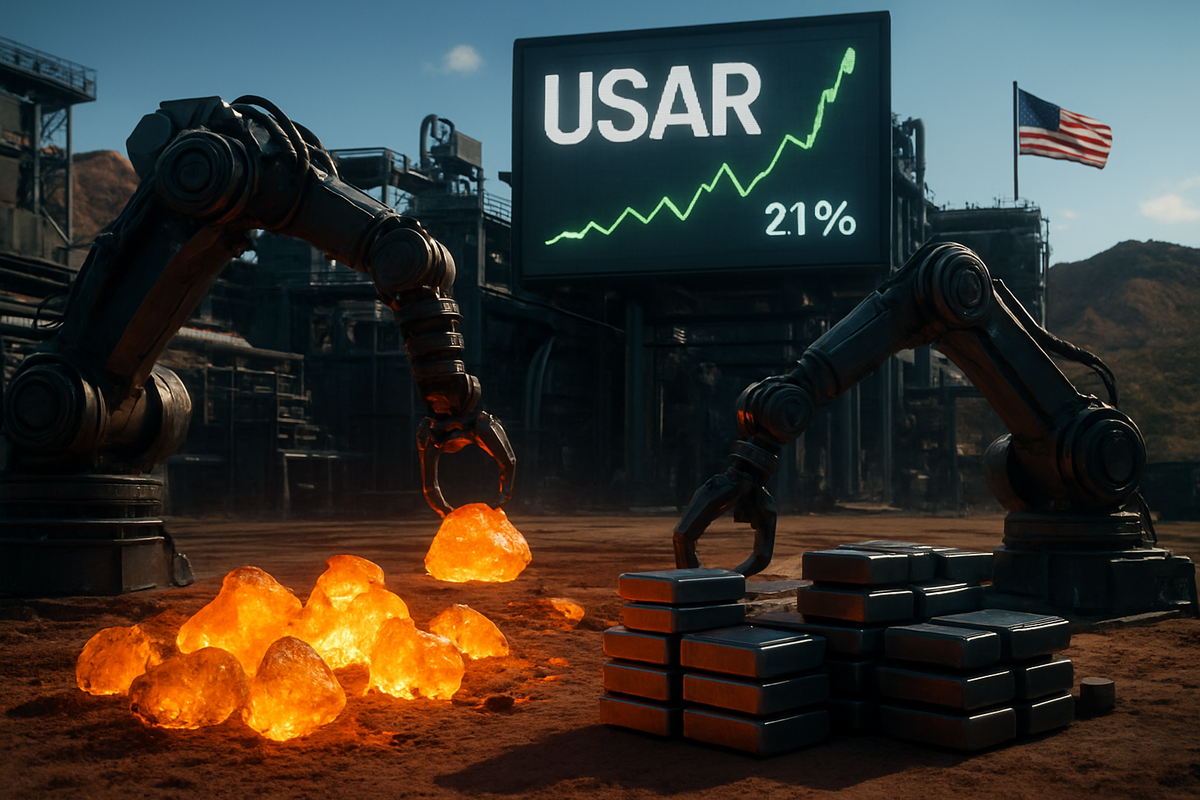
In a move that signals a radical shift in American industrial policy, the Trump administration has officially finalized a $1.6 billion investment package in USA Rare Earth (NASDAQ: USAR), including a direct 10% equity stake for the federal government. The announcement, made through the Department of Commerce on January 26, 2026, sent shares of the newly public miner and magnet manufacturer up by 21% in mid-day trading, as investors scrambled to price in what is effectively a sovereign "backstop" for the domestic critical minerals sector.
The move marks the most aggressive step yet in the administration’s "Critical Mineral Independence" agenda. By taking a direct ownership position, the U.S. government is not merely subsidizing domestic production but is actively becoming a primary stakeholder in the supply chain required for electric vehicles, fighter jets, and consumer electronics. The immediate implications are clear: the era of "hands-off" free-market mining is over, replaced by a strategic "State Capitalism" model designed to decouple the U.S. from China’s long-standing dominance in the rare earth market.
A New Frontier in Federal Intervention
The finalized deal, worth a total of $1.6 billion, is structured to ensure that USA Rare Earth (NASDAQ: USAR) has the liquidity to complete two massive infrastructure projects: the Round Top Mine in Sierra Blanca, Texas, and a state-of-the-art magnet manufacturing facility in Stillwater, Oklahoma. The package consists of a $1.3 billion senior secured loan alongside $277 million in direct federal funding. In exchange, the U.S. government received 16.1 million shares and 17.6 million warrants, which could eventually bring the federal stake to as high as 16% of the company.
The timeline leading to this moment has been a rapid-fire series of policy maneuvers. Since taking office in January 2025, the administration has moved with singular focus to address the "magnet gap." While MP Materials (NYSE: MP) had already successfully restarted domestic mining in California, the United States still lacked the commercial capacity to turn those minerals into the permanent magnets used in high-tech motors. The investment in USAR is specifically targeted at this "mine-to-magnet" integration, aiming to have the Stillwater facility operational by late 2026.
Initial market reactions were explosive. USAR shares, which debuted on the NASDAQ in March 2025 at approximately $26, saw heavy volume as the "Federal Catalyst Trade" took hold. Analysts at major Wall Street firms noted that the government’s presence as a shareholder essentially eliminates the "bankruptcy risk" that typically plagues junior mining operations, providing a level of creditworthiness that private capital could not match.
Winners and Losers in the Rare Earth Land Grab
The primary winner of this announcement is undoubtedly USA Rare Earth (NASDAQ: USAR), which now sits on a massive pile of low-cost capital and enjoys a de facto government guarantee. However, the ripple effects are being felt across the sector. MP Materials (NYSE: MP), the current leader in U.S. rare earth mining, saw its stock rise 8% on the news as the market speculated that the Pentagon—which already took a 15% stake in MP in July 2025—might increase its position to match the USAR deal.
Energy Fuels (NYSE: UUUU) also emerged as a significant beneficiary, with its stock jumping over 15% in the week following the announcement. As the administration rolls out "Project Vault"—a $12 billion strategic mineral reserve—Energy Fuels is positioned as a key processor of monazite sands, a secondary source of rare earths. On the losing side of this shift are global competitors outside the "U.S.-aligned" sphere. Chinese state-backed firms like China Rare Earth Group have seen their influence wane as Western automakers like General Motors (NYSE: GM) and Tesla (NASDAQ: TSLA) pivot toward domestic contracts that are now perceived as more geopolitically secure.
Other sectors are also feeling the heat. Tech giants like Apple (NASDAQ: AAPL) and aerospace leaders like Boeing (NYSE: BA) may face higher short-term costs as the U.S. moves away from cheap Chinese imports toward more expensive, domestically produced magnets. However, long-term, these companies gain a supply chain that is immune to the export bans frequently threatened by Beijing.
Analyzing the Significance: The End of Globalized Supply Chains
This event is not an isolated incident but the centerpiece of a broader trend toward "technological sovereignty." For decades, the U.S. allowed the rare earth industry to move offshore to seek lower costs and fewer environmental regulations. The 2026 investment in USA Rare Earth represents the final abandonment of that philosophy. It echoes historical precedents like the Reconstruction Finance Corporation of the 1930s or the massive government investments in the railroad industry during the 19th century.
The policy implications are vast. By holding equity, the government has a seat at the table in corporate boardrooms, a level of oversight that goes far beyond traditional grants or tax credits. This ensures that the technology developed—particularly the proprietary magnet manufacturing processes—remains on U.S. soil. Critics have raised concerns about "government overreach," but the administration argues that when a commodity is essential for national defense, the "invisible hand" of the market is insufficient to protect national interests.
Furthermore, this move has forced an arms race in industrial policy among U.S. allies. Since the USAR deal was signaled, the European Union and Japan have begun discussing similar "sovereign wealth" investments in their own domestic miners to prevent their critical supply chains from becoming entirely dependent on either Washington or Beijing.
Looking Ahead: The Road to Mid-2026
In the short term, all eyes will be on the construction milestones at the Stillwater, Oklahoma facility. If USA Rare Earth can meet its production targets for late 2026, it will prove that the "State Capitalism" model can successfully condense industrial timelines that usually take a decade into just a few years. However, the project faces challenges, including a tight labor market for specialized chemical engineers and potential environmental litigation over the Round Top mining site.
Long-term, the market is watching for the full implementation of "Project Vault." If the administration continues to stockpile minerals at the current rate, it could create a permanent floor for rare earth prices, incentivizing even more private investment in the sector. Investors should also watch for further "equity for funding" swaps in other critical sectors; there are already rumors that the administration is looking at similar deals for domestic semiconductor players like Intel (NASDAQ: INTC) and lithium producers like Lithium Americas (NYSE: LAC).
The Bottom Line for Investors
The government’s entry into the rare earth market as a primary shareholder is a watershed moment for the financial markets. The 21% jump in USA Rare Earth (NASDAQ: USAR) is a clear signal that the market rewards the perceived safety of federal backing. The key takeaway for investors is that "geopolitical risk" has now become a primary driver of valuation, often outweighing traditional metrics like P/E ratios or current cash flow.
Moving forward, the rare earth market will likely remain volatile but with a strong upward bias as the U.S. continues to build its strategic reserve. Investors should keep a close watch on the Department of Commerce’s quarterly reports on its equity holdings and monitor any shifts in China’s export policies, which could serve as further catalysts for government intervention. In this new era, the most successful portfolios will likely be those that align with the government's strategic industrial goals.
This content is intended for informational purposes only and is not financial advice.