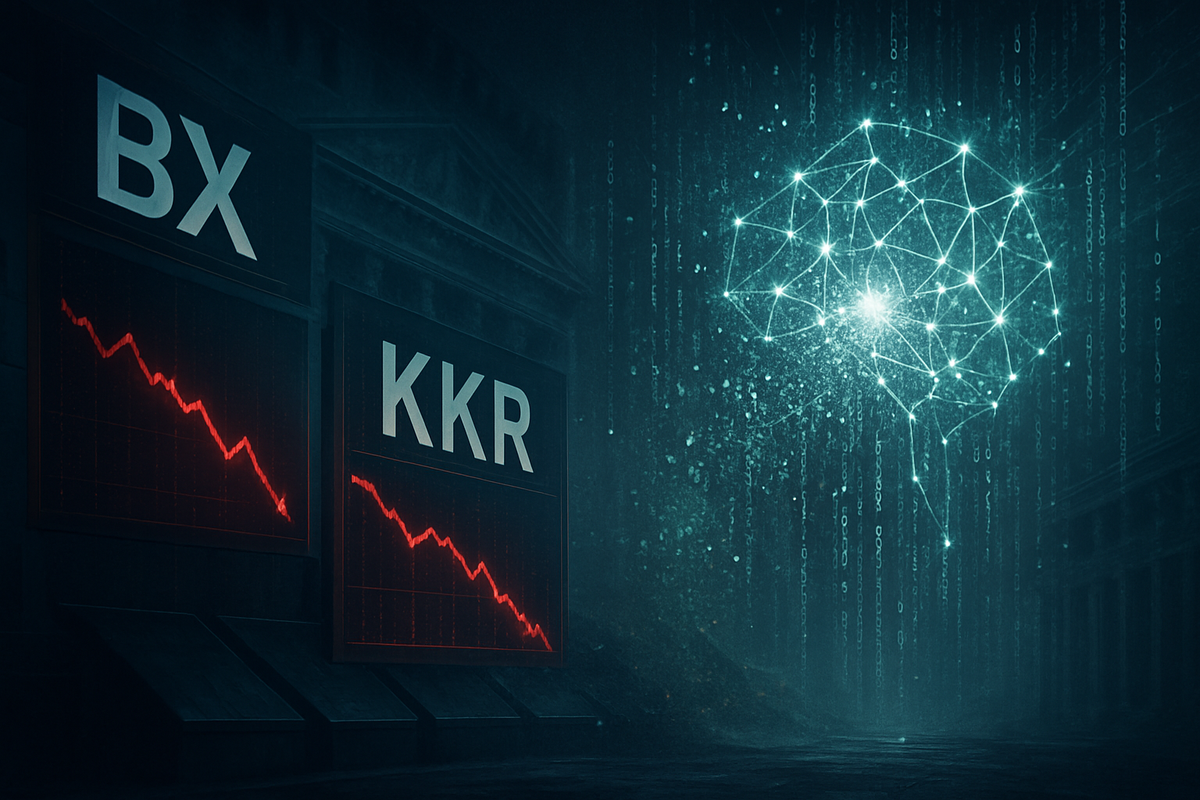
In a dramatic reassessment of the technology landscape, shares of private equity titans Blackstone (NYSE: BX) and KKR & Co. Inc. (NYSE: KKR) plummeted yesterday, February 23, 2026, as investors fled firms with heavy exposure to the software sector. Blackstone shares fell 6.2% to close at approximately $113.71, while KKR saw an even steeper decline of nearly 9%. The sell-off was triggered by growing fears that the rapid evolution of "agentic" artificial intelligence is systematically dismantling the moats of traditional Software-as-a-Service (SaaS) companies—firms that form the backbone of the $3 trillion private-credit market.
The market rout, already being dubbed "Software-mageddon" by traders, marks a pivotal moment for alternative asset managers. For years, these firms utilized private credit to fund massive software buyouts, banking on the "sticky" recurring revenue of seat-based licensing models. However, the emergence of AI agents capable of automating entire workflows has turned those once-reliable cash flows into liabilities. As legacy software valuations were repriced globally, the perceived risk of defaults within the private-credit portfolios of Blackstone and KKR sent shockwaves through the broader financial markets, raising urgent questions about the liquidity and solvency of non-traded credit funds.
The Anatomy of a Collapse: A February to Remember
The turmoil began in earnest in late January and accelerated through two distinct waves in February 2026. The first blow landed on January 30, when the AI lab Anthropic released a suite of specialized plugins for its "Claude Cowork" assistant. These tools demonstrated an unprecedented ability to automate complex legal, compliance, and administrative tasks—sectors that have historically been the bread and butter of enterprise software. Within days, approximately $285 billion in market value vanished from the software sector, dragging down giants like Salesforce (NYSE: CRM) and ServiceNow (NYSE: NOW) by more than 7%.
The crisis reached a breaking point over the weekend of February 21, when Citrini Research published a provocative report titled "The 2028 Global Intelligence Crisis." The report argued that "vibe-coding"—a term for AI-generated, natural-language software development—would lead to mass contract cancellations as companies realized they no longer needed expensive, per-seat software licenses. This sentiment was compounded yesterday, February 23, when Anthropic unveiled "Claude Code," a tool capable of modernizing legacy COBOL systems overnight. The news sent IBM (NYSE: IBM) into its steepest one-day decline in 25 years and provided the final catalyst for the retreat from private-equity-backed credit.
Central to the panic is the specific exposure held by the lending arms of these private equity giants. Blackstone’s prominent non-traded Business Development Company (BDC), BCRED, reportedly held a software exposure of roughly 26% heading into 2026. As the "SaaSpocalypse" intensified, BCRED faced a surge in redemption requests, reaching 4.5% of its total shares outstanding. Meanwhile, KKR, with approximately 7% of its total portfolio tied to software, became a target for analysts concerned about potential "valuation marks"—the process of adjusting the reported value of private assets to reflect current market realities.
Winners and Losers in the Age of Autonomy
The current downturn has created a stark divide between the legacy tech establishment and the new vanguard of AI-native platforms. On the losing side are the traditional SaaS heavyweights and IT service providers whose business models rely on human-centric labor or per-user fees. In addition to Salesforce and ServiceNow, companies like Intuit (NASDAQ: INTU) and Atlassian (NASDAQ: TEAM) have seen their "moats" evaporate as AI agents begin to perform the very functions these platforms were designed to facilitate. IT consulting firms such as Infosys (NYSE: INFY) and Wipro (NYSE: WIT) also face existential threats as AI-driven coding tools reduce the need for massive offshore developer teams.
Conversely, the clear winners are the AI infrastructure providers and the nimble startups built entirely on "agentic" architectures. While Anthropic remains private, the ripple effects have benefited hardware providers and specialized cloud firms that power these massive models. However, the most surprising "winners" may be institutional activists who are now preying on the weakened credit funds. Saba Capital Management, led by Boaz Weinstein, and Cox Capital Partners reportedly launched aggressive tender offers yesterday for credit funds managed by firms like Blue Owl Capital (NYSE: OWL) at discounts of 20% to 35%, signaling a vulture-like appetite for distressed private-credit assets.
For the private equity firms themselves, the path forward is bifurcated. Firms with diversified portfolios and lower debt-to-equity ratios in their software holdings, such as Apollo Global Management (NYSE: APO) and Ares Management (ARES), may find opportunities to acquire distressed assets at a discount. However, those like Blackstone and KKR, who are heavily "marked to market" by public sentiment, must now convince investors that their credit underwriting remains sound despite the structural shift in the software industry.
A Structural Shift: Beyond the Per-Seat Model
The significance of this event extends far beyond a simple market correction; it represents the end of the "per-seat" era of software economics. Since the mid-2000s, the software industry has flourished on the premise that more employees equal more licenses, which equals more revenue. AI disruption has shattered this correlation. When a single AI agent can perform the work of ten junior analysts, the value of a "seat" becomes negligible. This shift toward "outcome-based" pricing—where companies pay for the task completed rather than the software used—is a fundamental disruption that many legacy firms are ill-equipped to handle.
This event also mirrors the "Dot-com" crash of 2000, but with a crucial difference: the current crisis is driven by the rapid obsolescence of profitable companies rather than the failure of unprofitable ones. The speed at which Anthropic and its peers have moved from "assistants" to "agents" caught even the most sophisticated lenders off guard. UBS analysts warned this week that private-credit default rates in the software sector could spike to 5-8% in the coming year, a massive jump from the 1-2% historical norms that lenders had originally priced into their loans.
Furthermore, the "SaaSpocalypse" is likely to invite intense regulatory scrutiny into the private credit market. For years, regulators have warned that the opaque nature of private lending could hide systemic risks. The sudden liquidity strain at Blackstone’s BCRED and the aggressive discounting by activists like Saba Capital may provide the impetus for the SEC to demand more frequent and transparent valuations of private assets, potentially ending the "volatility-dampening" effect that attracted investors to private equity in the first place.
Navigating the "Software-mageddon" Aftermath
Looking ahead, the software industry and its financial backers face a period of forced adaptation. In the short term, Blackstone and KKR will likely focus on "portfolio triage," working with their borrowers to pivot toward AI-integrated business models. We may see a wave of forced mergers as legacy software companies scramble to acquire AI startups to remain relevant. For the asset managers, the primary challenge will be managing liquidity; if redemption requests continue to climb, they may be forced to "gate" their funds, a move that would further rattle investor confidence.
In the long term, the market will likely see the emergence of a new class of "outcome-based" software giants. These companies will not sell tools, but rather results—legal briefs, audited financial statements, or optimized supply chain routes—delivered entirely by AI. For private equity firms, the "gold mine" of software buyouts has not disappeared, but the criteria for a "safe" bet has changed forever. Future credit underwriting will likely require a deep technical audit of a company’s "AI-defensibility" before a single dollar is lent.
Summary and Investor Outlook
The events of February 23, 2026, serve as a stark reminder that in the age of AI, no moat is permanent. Blackstone and KKR, the titans of the leveraged buyout era, are now grappling with the reality that the software companies they financed are being disrupted by the very technology they once viewed as a growth catalyst. The immediate takeaways are clear: the per-seat licensing model is dying, private-credit liquidity is not as robust as it appeared, and AI agents are no longer a future threat—they are a present market force.
Moving forward, the market will remain volatile as it recalibrates the value of the entire technology sector. Investors should keep a close eye on the quarterly redemption figures for BDCs and the valuation marks of private software portfolios. The true test for Blackstone (NYSE: BX) and KKR (NYSE: KKR) will be their ability to navigate this transition without a systemic credit event. In the coming months, the focus will shift from "who has the best software" to "who can survive the transition to an agent-driven economy."
This content is intended for informational purposes only and is not financial advice