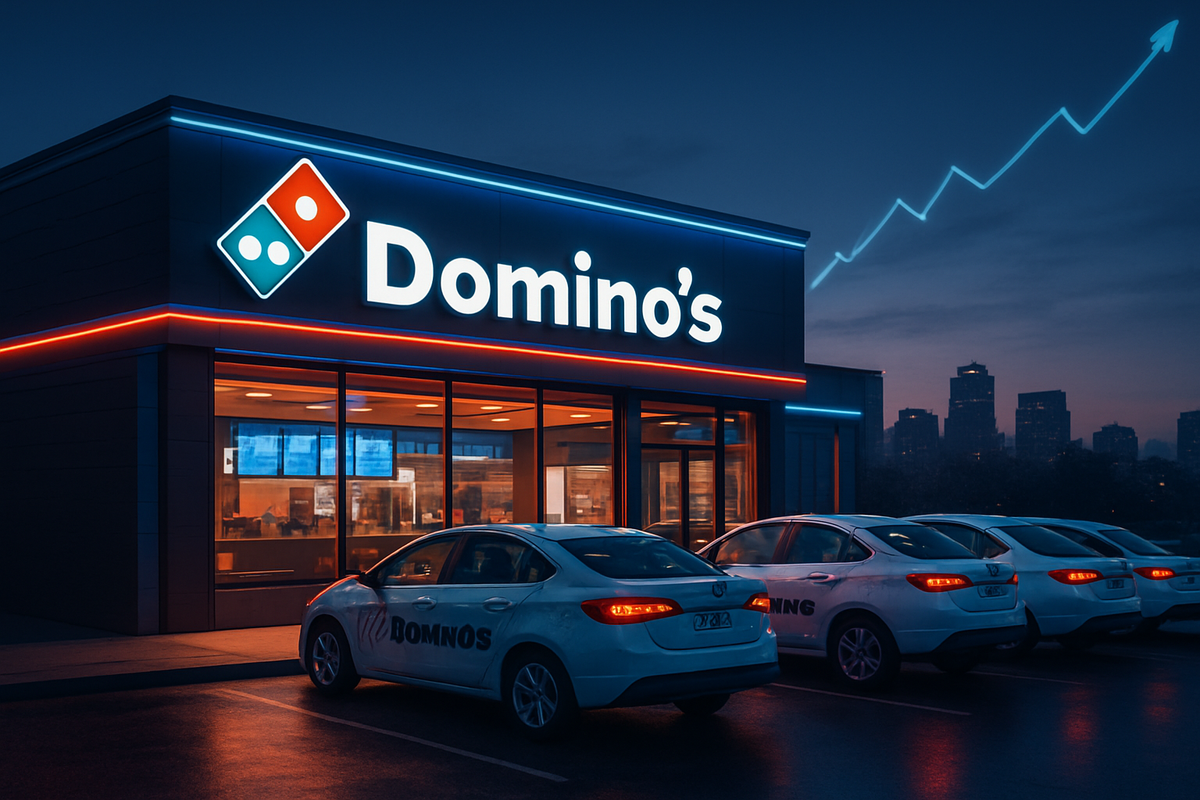
In a market environment where consumer discretionary spending has become a battlefield of shifting loyalties, Domino’s Pizza (NYSE: DPZ) has emerged as the clear victor. On February 23, 2026, the pizza giant reported a stellar fourth-quarter earnings beat for the fiscal year 2025, headlined by a robust 3.7% increase in U.S. same-store sales. This performance, driven by genuine transaction growth rather than just inflationary price hikes, signals that the company’s strategic pivots are resonating deeply with a price-sensitive American public.
The financial markets responded with immediate enthusiasm. While the broader indices showed signs of fatigue due to lingering macroeconomic concerns, Domino’s shares bucked the trend, climbing between 4% and 6% in early Monday trading. The company’s decision to reward shareholders with a 15% dividend increase further cemented investor confidence, marking a significant milestone in its long-term growth trajectory and underscoring a period of exceptional free cash flow generation.
A "Hungry for MORE" Success Story: The Numbers Behind the Heat
The Q4 2025 results serve as the most significant "proof of concept" yet for the company’s "Hungry for MORE" strategy, a multi-year initiative focused on maximizing sales, store growth, and franchisee profits. The 3.7% climb in domestic same-store sales was the star metric, comfortably exceeding analyst expectations and proving that Domino’s can still find "white space" in a saturated market. This growth was bolstered by the successful national rollout of the Parmesan Stuffed Crust Pizza—a permanent menu addition that filled a long-standing gap in the brand's lineup—and the "Smart Ops" AI-driven kitchen orchestration system which has significantly reduced delivery times.
The timeline leading to this blowout quarter began in mid-2025, when Domino’s finalized its nationwide integration with DoorDash (NASDAQ: DASH), complementing its existing partnership with Uber (NYSE: UBER) through Uber Eats. These aggregator partnerships, once viewed with skepticism by some franchisees, have instead acted as a powerful funnel for incremental sales. CEO Russell Weiner noted during the earnings call that the aggregator marketplace now represents a $1 billion incremental opportunity, and the company is capturing its "fair share" much faster than anticipated.
Market stakeholders were particularly impressed by the company's capital allocation strategy. The 15% dividend hike to $1.99 per share was supported by a 31.2% surge in annual free cash flow, which reached $671.5 million in 2025. This financial health allowed the board to not only raise the dividend for the 14th consecutive year but also to continue aggressive share repurchases, signaling to the street that management believes the stock remains undervalued even at its current premium.
Winners and Losers: The Pizza Wars Reach a Turning Point
The divergence in the QSR (Quick Service Restaurant) sector has never been more apparent. While Domino’s celebrates a banner year, its primary rivals are facing a far more turbulent landscape. Papa John’s International, Inc. (NASDAQ: PZZA) reported a 3% decline in sales as 2026 began, still reeling from the fallout of failed acquisition talks with private equity late last year. Without the same level of digital infrastructure and aggregator synergy that Domino's possesses, Papa John’s has struggled to maintain its value proposition in a "K-shaped" economy.
Similarly, Yum! Brands (NYSE: YUM) finds itself in a split-screen reality. While its Taco Bell division continues to be a powerhouse of growth, its Pizza Hut brand has officially entered a formal strategic review. Yum! Brands recently announced it would shutter approximately 250 underperforming Pizza Hut units in the first half of 2026. This retreat by a legacy competitor provides a massive opportunity for Domino’s to capture even more market share, particularly in suburban markets where Pizza Hut’s footprint is shrinking.
The clear winners in this scenario extend beyond just the pizza players. Aggregators like DoorDash and Uber are benefiting from the "Domino’s Effect," as the pizza leader's massive marketing spend drives more traffic to their platforms. Conversely, smaller, independent local pizzerias are the silent losers, finding it increasingly difficult to compete with the technology-driven efficiency and deep-discounting capabilities of the "Big Three," now dominated increasingly by a "Big One."
Strategic Significance: Value in a Bifurcated Economy
The broader significance of this earnings beat lies in what it reveals about the 2026 consumer. We are currently navigating a bifurcated economy where lower- and middle-income households are increasingly stretched by persistent living costs. In this environment, "value" has become more than just a low price point; it is about the reliability and convenience of the experience. Domino’s has mastered this by leveraging its "Dom.OS" technology to ensure that a $9.99 promotion isn't just cheap, but also fast and consistent.
Historically, pizza has been a defensive play during economic downturns, but the 2026 data shows a shift. This isn't just defensive; it's an aggressive land grab. By reaching a 23.3% share of the U.S. QSR pizza market, Domino's is following the playbook of industry titans like McDonald's, aiming for a category-dominant 40% share. This strategy of high-frequency, low-friction transactions is the new gold standard for the industry, moving away from the high-margin, low-volume models that are currently failing traditional sit-down casual dining establishments.
Furthermore, the focus on "Smart Ops" and automation reflects a wider industry pivot toward mitigating labor costs. With 89% of operators citing labor as a top concern in 2026, Domino’s early and heavy investment in proprietary tech has given it a structural margin advantage that competitors are now scrambling to replicate. This "tech-first" approach is no longer an elective strategy; it is the prerequisite for survival in the modern food service landscape.
Looking Ahead: The 2026 Roadmap
In the short term, Domino’s management has provided an optimistic guidance for 2026, anticipating that the momentum from the DoorDash rollout will continue to scale. Investors should look for at least two more major menu innovations this year, as the company seeks to maintain the excitement generated by the stuffed crust launch. The strategic pivot toward "Most Profits" for franchisees is also expected to accelerate store openings, with a target of several hundred new domestic units by year-end.
The long-term challenge will be maintaining this pace of growth as the "aggregator honeymoon" phase matures. As more competitors integrate with DoorDash and Uber Eats, the incremental advantage for Domino’s may narrow. To counter this, the company is likely to double down on its own loyalty program, "Domino’s Rewards," aiming to move aggregator customers back into its direct digital ecosystem where margins are highest and data ownership is absolute.
Potential scenarios for the latter half of 2026 include a deeper dive into automated delivery. With regulatory hurdles for sidewalk robots and autonomous vehicles beginning to clear in several key states, Domino’s is well-positioned to be a first-mover in reducing the "last mile" delivery cost—the final frontier in its quest for absolute market dominance.
Final Wrap-Up: A New Standard for QSR Excellence
The Q4 2025 earnings report from Domino’s Pizza is a masterclass in execution. By successfully blending traditional value-driven food service with cutting-edge digital logistics and aggressive capital returns, the company has set a new benchmark for the restaurant industry. The 3.7% same-store sales growth and the 15% dividend hike are not just numbers; they are a declaration of resilience in an uncertain market.
As we move forward into 2026, the market will be watching to see if Domino’s can sustain its transaction growth as consumer wallets continue to be squeezed. However, with its "Hungry for MORE" strategy firing on all cylinders and competitors like Pizza Hut and Papa John's in retreat, the path to a 40% market share seems increasingly plausible.
For investors, the key takeaways are clear: Domino’s is no longer just a pizza company; it is a technology-driven logistics firm that happens to sell pizza. Watch for continued margin expansion through AI integration and further market share gains as the industry consolidation continues. In the world of 2026 retail, Domino’s isn't just participating in the market—it’s redefining it.
This content is intended for informational purposes only and is not financial advice.