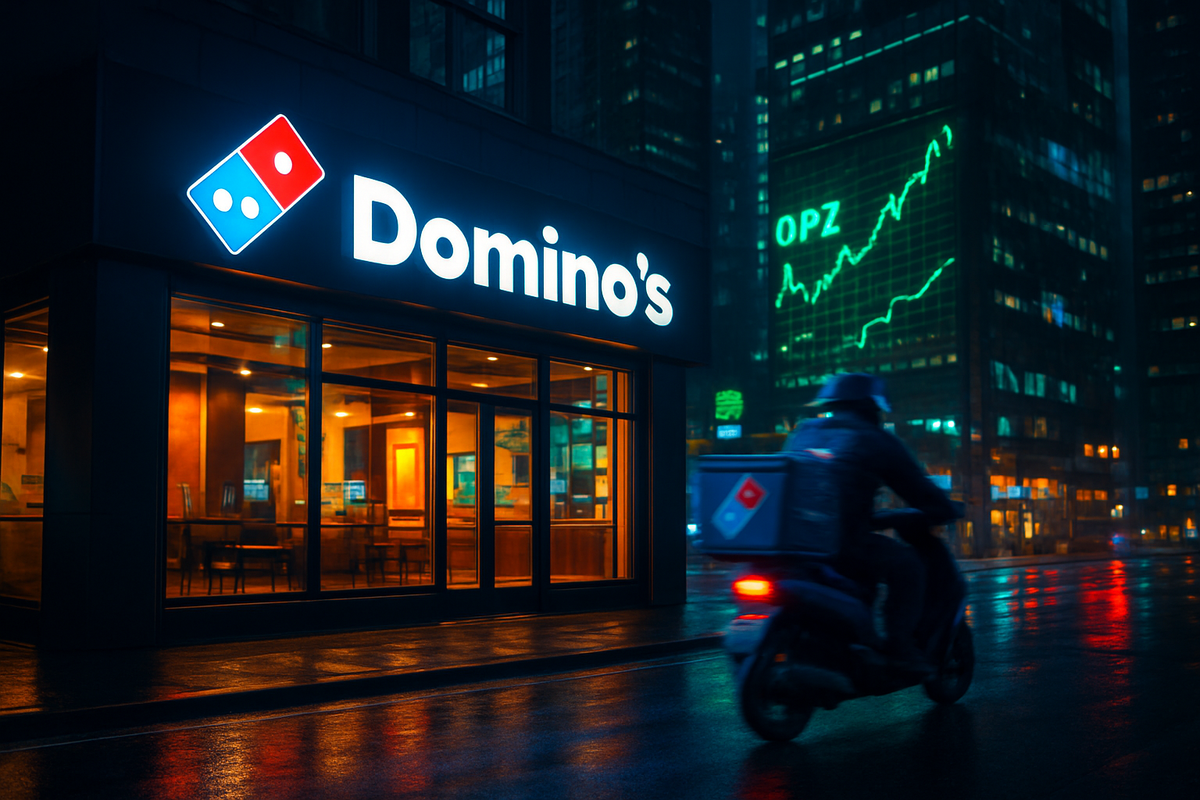
Shares of Domino’s Pizza (NYSE: DPZ) jumped nearly 5% in early trading on Monday, February 23, 2026, after the world’s largest pizza company reported fourth-quarter same-store sales that exceeded Wall Street expectations. Despite a slight miss on the bottom line, investors were buoyed by the company’s resilient domestic performance and an aggressive 15% dividend hike, signaling management's confidence in its long-term "Hungry for MORE" strategic initiative.
The rally reflects a broader market recognition of the company’s ability to capture market share from both independent pizzerias and casual dining competitors in a tightening consumer environment. As the company closes out its 2025 fiscal year, all eyes are now on its 2026 expansion roadmap, which promises a relentless focus on digital innovation, delivery efficiencies, and the acquisition of new customers through high-value promotional pricing.
A Dominant Domestic Performance Drives the Revenue Beat
For the fiscal fourth quarter ending December 28, 2025, Domino’s reported total revenue of $1.54 billion, a 6.4% increase year-over-year, which handily beat analyst consensus estimates of $1.52 billion. The engine behind this growth was a robust 3.7% increase in U.S. same-store sales, outpacing the 3.47% growth many analysts had projected. This performance was particularly notable given the cooling demand seen across the wider Quick Service Restaurant (QSR) sector, suggesting that Domino’s "Best Deal Ever" value bundles and its revamped loyalty program are successfully driving order frequency.
While the top-line growth was strong, the company reported diluted earnings per share (EPS) of $5.35, falling just short of the $5.38 analyst target. Net income rose 7.2% to $181.6 million, though margins were slightly squeezed by a 5.4 percentage point decrease in U.S. company-owned store gross margins. Executives attributed this pressure to rising labor costs and insurance premiums, which have become a persistent headwind for the industry. However, the market largely looked past the EPS miss, focusing instead on the company's aggressive capital return policy, including the board's approval of a $1.99 per share quarterly dividend.
The timeline leading up to this surge has been marked by a strategic pivot toward third-party delivery integration. The company’s decision in late 2023 to partner with DoorDash (NASDAQ: DASH) has continued to bear fruit, providing a steady stream of incremental customers who previously ordered through aggregator apps rather than the native Domino’s platform. CEO Russell Weiner noted during the earnings call that the company added a net 392 stores in the fourth quarter alone, bringing the 2025 total to 776 new locations globally.
The Winners and Losers in the Pizza Wars
Domino’s current trajectory places it firmly in the "winner" category of the current economic cycle. By leveraging its proprietary supply chain and massive scale, the company has been able to keep price increases to stores at a modest 1.7%, allowing franchisees to maintain competitive pricing while rivals struggle. The primary beneficiaries of this success are Domino’s shareholders and its delivery partner, DoorDash, which continues to see high volume from the pizza giant's nationwide footprint.
Conversely, the success of Domino’s poses a significant threat to its primary competitors, Papa John’s International (NASDAQ: PZZA) and Yum! Brands (NYSE: YUM), the parent company of Pizza Hut. Papa John’s has struggled to match the digital velocity and value-tier penetration of Domino’s, potentially leading to a further erosion of its market share in 2026. Smaller independent pizzerias also face a "lose-lose" scenario; they lack the marketing budget to compete with Domino’s national campaigns and the logistical scale to offer comparable delivery pricing, likely leading to more consolidation within the industry.
Beyond the immediate pizza space, casual dining chains like Darden Restaurants (NYSE: DRI) may feel the pinch as budget-conscious families trade down from sit-down meals to high-value carryout options. Domino’s reported that a significant portion of its growth in 2025 came from the "carryout" segment, which now accounts for nearly half of its domestic transactions, directly competing with the convenience of traditional fast-casual establishments.
Inflationary Resilience and the Shift to Value
The broader significance of the Domino’s report lies in what it reveals about the 2026 consumer. With persistent inflation affecting grocery and dining costs, the "value-seeking" behavior of the American public has become the dominant market force. Domino’s success with its $9.99 price point demonstrates that "affordable luxury" in the form of a hot meal remains a priority for households, even as they cut back on larger discretionary spends.
This event fits into a broader industry trend where the "middle" of the market is disappearing. Companies are either succeeding by offering ultra-convenience and low prices—like Domino’s and McDonald’s (NYSE: MCD)—or by catering to the ultra-high-end luxury market. The mid-tier restaurant space is being hollowed out, and Domino's is aggressively filling that vacuum. Historical precedents, such as the company’s performance during the 2008 financial crisis, suggest that pizza remains one of the most recession-resistant categories in the food industry.
Furthermore, the technological moat Domino’s has built is becoming a regulatory and operational template for the industry. The company’s focus on its e-commerce site and refined loyalty programs allows it to gather granular data on consumer habits, a move that partners and competitors are now racing to emulate. However, the "delivery wars" have shifted from a race for coverage to a race for profitability, and Domino’s is currently leading the pack by utilizing a hybrid model of in-house drivers and third-party overflow.
Looking Ahead: The 2026 Market Share Expansion
Looking toward the remainder of 2026, Domino’s is doubling down on its "Hungry for MORE" strategy. The company has publicly stated its intention to "meaningfully increase" its market share within the U.S. QSR pizza category this year. After gaining a full percentage point of market share in 2025, the company is targeting a long-term goal of over 7,700 U.S. stores by 2028. This expansion is not just about physical locations but about "fortressing" existing markets to improve delivery times and lower costs.
A key strategic pivot to watch will be the company’s international recovery. While the U.S. business is firing on all cylinders, international same-store sales grew only 0.7% in Q4, missing the 1.03% estimate. Markets like Japan and Australia have proven difficult to navigate due to intense local competition and currency fluctuations. If Domino’s can successfully export its U.S. "value and volume" playbook to these flagging international territories in late 2026, it could provide another significant catalyst for the stock.
Investors should also anticipate potential challenges in the form of labor market volatility. While the company has managed to maintain operations, any further legislative changes regarding the "gig economy" or minimum wage could impact the cost structure of its delivery model. However, the company's investment in automation and "anyware" ordering technology provides a hedge against these long-term labor risks.
Summary and Investor Outlook
In summary, Domino’s Pizza has started 2026 on a high note, proving that its brand remains a powerhouse of consumer resilience. The nearly 5% jump in share price is a validation of a strategy that prioritizes volume and market share over short-term margin maximization. Key takeaways for investors include the company's impressive domestic same-store sales beat, its commitment to shareholder returns via a major dividend hike, and its clear-eyed focus on 2026 expansion.
Moving forward, the market will be watching to see if Domino’s can maintain its momentum as it pushes deeper into the third-party delivery ecosystem and whether its international segments can return to their historical growth rates. The company's ability to navigate the "challenging restaurant backdrop" while still expanding its footprint suggests that it remains a top-tier pick in the consumer discretionary sector.
For the coming months, investors should keep a close eye on monthly inflation data and consumer spending reports. If the trend of "trading down" continues, Domino’s is perfectly positioned to capture even more of the American dinner table. With a valuation currently hovering around 22 times forward earnings—a decade low—the stock may still have significant runway as it marches toward its 2028 store-count targets.
This content is intended for informational purposes only and is not financial advice.