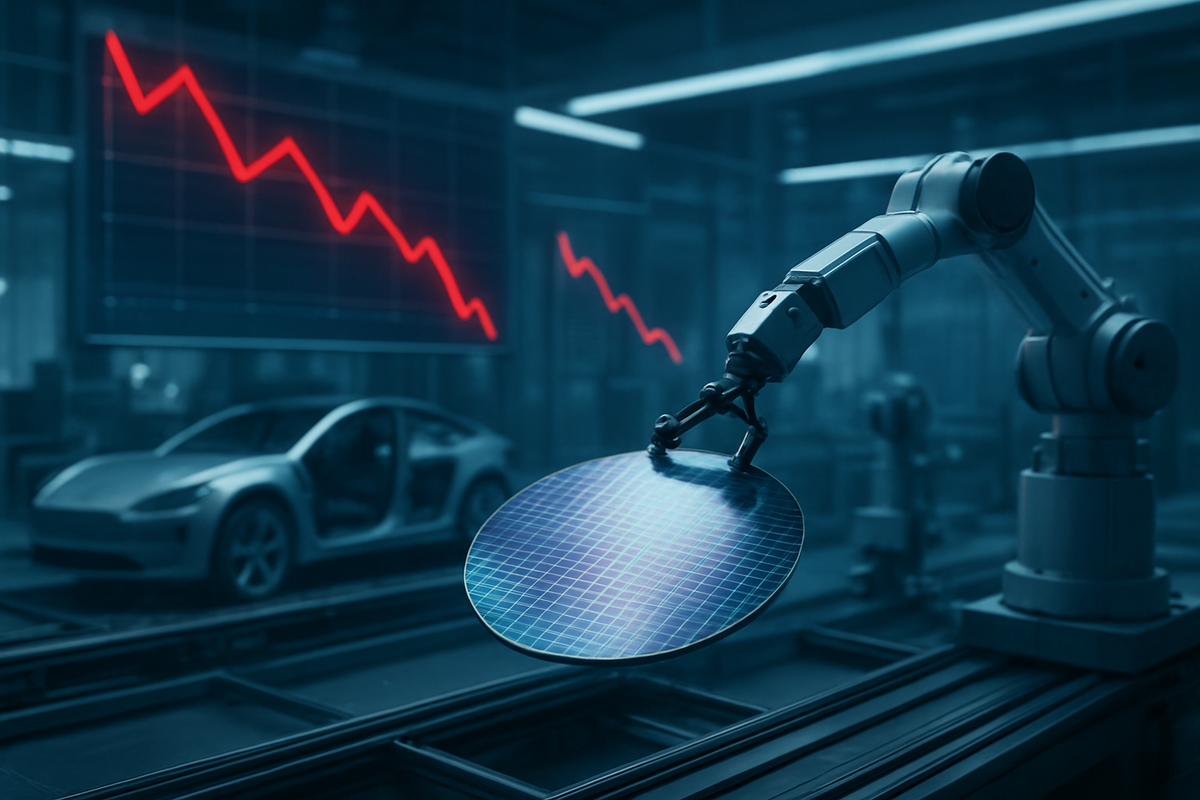
In a stark reminder of the cyclical volatility inherent in the semiconductor industry, shares of ON Semiconductor (NASDAQ: ON) tumbled more than 8% on February 10, 2025. The sell-off followed a fourth-quarter earnings report that not only missed analyst expectations but, more critically, offered a somber outlook for the first quarter of 2025. The results signaled that the much-anticipated recovery in the automotive and industrial sectors remained elusive, caught in a "perfect storm" of inventory excess and cooling consumer demand.
The decline wiped billions off the company's market capitalization in a single session, dragging down peers in the power and analog chip space. As the company grappled with the transition to electric vehicles (EVs) and a broader industrial slowdown, investors were forced to reassess the timeline for a return to growth. The February 10 event now stands as a pivotal moment in the 2024–2025 semiconductor cycle, highlighting the growing divergence between artificial intelligence-driven gains and the "traditional" silicon markets that power the physical economy.
A Miss on All Fronts: The February 10 Breakdown
The trouble began before the opening bell on February 10, 2025, when ON Semiconductor—commonly known as onsemi—released its financial results for the fourth quarter of 2024. The company reported revenue of $1.7225 billion, a 14.6% decline year-over-year and shy of the $1.76 billion consensus estimate. Non-GAAP diluted earnings per share (EPS) landed at $0.95, missing the $0.98 mark that Wall Street had pegged as the floor. While the Q4 misses were concerning, it was the guidance for the first quarter of 2025 that sent shockwaves through the trading floor.
Management issued a revenue forecast for Q1 2025 between $1.35 billion and $1.45 billion—a staggering distance from the $1.68 billion analysts had expected. Even more alarming was the EPS guidance, projected at a range of $0.45 to $0.55, nearly 40% below the consensus estimate of $0.88. CEO Hassane El-Khoury cited "prolonged volatility" in the global macro environment, specifically noting that the "inventory digestion" phase among automotive Tier-1 suppliers was taking significantly longer than the company had projected just three months prior.
The timeline leading up to this drop was defined by a series of false dawns. Throughout late 2024, many analysts had predicted that the semiconductor glut—a byproduct of the post-pandemic hoarding—would clear by the end of the year. However, as 2025 opened, it became clear that the cooling of the EV market in North America and Europe was more than a seasonal dip. By the time the earnings call concluded on the morning of February 10, the stock was already in freefall, eventually settling with an 8.2% loss on the day, its steepest single-day decline in nearly two years.
Winners and Losers: A Fractured Semiconductor Landscape
The fallout from onsemi’s dismal report immediately rippled across the sector, identifying clear "losers" among companies with high exposure to the automotive and industrial segments. STMicroelectronics (NYSE: STM) and NXP Semiconductors (NASDAQ: NXPI) both saw their shares slide by 4% to 5% in sympathy, as investors realized that the headwinds facing onsemi were systemic rather than company-specific. Texas Instruments (NASDAQ: TXN), though more diversified, also felt the heat, with its industrial-heavy portfolio coming under renewed scrutiny. These firms, which had bet heavily on the "electrification of everything," found themselves on the wrong side of a mid-cycle correction.
Conversely, the event highlighted a widening gap in the industry where the "winners" were almost exclusively found in the data center and AI realms. While onsemi struggled, NVIDIA (NASDAQ: NVDA) and other high-performance computing leaders continued to trade near record highs, insulated from the terrestrial struggles of car manufacturing and factory automation. This "tale of two markets" meant that investors began rotating capital out of "analog/power" and into "compute," further punishing the valuations of companies like onsemi that lacked a significant AI tailwind.
For the automotive OEMs themselves, the oversupply of chips was a double-edged sword. While it meant lower component costs and no more production line shutdowns due to "chip famines," it was also a symptom of their own slowing sales. Companies that had over-ordered in 2023 and 2024 were now stuck with warehouses full of silicon, leading to a "buyer's strike" that forced chipmakers to slash prices and margins.
The Broader Significance: EV Enthusiasm Meets Reality
The February 2025 crash for onsemi fits into a larger historical narrative of the "EV Hype Cycle." For years, Silicon Carbide (SiC) chips—onsemi’s specialty—were touted as the crown jewel of the green energy transition. However, the February 10 report served as a definitive signal that the transition was hitting a significant speed bump. High interest rates and a lack of charging infrastructure had slowed the adoption of EVs, leading to a surplus of the very high-efficiency power chips that onsemi had spent billions to produce.
Beyond the automotive sector, the industrial "softness" mentioned by management pointed to a global slowdown in capital expenditures. Factories were delaying upgrades to automated systems, and renewable energy projects were being pushed back due to financing costs. This was a classic cyclical downturn, reminiscent of the 2018–2019 semiconductor slump, but exacerbated by the massive capacity expansions companies had undertaken during the 2021–2022 shortage.
Furthermore, the early 2025 period was marked by significant geopolitical anxiety. With a new administration in Washington D.C. discussing universal tariffs, the semiconductor industry faced the prospect of increased costs for raw materials and potential retaliatory measures from China. For a company like onsemi, which operates a complex global supply chain, the threat of trade barriers added a layer of risk that made the soft guidance even harder for the market to stomach.
What Comes Next: The Long Road to Recovery
As we look back from the vantage point of February 2026, the events of a year ago were the "darkest before the dawn." In the short term following the February 10, 2025 drop, onsemi was forced to implement aggressive cost-cutting measures, including consolidating its manufacturing footprint and slowing the ramp-up of its New York and Czech Republic facilities. Strategic pivots became necessary, with a renewed focus on "intelligent sensing" for autonomous features rather than just power components for drivetrain electrification.
The long-term outlook, however, began to stabilize in late 2025 as the inventory glut finally cleared. The market eventually moved toward a "new normal" where growth in the automotive sector is steady rather than exponential. For onsemi, the challenge has been maintaining its leadership in Silicon Carbide while diversifying its revenue streams to avoid being a "single-point-of-failure" for the automotive cycle. Analysts suggest that the company’s ability to weather the 2025 storm has made it a leaner, more resilient player, though its valuation still carries a "cyclical discount" compared to its AI-focused peers.
Wrap-up: Lessons from the 2025 Correction
The 8% drop in ON Semiconductor shares on February 10, 2025, remains a textbook example of how quickly sentiment can shift when structural growth stories meet cyclical economic realities. The key takeaway for investors was that the "electrification" trade was not a straight line up, but a jagged path susceptible to the same inventory and demand cycles that have defined the chip industry for decades.
Moving forward, the market has become far more discerning, looking past high-level "megatrends" to focus on actual sell-through data and warehouse levels. For onsemi, the road to redemption has been paved with disciplined capacity management and a refocusing on high-margin industrial niches. As we move into the middle of 2026, investors should keep a close watch on the stabilization of European and North American EV sales and the potential for a "re-stocking" cycle, which could finally provide the tailwind that was so conspicuously absent a year ago.
This content is intended for informational purposes only and is not financial advice.