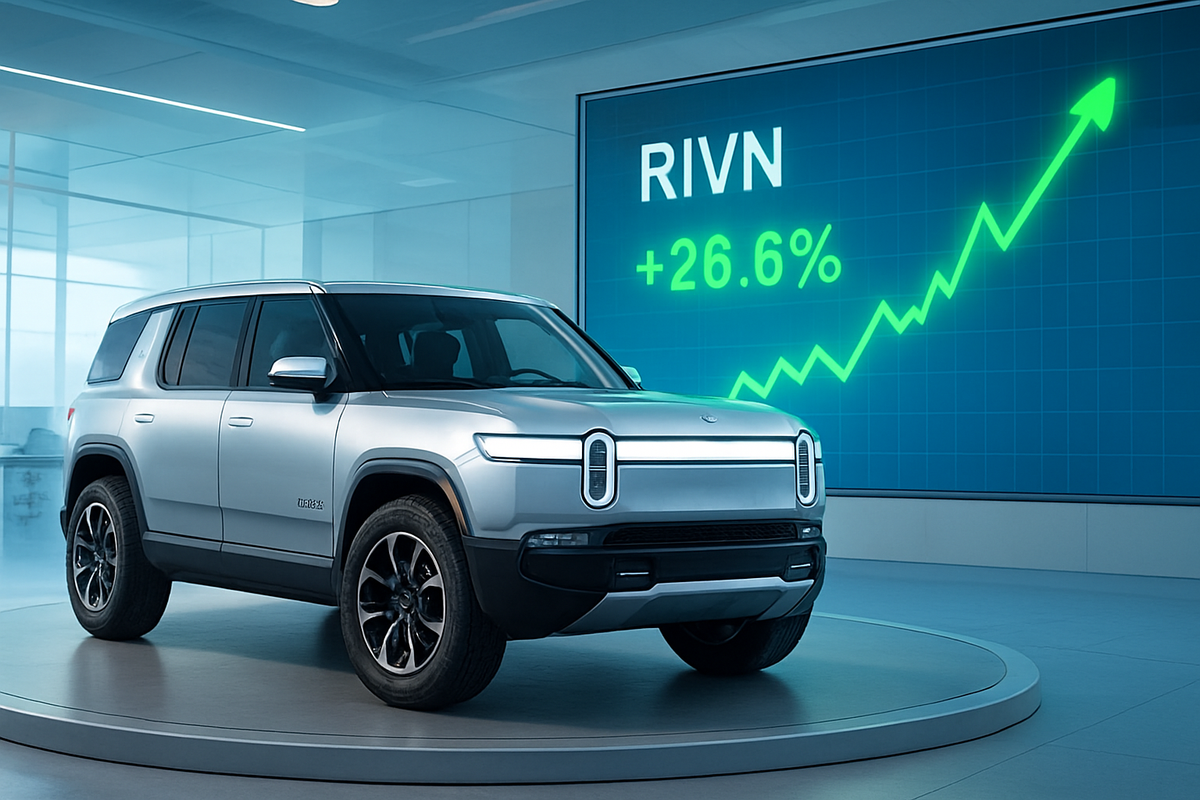
In a dramatic shift for the electric vehicle (EV) sector, Rivian Automotive, Inc. (NASDAQ: RIVN) saw its shares skyrocket by 26.6% following the release of its Q4 and full-year 2025 earnings report. The surge, which took place on February 13, 2026, marks a definitive turning point for the Irvine-based automaker, as it successfully navigated the "valley of death" that has claimed many of its startup peers. Investors cheered a report that showcased not only a significant narrowing of losses but also the emergence of a high-margin software revenue stream that could redefine the company's valuation.
The market's euphoric reaction was fueled by a combination of a $1.3 billion improvement in annual gross profit and the strategic validation provided by its joint venture with Volkswagen AG (OTC:VWAGY). With the upcoming 2026 launch of the R2—a midsize SUV priced under $50,000—Rivian has effectively signaled to Wall Street that it is no longer a niche luxury brand, but a scalable contender ready to challenge the dominance of Tesla, Inc. (NASDAQ: TSLA).
A Financial Breakthrough: $1.3B Gross Profit Swing
The Q4 2025 earnings call provided the data points that bulls had long been waiting for. Rivian reported a massive $1.344 billion improvement in full-year gross profit compared to 2024, finally moving into positive territory with a total gross profit of $144 million for the year. This achievement was underpinned by an aggressive cost-cutting regime that saw the company strip approximately $9,500 in costs from every vehicle produced at its Normal, Illinois facility. By optimizing its supply chain and integrating its new "Ascend" battery architecture, Rivian proved it could build premium EVs without hemorrhaging cash on every delivery.
The analyst community responded with a wave of optimism. Following the earnings release, UBS Group AG (NYSE: UBS) upgraded the stock from "Sell" to "Neutral," raising its price target to $16. Analysts at TD Cowen (NYSE: TD) were even more bullish, hiking their price target to $17 and citing the "compelling" value proposition of the R2 platform. Meanwhile, Deutsche Bank AG (NYSE: DB) moved its rating from "Hold" to "Buy," noting that Rivian’s path to 2026 now appears "de-risked" due to a stronger balance sheet and clearer production visibility.
Perhaps the most surprising revelation was the success of "RV Tech," the joint venture with Volkswagen. In Q4 alone, this partnership contributed $273 million to Rivian’s software and services revenue. This high-margin income, derived from licensing Rivian’s advanced electrical architecture and software stack to the German automotive giant, has transformed Rivian from a pure-play hardware manufacturer into a hybrid tech-and-auto company.
Winners and Losers in the New EV Landscape
The clear winner in this scenario is Rivian itself, which has secured its survival through a period of high interest rates and cooling EV demand. By securing a $5 billion commitment from Volkswagen and demonstrating an ability to generate software licensing fees, Rivian has insulated itself from the "capital crunch" that continues to plague other players. Volkswagen AG also emerges as a winner; the $273 million it paid in software fees is a small price to pay for access to a modern, integrated software platform that could solve the legacy automaker's long-standing digital struggles.
On the losing side are the "pure-play" EV startups that lack a strategic partner or a clear path to gross profitability. Lucid Group, Inc. (NASDAQ: LCID) and other smaller entrants now face increased pressure to find their own "Volkswagen moment" or risk being sidelined as the market consolidates around a few dominant survivors. Furthermore, traditional OEMs that have been slow to pivot to software-defined vehicles (SDVs) may find themselves falling further behind as the Rivian-VW alliance begins to set a new industry standard for vehicle connectivity and over-the-air updates.
Scaling Up: The R2 and the Mass-Market Shift
This event signifies a broader maturation of the EV industry. The "hype cycle" of 2020-2021 has officially given way to an era of operational execution. Rivian’s success in improving its gross margins by over $1.3 billion mirrors the early scaling journey of Tesla, suggesting that the "learning curve" for EV manufacturing is steep but manageable for companies with the right engineering focus. The shift toward software-led revenue also indicates that the future of automotive profitability lies not in the metal and rubber, but in the silicon and code.
The upcoming launch of the R2 vehicle in Q2 2026 is the next critical milestone. Priced starting at approximately $45,000, the R2 is designed to compete directly in the highest-volume segment of the US auto market. If Rivian can successfully ramp up production of the R2 while maintaining the cost efficiencies found in 2025, it will have successfully transitioned from a low-volume luxury manufacturer to a mass-market player. This transition is essential for any EV company seeking long-term viability in a market where scale is the only ultimate defense against competition.
The Road Ahead: 2026 and Beyond
Looking forward, the remainder of 2026 will be a "transitional" year as Rivian prepares its production lines for the R2. While the company guided for a 53% jump in total deliveries for the coming year, the execution of this ramp-up will be fraught with challenges. Short-term, investors will be watching for the successful completion of "winter testing" for Volkswagen’s next-gen models using Rivian tech, which is expected to unlock another $2 billion in capital for the company.
Strategic pivots may still be necessary. As Rivian scales, it will need to ensure its service and charging infrastructure—the Rivian Adventure Network—can handle a significantly larger fleet of vehicles. The company’s focus on vertical integration, including its proprietary "RAP1" autonomy chip, will be tested as it seeks to maintain its technological edge without letting research and development costs spiral out of control.
Conclusion: A New Chapter for Rivian
The 26.6% surge in Rivian’s stock is more than just a one-day rally; it is a validation of a multi-year strategy focused on vertical integration and strategic partnership. By achieving positive gross profit and proving the value of its software stack to the world’s second-largest automaker, Rivian has separated itself from the pack of struggling EV startups. The $1.3 billion improvement in its bottom line provides the financial foundation necessary to take on the ambitious task of mass-market production.
For investors, the coming months will be defined by "execution, execution, execution." The core metrics to watch will be the R2 reservation numbers and the progress of the Volkswagen joint venture integrations. While the path to full EBITDA profitability by 2027 remains steep, the Q4 2025 results suggest that Rivian finally has the wind at its back. The company has moved from being a "speculative bet" to a "top-tier EV survivor," marking a new chapter in the electrification of the American automotive industry.
This content is intended for informational purposes only and is not financial advice.