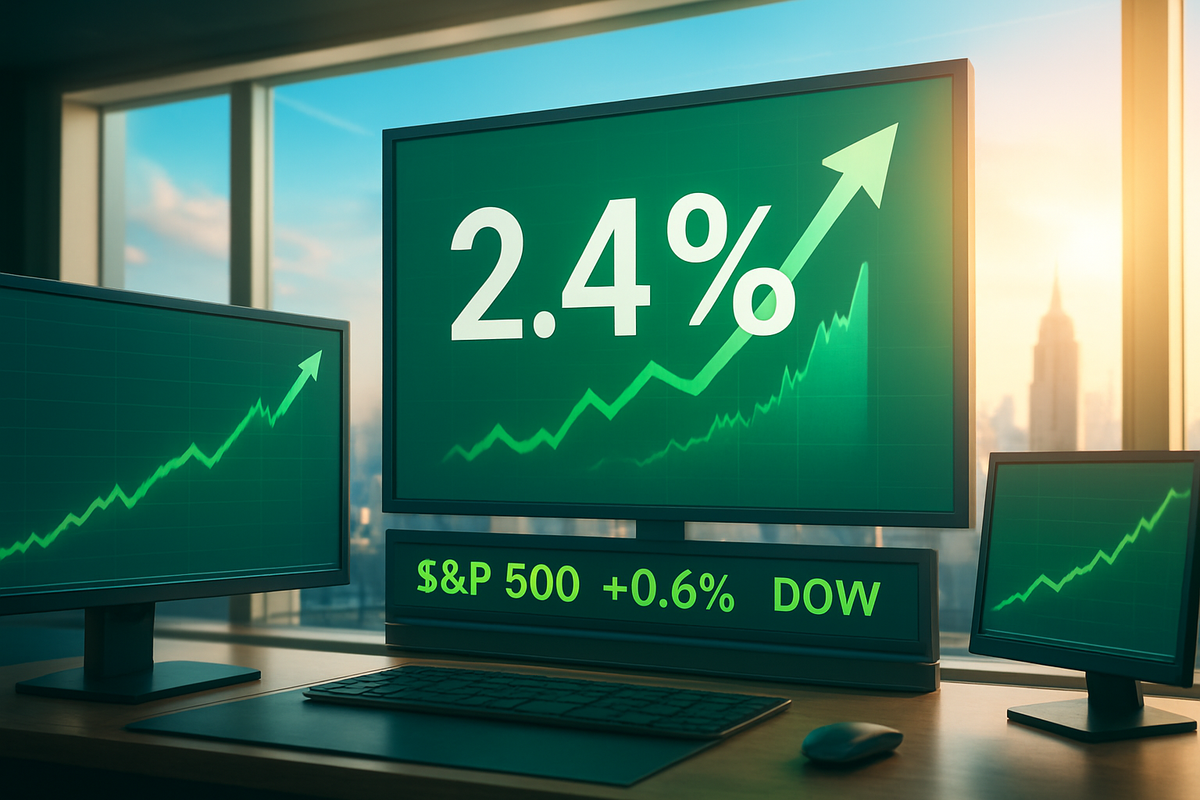
The U.S. financial markets shifted into high gear this week following a pivotal inflation report that suggests the Federal Reserve’s long-standing battle against rising prices may finally be entering its final chapter. The Bureau of Labor Statistics revealed on February 13, 2026, that the Consumer Price Index (CPI) for January slowed to 2.4% on a year-over-year basis, coming in cooler than the 2.5% consensus estimate. This surprising downshift has effectively dampened the "higher-for-longer" interest rate narrative that had dominated Wall Street sentiment throughout the winter, sparking a broad-based relief rally across major indices.
Investors reacted with immediate optimism to the data, which showed that core inflation—a metric that strips out volatile food and energy costs—met expectations at 2.5%. The market's response was swift and decisive: the S&P 500 (NYSE: SPX) climbed 0.6%, while the Dow Jones Industrial Average (NYSE: DIA) surged by over 200 points as traders began aggressively pricing in a pivot toward monetary easing. With the "soft landing" scenario appearing more plausible than ever, the focus has shifted from whether the Fed will cut rates to exactly when the first move will occur, with a growing consensus now pointing toward the July 2026 Federal Open Market Committee (FOMC) meeting.
A Decisive Downshift in Price Pressures
The January CPI report arrived at a critical juncture for the U.S. economy. Following a "hot" January jobs report that added 130,000 positions and kept unemployment at a lean 4.3%, many analysts feared that persistent service-sector inflation would force the Federal Reserve to maintain restrictive interest rates well into late 2026. However, the data released last Friday told a different story. The cooling trend was primarily anchored by a 1.5% monthly decline in energy costs, with gasoline prices plunging 3.2% in January alone. Perhaps more significantly for the Fed's long-term goals, shelter costs—which have been a stubborn component of core inflation—decelerated to a 0.2% monthly increase, half the pace recorded in December 2025.
The immediate reaction in the bond market was a sharp decline in Treasury yields. The 10-year Treasury note yield eased to approximately 4.07%, its lowest level since early December. This move in the fixed-income market provided the necessary oxygen for equities to rally, as lower yields increase the present value of future corporate earnings. The timeline of events leading to this moment had been characterized by extreme caution; earlier in February, the market had been shaken by a "SaaSpocalypse"—a sharp sell-off in the software-as-a-service sector—as investors fretted that sticky inflation would keep borrowing costs prohibitive for high-growth companies. This CPI print has served as a vital corrective to those fears.
Identifying the Winners and Losers of the Pivot
The relief rally was not uniform, creating a clear distinction between sectors poised to benefit from lower rates and those that might face headwinds. High-growth technology firms led the charge, with industry titans like NVIDIA Corp (NASDAQ: NVDA), Microsoft Corp (NASDAQ: MSFT), and Apple Inc (NASDAQ: AAPL) seeing significant inflows. For these companies, the prospect of a rate cut in July reduces the discount rate applied to their future cash flows, making their premium valuations more palatable to institutional investors. The tech-heavy NASDAQ Composite notably outperformed its peers as the "SaaSpocalypse" fears began to evaporate.
Real estate and utilities also emerged as primary beneficiaries. Interest-rate-sensitive stocks, particularly Real Estate Investment Trusts (REITs) like Prologis Inc (NYSE: PLD) and American Tower Corp (NYSE: AMT), saw robust gains. The 3.0% year-over-year moderation in shelter costs mentioned in the report suggests a more stable environment for property valuations and lower financing hurdles for new developments. Conversely, the banking sector saw a more muted reaction. While large institutions like JPMorgan Chase & Co (NYSE: JPM) posted modest gains, they generally underperformed the broader rally. A narrower yield curve, resulting from falling long-term yields, typically pressures net interest margins—the difference between what banks earn on loans and what they pay on deposits—making the prospect of rate cuts a double-edged sword for the financial sector.
Analyzing the Wider Significance and Market Trends
This shift in inflation dynamics marks a significant departure from the volatility of the 2022-2024 era. The fact that headline inflation is now hovering just 40 basis points above the Federal Reserve's 2% target suggests that the restrictive policy measures implemented over the last few years are reaching their intended conclusion. This event fits into a broader industry trend of "normalization," where the pandemic-era supply chain disruptions and energy spikes have finally been fully absorbed by the global economy.
The ripple effects of this cooling inflation are likely to be felt globally. As the U.S. dollar potentially weakens in anticipation of July rate cuts, emerging markets may find relief from their own currency pressures and dollar-denominated debt burdens. Historically, when the Fed nears the end of a tightening cycle and pivots toward cuts without a significant recession—the coveted "soft landing"—equities have historically entered prolonged periods of growth. However, the shadow of potential regulatory changes or geopolitical shifts remains a wildcard that could disrupt this trajectory.
The Road Ahead: Eyes on July
In the short term, market participants will be hyper-focused on upcoming secondary inflation prints, such as the Producer Price Index (PPI) and Personal Consumption Expenditures (PCE) data, to confirm that the January CPI dip wasn't a statistical anomaly. The Federal Reserve is expected to maintain a cautious "wait-and-see" approach in its spring meetings, likely keeping rates steady while refining its forward guidance. If the trend of decelerating shelter and energy costs continues through the second quarter, the July FOMC meeting will almost certainly be the venue for the first 25-basis-point reduction.
For investors, the primary challenge will be navigating the rotation out of defensive "cash-equivalent" positions and back into growth-oriented assets. Strategic pivots may be required for those heavily weighted in short-term money market funds, which have enjoyed high yields over the past year but will see diminishing returns as the Fed begins its easing cycle. The potential for a "melt-up" in equities exists if the economic data remains "goldilocks"—not too hot to trigger more hikes, but not too cold to signal a deep recession.
Conclusion and Investor Outlook
The January 2026 CPI report has provided the most definitive evidence to date that the U.S. economy is successfully navigating the transition away from high-inflation instability. With headline inflation at 2.4% and core figures meeting expectations, the "higher-for-longer" fear that has plagued markets for months has been replaced by a more constructive outlook. The rally in the S&P 500 and the Dow underscores a market that is ready to price in a more accommodative monetary environment, starting this summer.
As we move forward into the spring of 2026, investors should keep a close watch on labor market stability and consumer spending patterns. While the inflation battle appears to be nearing its end, the health of the underlying economy will determine if the July rate cuts are the start of a healthy new cycle or a necessary response to a cooling labor market. For now, the "relief" in this rally is well-earned, reflecting a hard-won victory for price stability in the post-pandemic era.
This content is intended for informational purposes only and is not financial advice.