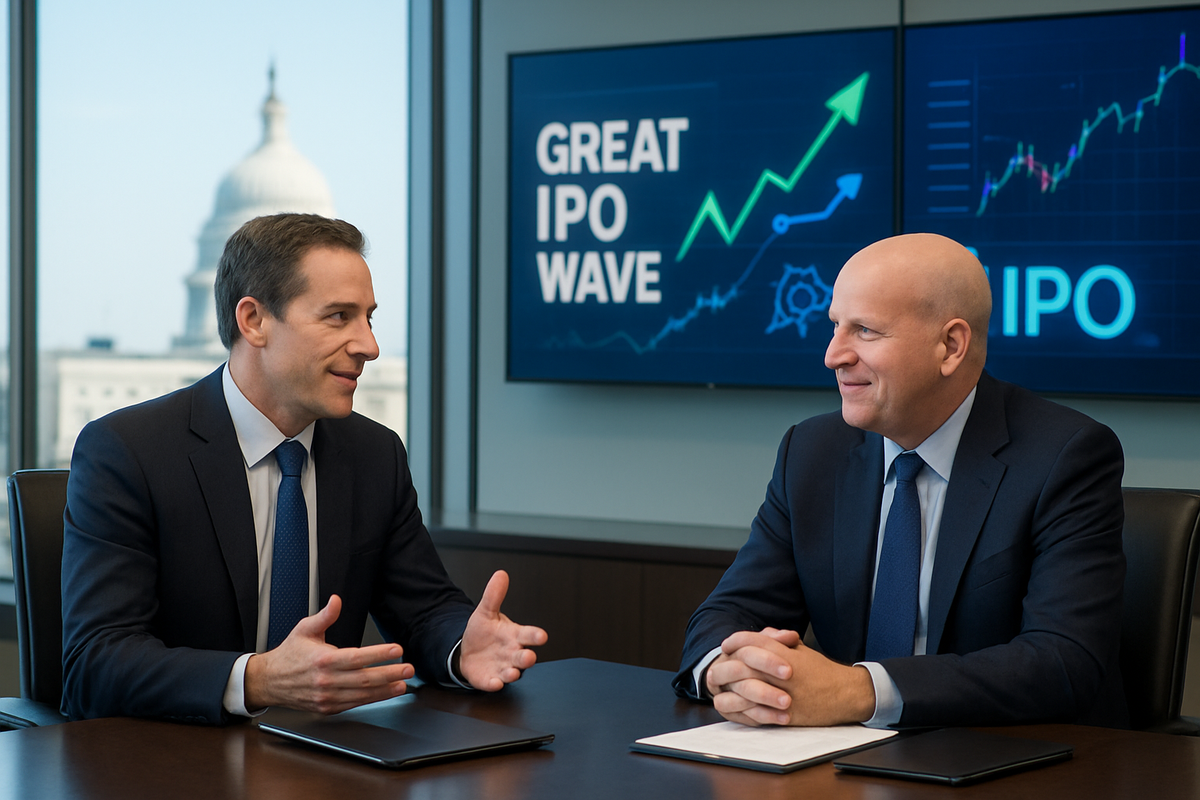
WASHINGTON D.C. — In a move that signals a seismic shift for American capital markets, Securities and Exchange Commission (SEC) Chair Paul S. Atkins met with Goldman Sachs (NYSE: GS) CEO David Solomon this week to finalize a strategic roadmap for what many are calling the "Great IPO Wave of 2026." The high-level dialogue, occurring just as the market enters a period of renewed optimism, focused on a series of sweeping deregulatory reforms aimed at dismantling "regulatory speed bumps" that have historically kept high-growth companies away from public exchanges.
The meeting marks a definitive pivot from the "regulation-by-enforcement" era of the previous administration. Chair Atkins, who took office in early 2025, has championed a "Make IPOs Great Again" initiative, promising to simplify listing requirements and broaden access for the average retail investor. With the SEC now actively collaborating with major Wall Street institutions like Goldman Sachs, market participants are bracing for an unprecedented surge of large-scale public offerings that could redefine the retail investment landscape.
Orchestrating the Return of the Megadeal
The discussions between Atkins and Solomon represent the culmination of a months-long effort to revitalize the U.S. listing environment. Following a period of relative stagnation in the IPO market through 2024 and early 2025, the Atkins-led SEC has moved aggressively to replace the litigation-heavy oversight of the past with a collaborative compliance model. Central to this week's talks was the expansion of the "IPO on-ramp," a provision originally established by the JOBS Act, which allows companies to maintain lighter disclosure requirements for their first three years as public entities.
Leading up to this meeting, David Solomon has been vocal about the "unleashing of animal spirits" within the financial sector. During his recent appearance at the World Economic Forum, Solomon noted that the current regulatory tone has shifted the answer for complex strategic deals from a "flat no" to an "open door." This shift has encouraged a massive backlog of private "unicorns"—companies valued at over $1 billion—to accelerate their 2026 listing timelines. Key stakeholders, including venture capital firms and private equity giants, have reportedly been waiting for this exact regulatory signal to trigger their exit strategies.
Winners and Losers in the New IPO Regime
The primary beneficiaries of this regulatory thaw are the major investment banks, led by Goldman Sachs (NYSE: GS), Morgan Stanley (NYSE: MS), and JPMorgan Chase (NYSE: JPM). These institutions are poised to capture significant underwriting fees as the IPO pipeline opens. Furthermore, retail-focused brokerages such as Robinhood Markets (NASDAQ: HOOD) stand to gain immense trading volume as the SEC moves to democratize access to these offerings. High-profile companies rumored to be eyeing 2026 listings include stablecoin issuer Circle Internet Group and the digital asset exchange Kraken (Payward Inc.), both of which are expected to benefit from the SEC’s more permissive stance on blockchain technology.
Conversely, the shift toward "financial materiality" and the rollback of mandatory ESG (Environmental, Social, and Governance) disclosures could be seen as a loss for the climate-tech and sustainable investing sectors. Companies that relied on ESG-centric reporting to attract institutional capital may find themselves competing in a market that prioritizes traditional bottom-line performance. Additionally, smaller regional banks might struggle to compete with the sheer scale and resources of the "Bulge Bracket" firms that are currently being invited to the table by the Atkins SEC.
A Fundamental Shift in Market Participation
The Atkins-Solomon meeting underscores a broader industry trend toward the "retailization" of private markets. One of the most significant policy shifts discussed was the reform of the "accredited investor" definition. Under the new proposal, the SEC intends to move away from wealth-based thresholds, instead allowing individuals to qualify as sophisticated investors by passing a certification exam. This would allow a teacher or a nurse with market knowledge to invest in high-growth companies long before they hit the public exchange—a privilege previously reserved for the ultra-wealthy.
This move fits into a larger narrative of dismantling the barriers between public and private capital. By coordinating with the Department of Labor, the SEC is also exploring rules that would allow 401(k) accounts to hold private equity and venture capital investments. Critics warn of the increased risk to retirement savings, but proponents argue that this is the only way for the middle class to capture the massive wealth creation that occurs in a company’s early growth stages. This historical precedent mirrors the deregulation of the 1980s, which led to a decade of explosive corporate growth, though it remains to be seen if today's protections are sufficient to prevent a repeat of past market excesses.
The Road to the 2026 'Top-Decile' Year
In the short term, investors should expect a flurry of S-1 filings as companies rush to take advantage of the favorable regulatory climate. The SEC is also reviewing Regulation S-K, with the potential to replace quarterly (10-Q) reporting with a semi-annual system for mid-cap companies. This change is designed to curb the "short-termism" of Wall Street and allow newly public companies to focus on long-term strategy rather than quarterly earnings beats. If successful, these changes could lead to 2026 being a "top-decile" year for the IPO market, potentially surpassing the records set in 2021.
However, the rapid pace of change brings its own challenges. The market must be able to absorb a sudden influx of supply without crashing valuations. Strategic pivots will be required for traditional asset managers who must now navigate a world where private and public asset classes are increasingly blurred. The ultimate success of the Atkins agenda will depend on whether these new "on-ramps" and "light-touch" rules actually foster sustainable growth or merely inflate another speculative bubble.
A New Era for the American Investor
The meeting between SEC Chair Paul Atkins and David Solomon signals more than just a busy year for investment bankers; it marks the beginning of a new philosophy in U.S. financial oversight. By prioritizing capital formation and retail access over rigid enforcement, the SEC is betting that a more permissive environment will restore the United States’ competitive edge as the world’s premier destination for public listings. The "Great IPO Wave" of 2026 is no longer a forecast—it is a policy objective.
For investors, the coming months will be a period of intense activity and opportunity. Watching the progress of the "accredited investor" reforms and the specific listing dates for massive technology and crypto firms will be essential. While the risks of a deregulated market are real, the potential for retail investors to finally sit at the same table as institutional giants represents a potential turning point in the history of American capitalism.
This content is intended for informational purposes only and is not financial advice.