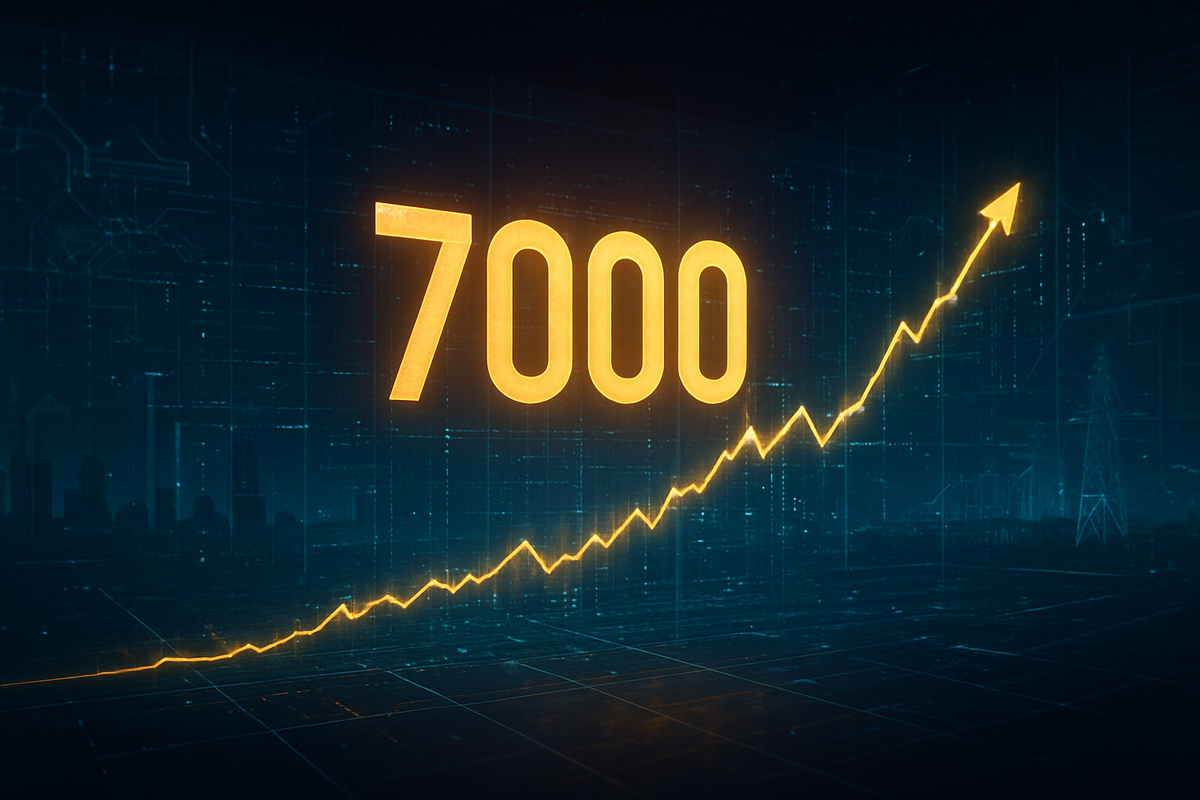
The S&P 500 is currently hovering at a critical psychological juncture, closing at 6,941.47 on February 11, 2026, as investors set their sights on the elusive 7,000-point milestone. This march toward 7,000 represents a historic acceleration in market value, coming just 14 months after the index first breached the 6,000 level in late 2024. While the broader market remains buoyant, a slight cooling on February 12 saw the index dip to 6,832.76, reflecting a moment of consolidation after one of the most aggressive rallies in modern financial history.
This surge has been underpinned by a "perfect storm" of economic conditions: a resilient labor market, a massive capital expenditure cycle in artificial intelligence, and pro-fossil fuel fiscal policies that have revitalized the energy sector. However, as the index dances around the 7,000 mark, the market is grappling with "AI anxiety," a growing concern that while hardware providers are thriving, the traditional software landscape may be on the verge of a structural transformation that could leave some legacy giants behind.
The Road to 7,000: A Timeline of the Great 2026 Rally
The journey to the 7,000-point threshold has been characterized by breathtaking speed and sector-wide rotations. The S&P 500 (INDEXSP:.INX) first touched the 7,000 mark during intraday trading on January 28, 2026, reaching a peak of 7,002.28. This milestone was driven largely by a blockbuster fourth-quarter 2025 earnings season, where technology titans demonstrated that AI investments were finally translating into tangible productivity gains and bottom-line growth.
While the S&P 500 grabbed the headlines for its proximity to 7,000, the Dow Jones Industrial Average (INDEXDJI:.DJI) reached its own historic peak earlier in the month. The Dow closed above the 50,000 mark for the first time on February 6, 2026, finishing at 50,115.67. This kicked off a string of record closes on February 9 and February 10, as blue-chip industrials and financials benefited from a "soft landing" economic narrative. However, the streak was broken on February 12, when the Dow dropped 669.42 points, or 1.34%, to close at 49,451.98, its largest one-day decline in weeks.
The volatility observed on February 12 was triggered by a stronger-than-expected jobs report, which paradoxically spooked investors who feared the Federal Reserve might maintain higher interest rates for longer to prevent the economy from overheating. Despite the dip, the market's trajectory remains upward, supported by a "Capex Super-Cycle" where companies are spending record amounts on digital and physical infrastructure to support the next generation of the global economy.
Winners and Losers in the Race to the Top
The ascent to 7,000 has created a stark divide between the "AI Haves" and the "AI Have-Nots." In the hardware and infrastructure space, Nvidia (NASDAQ: NVDA) continues to serve as the market’s primary engine, having become the first company to achieve a $5 trillion market capitalization in late 2025. Similarly, Micron Technology (NASDAQ: MU) saw its stock surge nearly 10% in mid-February after announcing that its HBM4 memory chips—essential for high-end AI processing—were entering high-volume production ahead of schedule. Equinix (NASDAQ: EQIX) has also emerged as a significant winner, as the demand for specialized data centers to house AI workloads reaches an all-time high.
Conversely, the software sector has faced a "Claude Crash," named after the popular AI model, as investors fear that advanced large language models will automate tasks previously handled by expensive enterprise software suites. Companies like Salesforce (NYSE: CRM) and Adobe (NASDAQ: ADBE) have faced downward pressure, with their stocks underperforming the broader index as the market re-evaluates their long-term moat in an AI-first world. IBM (NYSE: IBM) has also seen a cooling of sentiment as investors question whether its legacy consulting and cloud arms can pivot fast enough to compete with leaner, AI-native startups.
In the energy and industrial sectors, a shift in fiscal policy has revitalized traditional powerhouses. Peabody Energy (NYSE: BTU) has seen a resurgence following executive orders aimed at stabilizing the power grid through coal and fossil fuel production. At the same time, networking firms like Lumen Technologies (NYSE: LUMN) have been re-rated by the market, not as legacy telecom providers, but as essential conduits for the massive amounts of data flowing between AI training clusters.
Analyzing the Psychological Significance and Market Trends
The 7,000 level for the S&P 500 is more than just a number; it is a psychological barrier that often triggers a shift in investor sentiment. Historically, these thousand-point milestones are met with a mixture of euphoria and "melt-up" fears. The transition from 6,000 to 7,000 in just 14 months is one of the fastest on record, drawing comparisons to the late 1990s tech boom. However, analysts point out that unlike the dot-com era, current valuations are backed by record corporate profits and a genuine shift in industrial capacity.
The broader significance of this event lies in the "Great Rotation" occurring under the surface. While the S&P 500 is heavily weighted toward tech, the Dow’s run to 50,000 indicates that the rally has broadened to include financials, energy, and retail. Companies like Walmart (NYSE: WMT) and McDonald’s (NYSE: MCD) hitting record highs in early 2026 suggests that consumer spending remains a robust pillar of the U.S. economy, even as the "AI arms race" dominates the headlines.
Furthermore, the policy environment in early 2026 has been a significant catalyst. The current administration's focus on domestic energy independence and deregulation has provided a tailwind for industrial and energy stocks that were previously sidelined. This policy-driven growth, combined with the technological breakthrough of generative AI, has created a unique "bimodal" market where both the old economy and the new economy are finding ways to grow simultaneously, albeit at the expense of middle-tier service sectors.
What Lies Ahead: Strategic Pivots and Scenarios
As the market settles into the mid-6,000s after the February 12 pullback, the question for investors is whether the rally has "run too far, too fast." In the short term, the market is likely to remain data-dependent, with every inflation print and jobs report being scrutinized for its impact on the Federal Reserve's rate path. A primary challenge will be the potential for "AI fatigue," where the market demands more than just infrastructure growth and starts looking for significant revenue contributions from AI implementation across all sectors.
Strategically, we may see a wave of M&A activity as legacy software companies attempt to buy their way into the AI hardware or networking space to stay relevant. For investors, the opportunity may lie in the "Phase 2" of the AI trade—looking beyond the chipmakers to the utilities and networking firms that provide the backbone for the digital revolution. Conversely, the risk remains that if the massive capital expenditure by tech giants does not yield the expected productivity gains by late 2026, the market could face a significant "reset" to align valuations with more modest growth expectations.
Final Assessment: Navigating the 7,000 Threshold
The S&P 500's flirtation with the 7,000 mark is a testament to the resilience and dynamism of the American economy in the face of rapid technological change. While the dip on February 12 serves as a reminder that markets do not move in a straight line, the fundamental drivers of this rally—AI infrastructure and energy revitalization—appear to have significant momentum. The Dow’s record-breaking run to 50,000 further underscores the breadth of the current economic expansion.
For investors, the coming months will require a discerning eye. The "passive" era of simply holding an index fund may face headwinds if the software sector continues to lag, creating a "drag" on the S&P 500's performance relative to more targeted portfolios. Key indicators to watch will include the sustainability of the "Capex Super-Cycle," energy policy developments, and the ability of the consumer to withstand a "higher-for-longer" interest rate environment. As the market eyes the 7,000 level once again, the distinction between innovation-led growth and speculative excess will be the most important factor to monitor.
This content is intended for informational purposes only and is not financial advice.