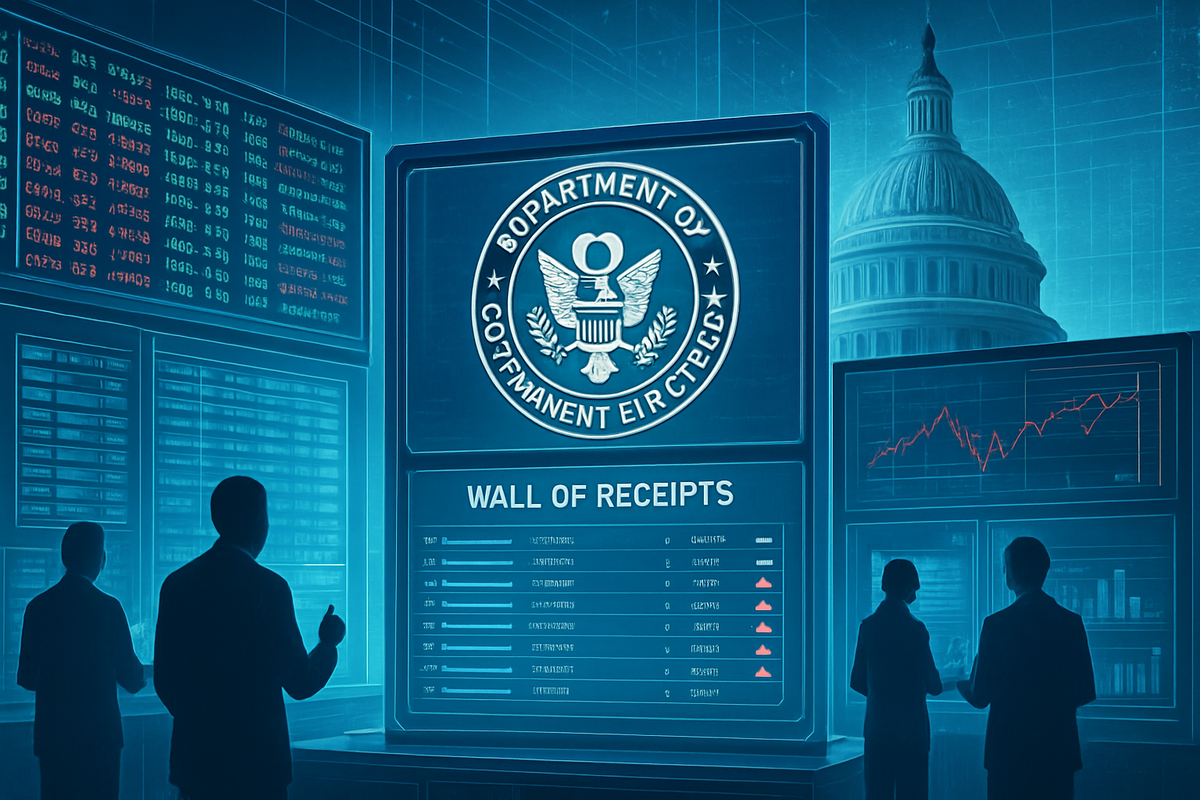
The federal government has fully implemented the so-called "Trump Accounts" reporting rule. As of February 11, 2026, every federal agency is now mandated to provide a granular, real-time accounting of every dollar spent and every personnel hour logged. This initiative, which began as a campaign promise to "drain the swamp" with surgical precision, has evolved into a sophisticated digital dragnet, exposing the inner workings of the federal bureaucracy to unprecedented public and executive scrutiny.
The immediate implications are stark: the reporting rule serves as the analytical foundation for the Department of Government Efficiency (DOGE) to execute a planned 22.6% average cut to non-defense discretionary spending in the FY2026 budget. By forcing agencies to justify every "account" (spending line) and personnel position, the administration has created a "Wall of Receipts"—a public-facing portal where taxpayers can view justifications for everything from multi-billion dollar aerospace contracts to the travel expenses of mid-level bureaucrats. For the markets, this represents the most significant shift in federal procurement and fiscal policy in over four decades.
The Mandate for Radical Transparency
The "Trump Accounts" reporting rule, codified under a series of executive actions including Executive Order 14222, represents the operationalization of the administration's transparency agenda. The mandate requires federal agencies to integrate their financial systems with a centralized AI-driven oversight platform. This platform tracks payments for contracts, grants, and loans, requiring a "brief, written justification" from the authorizing official for every transaction. Failure to provide a sufficient justification within 30 days results in an automatic "red-flag" for the DOGE auditors, led by Elon Musk and Vivek Ramaswamy, who then have the authority to recommend immediate rescission of funds.
The timeline leading to this moment was aggressive. Following the administration's inauguration in 2025, the DOGE was established with a temporary 18-month mandate to "slash and burn" federal waste. By May 2025, the FY2026 "Skinny Budget" utilized early data from these reporting rules to identify over $100 billion in potential "inefficiencies." Throughout the fall of 2025, "DOGE Teams"—consisting of engineers, HR specialists, and attorneys—were embedded within every major agency to oversee the transition to this new reporting standard. The market reaction has been a mix of volatility and strategic repositioning, as the "cost-plus" era of federal contracting appears to be giving way to a "fixed-price, high-accountability" model.
Key players in this transition extend beyond the political sphere. While the DOGE leadership provides the ideological drive, the technological backbone is being managed by a coalition of Silicon Valley veterans who have moved into the "Department of War" and the Treasury. The initial market response saw a sharp sell-off in consultancy-heavy firms, while technology companies capable of automating federal reporting requirements saw their valuations swell.
Market Winners and Losers: The Tech Shift
The impact of the "Trump Accounts" rule has created distinct winners and losers among public companies. At the forefront of the winners is Palantir Technologies (NYSE: PLTR), which has seen its stock surge as it serves as the "operating system" for the DOGE transparency portal. Palantir’s Artificial Intelligence Platform (AIP) is the primary tool used to harmonize disparate agency data and identify redundant spending. Similarly, Oracle Corporation (NYSE: ORCL) has benefited significantly, as its Oracle Cloud Infrastructure (OCI) provides the secure, air-gapped environment necessary for hosting the government’s massive new transparency dashboards.
On the losing end, traditional management consultancies that have long relied on "hours-billed" contracts are facing an existential threat. Booz Allen Hamilton (NYSE: BAH) has been a primary target of the new scrutiny; in early 2026, the Treasury Department canceled 31 active contracts with the firm, citing "wasteful consulting overhead" identified through the new reporting rule. CACI International (NYSE: CACI) has reported more resilience, as it has pivoted faster toward software-defined capabilities. However, Leidos Holdings (NYSE: LDOS) has also seen several "civilian-sector" contracts de-scoped as DOGE auditors prioritize algorithmic efficiency over human-led project management.
Meanwhile, major defense contractors like Lockheed Martin (NYSE: LMT) and Northrop Grumman (NYSE: NOC) are navigating a complex landscape. While their non-defense "clerical" contracts are being cut, their core mission-critical programs are being shielded—and in some cases, accelerated—by the administration’s focus on "speed of relevance." RTX Corporation (NYSE: RTX) has pivoted by aggressively automating its supply chain to protect margins, as the reporting rule’s transparency makes it increasingly difficult to pass on cost overruns to the taxpayer.
Broader Significance: Algorithmic Governance
The "Trump Accounts" initiative is more than just a budget-cutting tool; it represents a fundamental shift in the "Trend toward Algorithmic Governance." By replacing traditional bureaucratic oversight with automated, real-time reporting, the administration is attempting to create a "leaner" federal state that operates more like a high-tech startup than a traditional government. This fits into a broader industry trend where data transparency is being used as a weapon against institutional inertia.
The ripple effects are being felt by competitors and partners alike. As major agencies like the Department of Education and the IRS see their workforces reduced—sometimes by as much as 50% through "Mass Reductions in Force" (RIFs) enabled by personnel accounting—private sector firms are having to reconsider their service offerings. The historical precedent for this is often cited as the Reagan-era Grace Commission, but the 2026 iteration is far more potent due to the inclusion of AI and real-time data auditing. Unlike the Grace Commission, which provided recommendations that were often ignored by Congress, the "Trump Accounts" rule uses the power of the executive branch to withhold funds through the Impoundment Control Act, forcing a confrontation with legislative spending priorities.
What Comes Next: Strategic Pivots and Scenarios
Looking ahead, the short-term focus will be on the July 4, 2026, deadline, when the DOGE’s temporary mandate is set to expire. The administration’s goal is to have the "Trump Accounts" reporting infrastructure permanently baked into the federal code before this date. Investors should expect a "Second Wave" of contract cancellations as the AI models become more sophisticated at identifying "micro-waste"—redundancies in the hundreds of thousands rather than millions.
Strategic pivots will be required for any company doing business with the federal government. The era of "land and expand" consulting is likely over, replaced by a "prove and provide" model. Market opportunities will emerge for firms that specialize in "Efficiency-as-a-Service," helping agencies meet their DOGE-mandated headcount and spending targets through automation. Potential scenarios include a legal showdown in the Supreme Court over the President's authority to use transparency data to unilaterally withhold appropriated funds, a move that could create significant market uncertainty in the latter half of 2026.
Wrap-up: The New Fiscal Reality
The "Trump Accounts" reporting rule has fundamentally altered the relationship between the federal government, its employees, and its contractors. By treating every spending line as a public "account" subject to real-time audit, the administration has successfully moved the goalposts of fiscal policy from "how much can we spend" to "how much can we justify." The "Wall of Receipts" is no longer a hypothetical; it is a functioning piece of the American fiscal apparatus that has already redirected billions of dollars away from traditional bureaucracy and toward high-tech, mission-focused initiatives.
For investors, the coming months will require a close eye on the "DOGE Dashboard." The companies that thrive will be those that align with the administration’s "tech-over-hours" philosophy. As the FY2026 budget process reaches its climax, the level of transparency provided by these new reporting rules will likely lead to even more aggressive rescission requests. Watch for whether the "Golden Dome" defense initiatives and AI infrastructure projects can offset the losses in the civilian contracting sector. The "Trump Accounts" era has arrived, and for the federal market, nothing will ever be the same.
This content is intended for informational purposes only and is not financial advice