As of February 11, 2026, the global economy is navigating the aftershocks of a geopolitical standoff that nearly dismantled the post-war trade order. The "Greenland Tariff Escalation," a high-stakes diplomatic confrontation sparked by the United States’ aggressive pursuit of the world’s largest island, has shifted from an imminent trade war to a fragile "security-for-trade" truce. While the immediate threat of a 10% blanket tariff on eight European nations was averted on February 1, the incident has permanently recalibrated how investors price transatlantic risk and Arctic territorial value.
The crisis, which reached its zenith in late January, saw the White House leverage the U.S. consumer market as a weapon to force the Kingdom of Denmark into land negotiations. Though the initial February 1 deadline passed without the implementation of duties, the "June 1 Escalation"—a threat to raise tariffs to 25%—still hangs over the markets like a Damoclean sword. For the European allies and the American companies that rely on them, the past month has been a masterclass in "leverage-based diplomacy," leaving the S&P 500 Index (INDEXSP: .INX) struggling to reclaim its January peaks.
The January Freeze: A Timeline of the 2% Market Shock
The escalation began in earnest on Saturday, January 17, 2026, when President Trump announced via social media that the U.S. would impose a 10% "Arctic Security Tariff" on Denmark, Norway, Sweden, France, Germany, the United Kingdom, the Netherlands, and Finland. The stated reason was their participation in "Operation Arctic Endurance," a joint symbolic deployment of troops to Greenland intended to reinforce Danish sovereignty. The administration framed the move not as a trade dispute, but as a response to a "hostile intervention" in what the U.S. considers its own strategic security zone.
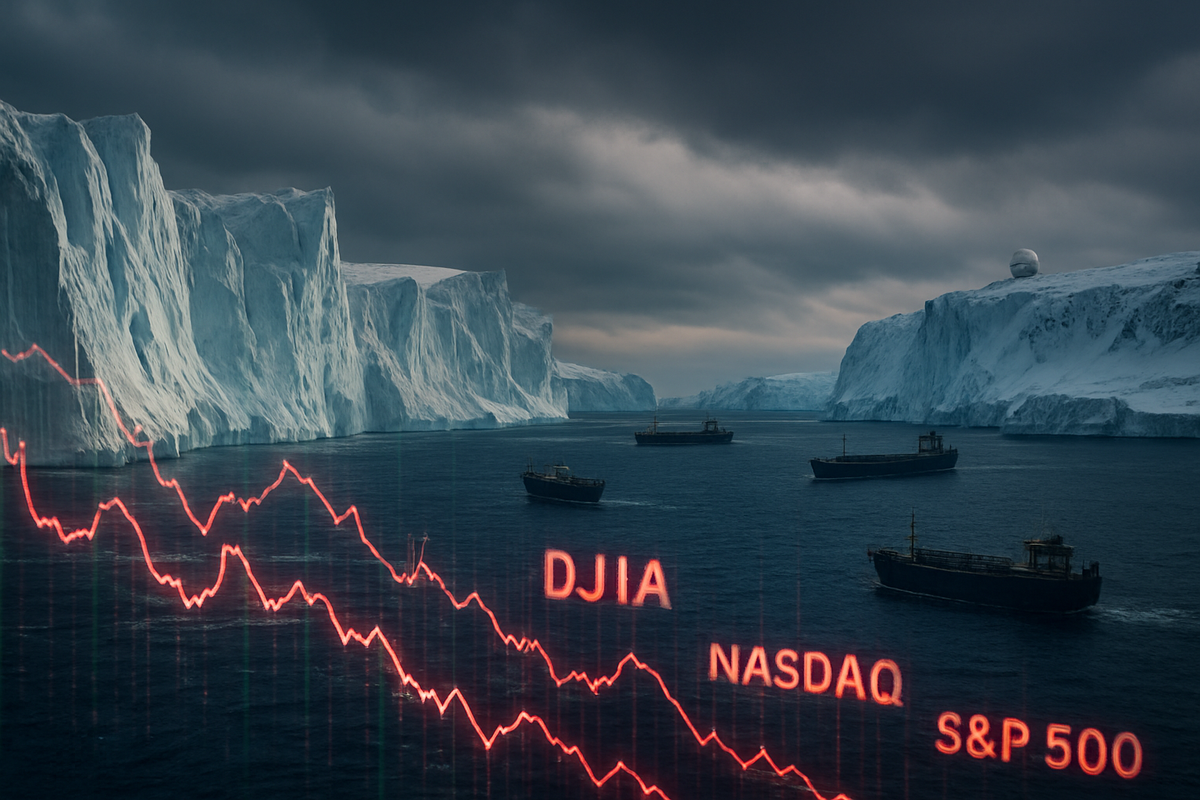
When markets opened after the Martin Luther King Jr. holiday on Tuesday, January 20, the reaction was swift and violent. The S&P 500 plummeted 2.1% in a single session, its worst one-day performance in months, as investors realized the "Greenland question" was no longer a rhetorical flourish but a concrete policy directive. The Nasdaq Composite (INDEXNASDAQ: .IXIC) fell even further, dropping 2.4% on fears of retaliatory European taxes on American digital services. The tension only broke on January 21 at the World Economic Forum in Davos, where a "framework of a future deal" was announced between the U.S. and NATO Secretary-General Mark Rutte, leading to the current suspension of the tariffs.
Key stakeholders, including Danish Foreign Minister Lars Løkke Rasmussen and Greenlandic officials, have remained adamant that "Greenland is not for sale." However, the Davos framework has shifted the conversation toward a "Board of Peace" model, where increased U.S. basing rights and missile defense infrastructure in the Arctic may serve as a substitute for a formal purchase. The market’s 2% drop in January was a visceral reaction to the possibility of a total breakdown in NATO cooperation and the collapse of the $1.3 trillion transatlantic trade relationship.
Corporate Fallout: The Winners and Losers of the Arctic Standoff
The companies caught in the crosshairs of the Greenland escalation represent the bedrock of the global economy. Novo Nordisk (NYSE: NVO), the Danish pharmaceutical giant, saw its shares dive 9% in the immediate wake of the tariff announcement. As the "economic proxy" for Denmark, any trade friction between Washington and Copenhagen directly impacts NVO's primary revenue stream: the U.S. market for its GLP-1 weight-loss and diabetes medications. While the stock has partially recovered on strong clinical data, it remains the most visible target for potential future retaliatory measures.
In Germany, Volkswagen AG (OTC: VWAGY) and other industrial exporters faced a similar "tariff shock." The German automotive sector, already struggling with high energy costs and a transition to electric vehicles, viewed the 10% threat as an existential risk. Conversely, U.S. defense contractors like Lockheed Martin Corporation (NYSE: LMT) and Raytheon Technologies—now operating as RTX Corporation (NYSE: RTX)—have seen increased interest. The proposed "Golden Dome" missile defense system for the Arctic, a key component of the Davos framework, suggests a massive influx of federal spending that could benefit these firms regardless of the eventual status of Greenland's sovereignty.
U.S. technology leaders like Apple Inc. (NASDAQ: AAPL) and Nvidia Corporation (NASDAQ: NVDA) were not the primary targets of the U.S. administration, but they became "collateral damage" as the European Union prepared a €93 billion retaliatory package. The EU’s "anti-coercion mechanism" threatened to invalidate data-sharing agreements and impose heavy duties on American tech imports. While the Davos de-escalation saved these firms from immediate margin compression, the "Greenland Effect" has forced a permanent increase in the geopolitical risk premium applied to their European operations.
Arctic Ambitions and the New Cold War
The Greenland Tariff Escalation is not a standalone trade dispute; it is a manifestation of the "New Cold War" for Arctic supremacy. As polar ice melts, the region’s untapped mineral wealth—including rare earth elements essential for the green energy transition—and the strategic value of the Northern Sea Route have become the most valuable real estate on the planet. The U.S. move mirrors historical precedents like the 1867 purchase of Alaska, but updated for an era of global supply chains and integrated financial markets.
This event signals a broader shift in industry trends where trade policy is increasingly used as a tool for territorial and strategic expansion. The "Board of Peace" introduced by the administration at Davos suggests a new regulatory environment where traditional international law is bypassed in favor of direct, bilateral negotiations backed by the threat of market exclusion. For competitors like China and Russia, the U.S. assertion of an "Arctic Security Zone" complicates their own polar ambitions, potentially leading to a more militarized and contested Arctic environment.
The ripple effects extend beyond the eight targeted nations. Other NATO members and non-aligned trading partners are now forced to consider how their own sovereign decisions might trigger similar "security tariffs." The precedent set here—that a refusal to negotiate territory can lead to immediate, massive import duties—is a radical departure from the rules-based order that has governed the World Trade Organization (WTO) for decades, effectively rendering the WTO's dispute resolution mechanism obsolete in the face of "national security" claims.
The Road to June: What Comes Next for Investors
The immediate question for the market is whether the "Davos framework" will hold until the June 1 deadline. While the 10% tariff was stayed, the threat of a 25% jump in June remains the administration’s primary leverage. Investors should watch for the formalization of a treaty regarding U.S. basing rights in Greenland. If negotiations stall or if Denmark remains defiant on the "Board of Peace" structure, the market could see a repeat of the January volatility, with a potentially larger drawdown as the "June cliff" approaches.
Short-term, the S&P 500 is likely to remain in a period of "choppy consolidation." The index closed at 6,953 on February 11, still nearly 1% below its pre-crisis highs. Strategic pivots are already underway in corporate boardrooms; European exporters are reportedly accelerating plans to move production facilities to the U.S. to bypass potential "Arctic duties," a trend known as "near-shoring" or "friend-shoring." This could lead to a capital expenditure boom in the U.S. industrial belt but at the cost of long-term global efficiency.
The most likely scenario is a series of "soft" agreements that increase U.S. military and economic influence in Greenland without a formal change in the map. However, the "tail risk"—a full-blown trade war with the EU—is now a permanent fixture of the investment landscape. Opportunities may emerge in the mining sector, specifically companies like Freeport-McMoRan (NYSE: FCX) or MP Materials Corp. (NYSE: MP), as the race to secure Greenland’s mineral deposits intensifies through diplomatic or corporate means.
Market Outlook: The Lasting Impact of the Greenland Gambit
The events of early 2026 have redefined the boundaries of trade and territory. The key takeaway for investors is that the "globalization era" of predictable, rules-based trade is being replaced by an era of "sovereignty-based trade," where political demands can disrupt supply chains overnight. The 2% market drop in January was more than just a dip; it was a realization that the largest economy in the world is willing to use its consumer base as a geopolitical pawn.
Moving forward, the market will remain sensitive to every social media update and diplomatic leak concerning the "Board of Peace." The significance of the Greenland Tariff Escalation lies in its audacity—it has proven that even the closest of allies are not immune to "America First" leverage. Investors should monitor the EUR/USD exchange rate and Danish bond yields as leading indicators of stress in the transatlantic relationship.
In the coming months, the focus will shift from the immediate threat of 10% tariffs to the long-term feasibility of the Davos agreement. If a treaty is signed by May, we may see a "sovereignty relief rally" that carries the S&P 500 to new record highs. However, if the rhetoric sharpens as June approaches, the "Greenland Gambit" could become the catalyst for a broader global recession. For now, the world waits to see if the Arctic ice will thaw, or if a new era of trade protectionism has just begun.
This content is intended for informational purposes only and is not financial advice.