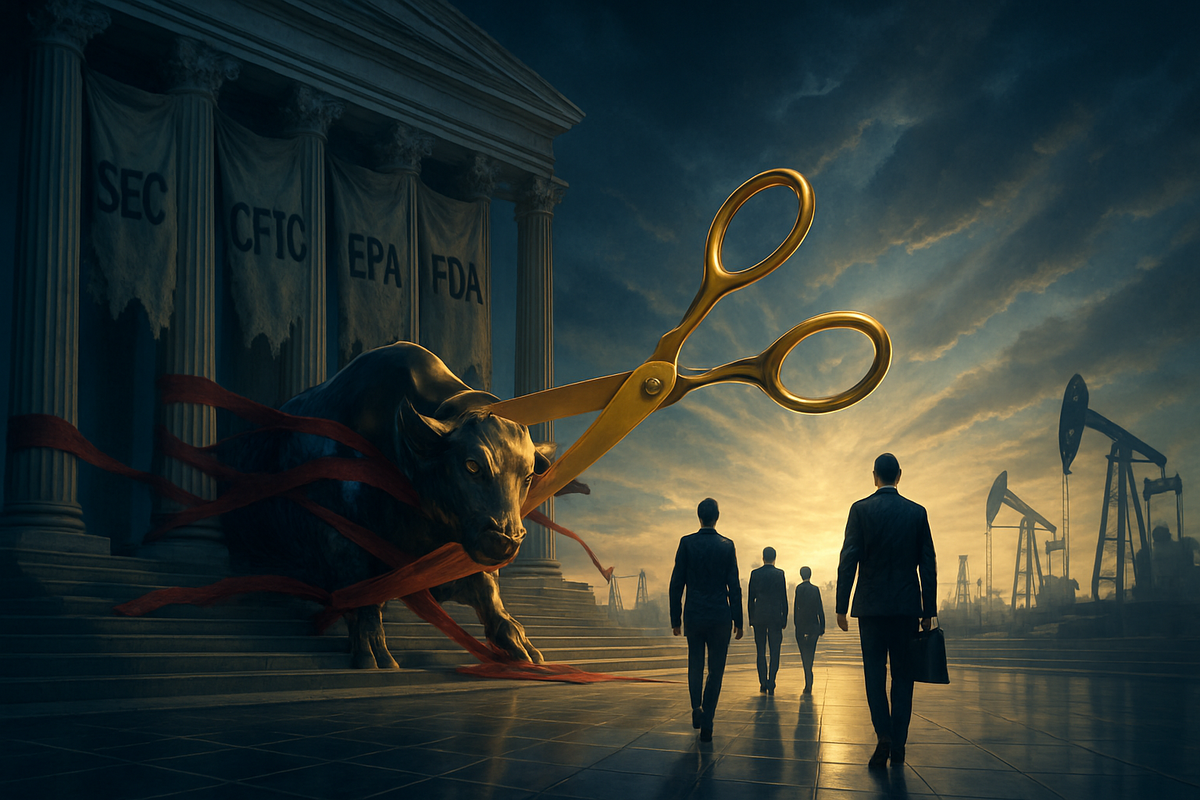
As the Trump administration enters its second year, a seismic shift in the American legal and economic landscape is reaching a fever pitch. What began as a series of "Day One" executive orders has evolved into a massive, coordinated legal offensive by U.S. corporations to dismantle the regulatory framework of the previous four years. Dubbed by supporters as the "Liberation Day" lawsuits—following the administration’s April 2nd branding of its new trade and economic policies—this wave of litigation is being hailed by Wall Street as a generational tailwind for corporate earnings and domestic industrial growth.
Investors are now witnessing a "legal deregulation" phase that is effectively rewriting the cost of doing business in the United States. Following the inauguration in January 2025, the court system has become the primary battleground for the "Great Regulatory Purge," with the U.S. Chamber of Commerce and major industry groups filing hundreds of petitions to vacate rules ranging from environmental mandates to labor protections. As of February 11, 2026, the S&P 500 sits near record highs, buoyed by the prospect of a leaner, less-intervened corporate environment.
The Litigation Surge: From Climate to Competition
The current legal climate is defined by the strategic abandonment of defense by federal agencies. In early 2025, the Securities and Exchange Commission (SEC) shocked markets by voting to stop defending its landmark 2024 Climate Disclosure Rule in the Eighth Circuit Court of Appeals. This move left the regulation in a state of "suspended animation," where it remains technically on the books but entirely unenforced, pending a formal judicial order. This pattern has repeated across the executive branch. The Federal Trade Commission (FTC), now under new leadership, recently voted to dismiss its own appeals in Ryan LLC v. FTC, effectively allowing a Texas court’s vacatur of the nationwide non-compete ban to stand as the law of the land.
The timeline of this deregulation began in earnest on "Liberation Day"—April 2, 2025—when the administration utilized the International Emergency Economic Powers Act (IEEPA) to announce sweeping tariffs. While those tariffs faced immediate legal challenges in V.O.S. Selections, Inc. v. Trump, the administration used the resulting legal chaos as cover to systematically roll back Biden-era mandates. By mid-2025, the Department of Labor (DOL) had reverted to a 2021 standard for independent contractor classification, a move that provided immediate relief to the gig economy and logistics sectors.
The involvement of the U.S. Chamber of Commerce has been pivotal but complex. While the Chamber has acted as a primary architect of the deregulation of the administrative state, it has simultaneously found itself in the Supreme Court as a fierce adversary of the administration on trade. In the high-stakes case Trump v. V.O.S. Selections, currently being heard by the Supreme Court in February 2026, the Chamber argued that the "Liberation Day" tariffs constitute an unconstitutional delegation of taxing power. This friction highlights a divide between the administration’s protectionist trade agenda and the corporate world’s desire for traditional free-market deregulation.
Winners and Losers in the Post-Regulatory Era
The primary beneficiaries of this legal pivot have been the "Old Economy" giants. Exxon Mobil Corp. (NYSE: XOM) and Chevron Corp. (NYSE: CVX) have seen their valuations swell as the Environmental Protection Agency (EPA), led by Administrator Lee Zeldin, initiated the repeal of the 2009 Endangerment Finding. This move strips the legal foundation for federal carbon mandates, allowing energy firms to reallocate billions from compliance to exploration and production. Similarly, the financial sector, led by JPMorgan Chase & Co. (NYSE: JPM), has thrived under a "merger-friendly" FTC that has replaced aggressive antitrust enforcement with a more traditional focus on consumer welfare.
However, the "Great Rotation" has not been kind to everyone. The professional services and legal technology sectors have faced an existential threat known as the "Anthropic Effect." In early February 2026, the release of sophisticated AI legal agents—specifically designed to navigate the new, less complex regulatory landscape—triggered a sell-off in traditional data and legal providers. Thomson Reuters (NYSE: TRI) and RELX PLC (NYSE: RELX) saw significant pullbacks as investors bet that the combination of deregulation and AI automation would drastically reduce the demand for high-cost legal compliance services.
Furthermore, the renewable energy sector has faced a dual blow. The gutting of Biden-era climate rules, combined with the "One Big Beautiful Bill Act" (OBBBA) which prioritizes traditional domestic manufacturing, has redirected capital away from ESG-focused funds. While the OBBBA made the 2017 tax cuts permanent and reinstated 100% bonus depreciation—a massive win for capital-intensive firms—it also redirected green energy subsidies toward broader industrial R&D.
Wider Significance and Historical Precedents
The current legal environment marks the definitive end of the "Chevron Deference" era, following the Supreme Court's 2024 decision in Loper Bright. This shift has empowered corporations to challenge the "alphabet soup" of agencies with unprecedented success. We are seeing a fundamental rebalancing of power between the executive branch and the judiciary. Historically, this mirrors the deregulatory push of the late 1970s and early 1980s under Reagan, but at a velocity amplified by modern technology and a more ideologically aligned judicial branch.
The ripple effects extend far beyond U.S. borders. As the U.S. dismantles its climate and labor regulations, European and Asian markets are grappling with a "regulatory gap." This has led to concerns of a "race to the bottom" in global standards, but from the perspective of many domestic CEOs, it is a necessary restoration of American competitiveness. The policy implication is clear: the administration believes that by "liberating" companies from the administrative state, they can trigger a domestic manufacturing renaissance that outweighs the volatility of their own trade policies.
The Road Ahead: Supreme Court Rulings and Market Outcomes
The short-term outlook depends heavily on the Supreme Court’s decision in the tariff cases. If the Court rules against the administration, it could trigger a fiscal crisis, requiring the government to refund upwards of $100 billion in collected duties. Such an event would likely spark a "Truss-style" volatility in the bond market, which is already showing signs of a "bear steepener" due to the $12.9 trillion in tax provisions contained within the OBBBA.
Long-term, corporations must adapt to a "litigation-first" regulatory environment. Strategic pivots are already underway, with many firms moving their compliance departments into "efficiency mode" using AI. The market opportunities lie in domestic industrials and materials, which stand to gain the most from the OBBBA’s R&D expensing. However, the risk of a "legal pendulum" remains—if the next administration reverses these moves, the lack of a stable regulatory floor could lead to a massive "regulatory whiplash" by the end of the decade.
Summary: A Market Refined by Lawsuits
The "Liberation Day" lawsuits represent more than just a series of court cases; they are the manifestation of a new corporate philosophy that views regulation as a negotiable obstacle rather than a fixed rule. For investors, the key takeaways are the permanence of the TCJA tax cuts via the OBBBA and the massive reduction in compliance-related capital expenditures for the energy and financial sectors.
Moving forward, the market will likely remain bifurcated. While domestic-focused industrial stocks are poised for a multi-year run, the tech and legal services sectors must prove they can remain relevant in an era where AI agents can handle the bulk of a diminished regulatory burden. Investors should watch the Supreme Court's rulings on presidential tariff power and the FTC's "removal power" cases in the coming months, as these will define the limits of the new "legal deregulation" era.
This content is intended for informational purposes only and is not financial advice.