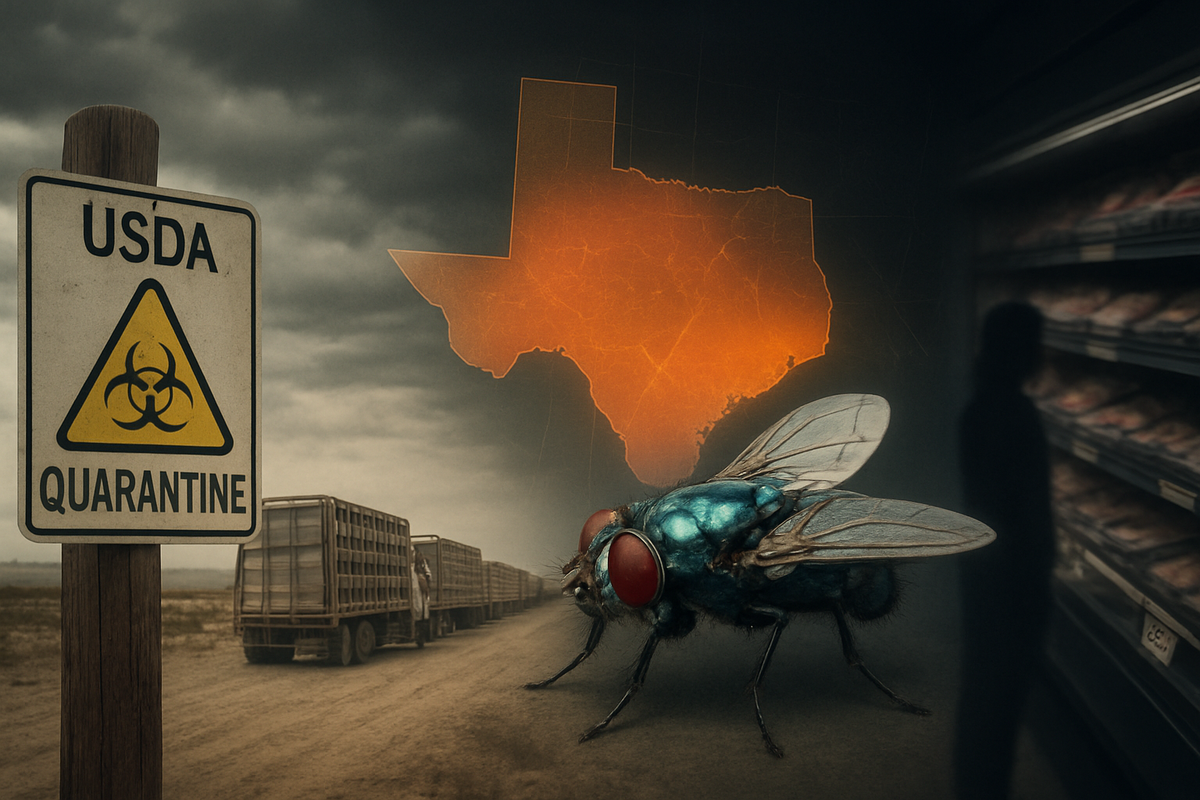
The North American cattle industry has entered a state of emergency following the U.S. Department of Agriculture’s (USDA) decision to indefinitely suspend all live cattle imports from Mexico. This drastic measure comes as the New World screwworm (NWS)—a devastating, flesh-eating parasite—has been detected within 200 miles of the U.S.-Mexico border in the state of Tamaulipas. For a U.S. market already reeling from the smallest domestic cattle herd in 75 years, the loss of nearly 1.5 million annual head of Mexican feeder cattle has sent shockwaves through the supply chain, pushing beef prices to historic highs and forcing a radical shift in national agricultural policy.
The immediate fallout is being felt most acutely in the American Southwest, where feedlots that rely on Mexican calves are facing empty pens and skyrocketing "basis" prices. As of February 11, 2026, retail ground beef prices have surged to a national average of $7.85 per pound, leaving consumers to grapple with the reality of a "beef deficit." While the USDA and state officials move to fortify the border with a new sterile fly dispersal facility in Texas, the industry warns that the supply gap created by the import ban will likely persist for years, fundamentally altering the economics of the American dinner table.
The Parasitic Advance: The Timeline of the 2026 Crisis
The return of the New World screwworm to the North American frontier is the culmination of a two-year migration that began in the Darien Gap and moved steadily through Central America. By late 2025, the "biological barrier" that had successfully kept the pest in Panama for decades finally collapsed under the weight of climate-driven migration and shifting trade patterns. The USDA’s Animal and Plant Health Inspection Service (APHIS) moved from "heightened surveillance" to "emergency suspension" in late January 2026, after Mexican authorities confirmed active infestations in Tamaulipas and Nuevo León.
The urgency of the situation was underscored last week when USDA inspectors identified screwworm larvae in a horse imported from Argentina at a quarantine station in Florida. While that specific case was contained, it served as a wake-up call regarding the vulnerability of U.S. ports of entry. In response, Texas Governor Greg Abbott issued a disaster declaration for the border counties, mobilizing the Texas Department of Agriculture to conduct mandatory inspections of all livestock moving north of the Rio Grande.
Key stakeholders, including the National Cattlemen’s Beef Association (NCBA), have largely supported the USDA’s aggressive stance, despite the economic pain. "The alternative to a border closure is a domestic infestation that would cost the U.S. livestock industry billions of dollars in annual losses," said a spokesperson for the USDA. "We are fighting a war of attrition against a pest that hasn't been a resident on U.S. soil since 1982. We cannot afford to lose."
The Corporate Toll: Meatpackers and Retailers in the Crosshairs
The disruption of the U.S.-Mexico cattle trade has created a stark divide between winners and losers in the public markets. Tyson Foods (NYSE: TSN) has emerged as one of the most visible casualties of the supply crunch. Heavily dependent on a steady flow of "fed cattle" to keep its massive processing plants efficient, Tyson recently projected an adjusted operating loss of up to $600 million for its beef segment in fiscal 2026. The company has already been forced to reduce shifts at its Amarillo, Texas, facility, citing the "supply desert" created by the lack of Mexican imports.
In contrast, JBS S.A. (OTC: JBSAY) has utilized its global footprint to mitigate the North American crisis. While its U.S. division is suffering from the same margin compression as Tyson, JBS has increased exports from its Brazilian and Australian facilities to fill the gap in the global market. However, the company still faces domestic pressure as the Department of Justice continues to monitor meatpacker margins amidst the record-high retail prices. Meanwhile, Hormel Foods (NYSE: HRL) is navigating a difficult landscape; as a major producer of value-added beef products, it is facing double-digit increases in raw material costs, which it is passing on to consumers via price hikes on branded goods.
On the retail and foodservice side, the pressure is even more immediate. Texas Roadhouse (NASDAQ: TXRH), a steakhouse chain known for its fixed-price value proposition, saw its stock dip recently as analysts factored in the projected $260-per-hundredweight cost for fed cattle. In the grocery aisles, Walmart (NYSE: WMT) and Kroger (NYSE: KR) are reporting a significant "consumer trade-down" effect. Internal data suggests that as beef prices climb toward $10 per pound for choice cuts, shoppers are pivoting en masse to poultry and pork, benefiting companies like Pilgrim’s Pride (NASDAQ: PPC).
A Perfect Storm: Cattle Shortages and Regulatory Shifts
The screwworm crisis does not exist in a vacuum; it has collided with a pre-existing structural shortage in the U.S. cattle industry. The January 2026 USDA Cattle Inventory Report revealed that the U.S. herd has fallen to 86.2 million head—the lowest level since 1951. Decades of drought in the Southern Plains and high feed costs had already incentivized ranchers to liquidate their herds. The Mexican import ban has effectively removed the "safety valve" that usually helps the U.S. market compensate for domestic shortages.
This event mirrors the 2003 "Mad Cow" (BSE) crisis in its scale of market disruption, but with a more complex biological component. Unlike BSE, which was managed through feed regulations, the screwworm requires a massive, ongoing entomological intervention. The federal government has responded with a $750 million emergency funding package, which includes the expansion of the "Sterile Insect Technique" (SIT)—a process where millions of sterile flies are released to mate with wild populations, effectively crashing the birth rate of the parasite.
The regulatory implications are also shifting toward international trade. To stabilize the ground beef supply, the White House recently signed an executive order to temporarily expand tariff-free beef imports from Argentina, a move that has drawn fire from domestic producer groups but is seen as a necessary "inflation killer" for the 2026 fiscal year.
The Edinburg Solution: Sterile Flies and the Path Forward
The long-term resolution to the crisis rests on the shoulders of a tiny insect. On February 9, 2026, U.S. officials held a ribbon-cutting ceremony for a new $8.5 million sterile fly dispersal facility at Moore Air Base in Edinburg, Texas. This facility is the first of its kind on U.S. soil in over forty years and serves as the primary hub for dispersing sterile pupae along the Rio Grande. By releasing up to 100 million sterile flies per week, the USDA hopes to create a "biological wall" that prevents the NWS from establishing a foothold in Texas.
In the short term, however, the strategy requires patience. A second, larger production plant is slated for groundbreaking in late 2026, which would eventually produce 300 million flies weekly and end the U.S. reliance on the sole existing production site in Panama. Until this facility is operational, the border is likely to remain closed to live cattle, forcing U.S. feedlots to adapt to a "smaller and more expensive" reality. Strategic pivots are already occurring, with some Northern Plains operations looking to increase imports from Canada to offset the southern deficit.
Market Outlook and Investor Takeaways
The New World screwworm crisis of 2026 is more than a localized agricultural hurdle; it is a systemic shock to the North American protein market. The USDA's decision to halt Mexican imports has effectively placed a floor under beef prices for the foreseeable future. While the opening of the Edinburg facility offers a light at the end of the tunnel, the biological reality of the pest means that a full reopening of the border is likely 18 to 24 months away.
Investors should closely watch the quarterly earnings of major meatpackers for signs of further plant consolidations or shifts toward alternative proteins. Additionally, the success or failure of the sterile fly barrier in northern Mexico will be the primary indicator for when cattle futures might begin to normalize. For now, the "Beef Siege" continues, and the American consumer should prepare for a prolonged period of record-breaking prices at the butcher counter.
This content is intended for informational purposes only and is not financial advice.