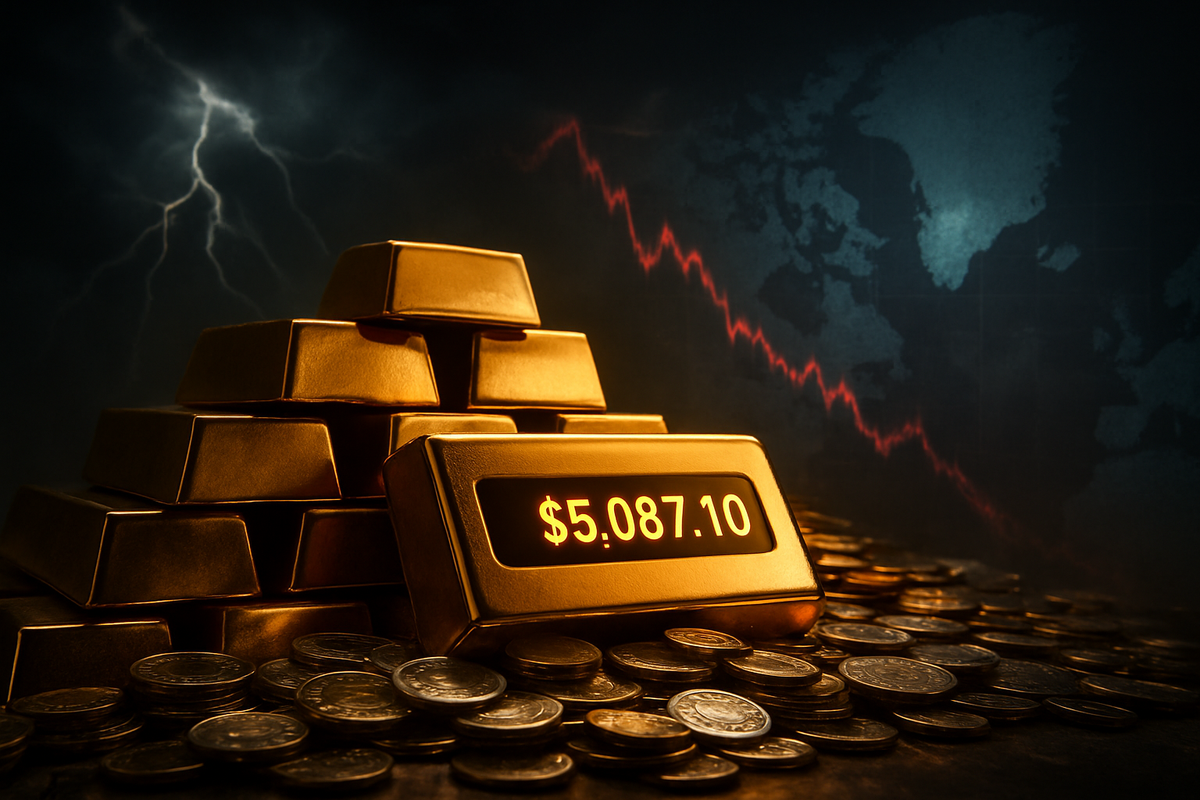
In a historic session that has redefined the boundaries of the precious metals market, spot gold surged to a fresh all-time high of $5,087.10 on February 11, 2026. This monumental ascent past the $5,000 psychological barrier marks a watershed moment for global finance, driven by an aggressive flight to safe-haven assets. As investors grapple with the intensifying "Warsh era" volatility and a geopolitical landscape fractured by unprecedented trade threats, the yellow metal has transitioned from a mere inflation hedge to a mandatory insurance policy against systemic instability.
The implications of this rally are profound, signaling a deepening of the "sell America" trade that has seen global capital migrate away from traditional U.S. equities and Treasuries. While gold stole the spotlight, silver followed suit with a dramatic 3.9% jump, closing at $83.53 per ounce. This dual-metal surge underscores a broad-based lack of confidence in fiat stability as the world monitors the escalating "Greenland tariff" standoff and a fundamental pivot in Federal Reserve leadership.
The Convergence of Chaos: Tariffs, Tensions, and the Warsh Pivot
The road to $5,087.10 was paved by a series of high-stakes geopolitical maneuvers and a radical shift in U.S. monetary policy. At the heart of the current market anxiety is the "Greenland tariff" threat, a provocative diplomatic campaign by the U.S. administration that has threatened 10% to 25% tariffs on a coalition of European nations unless the U.S. is permitted to purchase the Arctic territory. This standoff has not only strained transatlantic relations but has also triggered a defensive posture among global fund managers, who view the potential for a full-scale trade war with Europe as a terminal threat to global supply chains.
Simultaneously, the transition into the "Warsh era" at the Federal Reserve has introduced a new brand of market turbulence. Following the nomination of Kevin Warsh to lead the central bank, markets have been forced to price in a "monetary barbell" strategy. Warsh’s proposed regime—advocating for a massive $3 trillion reduction in the Fed's balance sheet while simultaneously keeping interest rates low to stimulate AI-driven productivity—has left investors in a state of whiplash. This policy uncertainty, combined with the "Sell America" sentiment, created a perfect vacuum that only hard assets could fill.
The timeline leading to today’s record began in late 2025, when gold first breached the $4,000 mark. By January 2026, the rhetoric surrounding the Greenland acquisition intensified, and the initial "Warsh shock" caused a temporary but violent correction in precious metals. However, the market quickly realized that the proposed balance sheet tightening would likely drain liquidity from risk assets faster than from "real" money. By early February, a relentless bid from central banks in the Global South, combined with a stampede of retail and institutional investors, catapulted gold through the final resistance levels to today’s record.
Winners and Losers in the New Golden Age
The ascent to $5,000 gold has created a stark divergence in the equity markets. The most immediate beneficiaries are the primary producers and royalty companies. Newmont Corporation (NYSE: NEM) and Barrick Gold (NYSE: GOLD) have seen their margins expand to levels previously thought impossible, with their share prices surging in tandem with the spot price. Streaming companies like Wheaton Precious Metals (NYSE: WPM) are also reaping the rewards of high-volume contracts negotiated when prices were nearly 50% lower.
Conversely, U.S. multinationals with heavy exposure to European markets are feeling the squeeze. Companies like Ford Motor Company (NYSE: F) and Apple Inc. (NASDAQ: AAPL) are facing the double-edged sword of potential retaliatory tariffs and a weakening "Sell America" sentiment that has suppressed their domestic valuation premiums. Furthermore, asset managers like State Street Corporation (NYSE: STT), which oversees the SPDR Gold Shares (NYSEARCA: GLD), are seeing record inflows even as their traditional equity-weighted portfolios face significant headwinds.
Silver’s rise to $83.53 has also revitalized the industrial and mining sectors. Pan American Silver (NASDAQ: PAAS) and the iShares Silver Trust (NYSEARCA: SLV) have become focal points for investors looking for "high-beta" exposure to the precious metals rally. However, for industrial manufacturers in the solar and semiconductor space, these soaring input costs are beginning to eat into profitability, potentially slowing the very technological growth that the "Warsh Fed" hopes to capitalize on.
Broader Significance: De-Dollarization and the 1979 Parallel
The current rally is more than just a price spike; it is a reflection of a fundamental shift in the global monetary order. Analysts are increasingly drawing parallels to the 1979–1980 period, when a combination of oil shocks, rampant inflation, and geopolitical crises pushed gold to then-unthinkable highs. However, the 2026 rally is distinct because it is occurring in an era of "de-dollarization." Central banks, particularly those in the BRICS+ bloc, have been aggressive buyers of gold, treating it as a neutral reserve asset that cannot be sanctioned or devalued by unilateral trade policy.
This event also highlights a growing skepticism toward the "American Exceptionalism" that has underpinned the U.S. dollar for decades. The "sell America" trade suggests that the market no longer views U.S. Treasuries as the "risk-free" asset of last resort. Instead, the "Greenland tariff" threats have signaled to the world that U.S. economic policy has become increasingly unpredictable, prompting a structural move into gold as a form of "geopolitical insurance."
The regulatory implications are also beginning to surface. There are already whispers in Washington about the potential for a "windfall tax" on precious metal miners or even a domestic gold-reporting requirement to curb capital flight. Historically, such moves have only served to drive prices higher as they further erode trust in the traditional financial system.
The Path Ahead: Can the Rally Sustain $5,500?
Looking forward, the market is divided on whether gold will stabilize or continue its parabolic trajectory. In the short term, much depends on the official confirmation of the Greenland tariff schedule. If the administration follows through with the 25% levy, gold could easily test the $5,500 level by the end of the second quarter. Conversely, a diplomatic de-escalation could lead to a healthy correction as "fear money" rotates back into depressed equities.
The "Warsh Fed" will also be a critical factor. If the transition in May 2026 results in a more hawkish balance sheet reduction than anticipated, it could suck the oxygen out of the gold rally by significantly strengthening the dollar. However, if the "Productive Dovishness" model leads to higher-than-expected inflation without the promised productivity gains, gold’s role as an inflation hedge will be re-emphasized, potentially pushing it toward $6,000.
Investors should prepare for a period of extreme volatility. Strategic pivots may be required, shifting from general equity exposure to "hard asset" proxies and companies with localized supply chains that are insulated from the Greenland-related trade wars. The emergence of gold as a $5,000+ asset creates a new floor for the global economy, one where the cost of "safety" has never been higher.
Closing Thoughts: A New Anchor in a Turbulent Sea
The milestone of $5,087.10 gold is a sobering reminder of the volatility that defines the current era. It represents a collective vote of no confidence in the prevailing geopolitical and monetary status quo. As we navigate the "Warsh era" and the complexities of modern trade warfare, the flight to gold and silver remains the most visible symptom of a global economy in transition.
For the market moving forward, the focus will remain on two fronts: the Federal Reserve's balance sheet and the North Atlantic diplomatic cables. If the "Sell America" trade continues to gain momentum, today’s record might soon be viewed as merely the beginning of a much larger structural revaluation. For now, investors should watch the $5,000 level closely; it is no longer a ceiling, but the new foundation of a fractured financial world.
This content is intended for informational purposes only and is not financial advice.