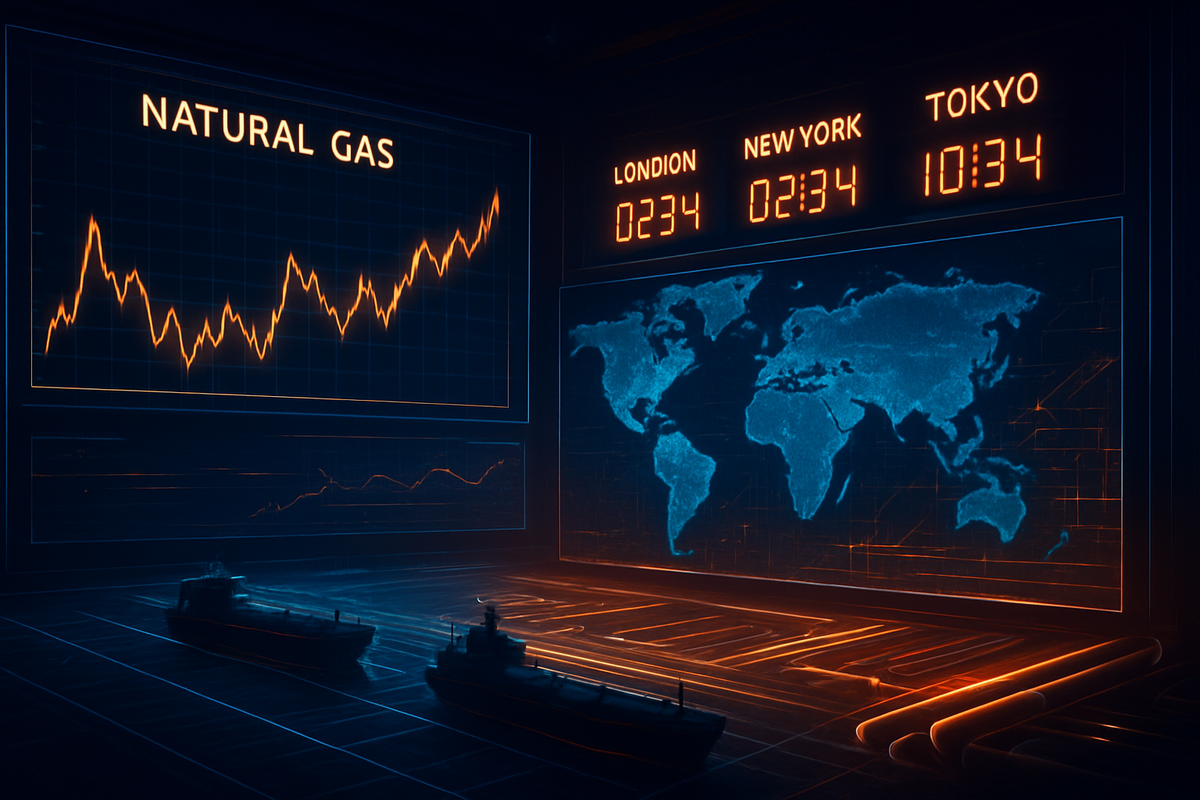
In a move that signals the definitive transformation of European natural gas from a regional utility into a global commodity, the Intercontinental Exchange (NYSE: ICE) officially announced today, January 8, 2026, that it will extend the trading hours for its Dutch Title Transfer Facility (TTF) benchmark to 22 hours a day. Starting February 23, 2026, the market will open at 01:50 CET and close at 00:00 CET, a dramatic expansion from the traditional 10-hour window that has governed European gas trading for decades.
This shift is more than a simple schedule change; it is a strategic maneuver to align European gas pricing with the 24-hour cycles of the global Liquefied Natural Gas (LNG) market. By nearly eliminating the "dark hours" when European markets were closed but North American and Asian markets remained active, ICE is positioning the TTF as the central nervous system for global gas arbitrage, directly challenging the dominance of the U.S. Henry Hub and the Asian Japan-Korea Marker (JKM).
Globalizing the Benchmark: A Timeline of the 22-Hour Shift
The decision to move to a 22-hour trading day is the culmination of a three-year evolution that began with the energy crisis of 2022. Following the loss of Russian pipeline gas, Europe became the world’s "balancing market," relying heavily on flexible LNG cargoes. This shift necessitated a pricing mechanism that could react in real-time to events in the Gulf of Mexico or the South China Sea. Throughout 2025, ICE saw record-breaking activity, with TTF futures and options volume surpassing 103 million contracts, prompting heavy lobbying from global trading houses for a window that better captures the overlap with Asian and U.S. sessions.
The implementation, set for late February, follows months of consultation with regulators and market participants. Historically, the TTF operated from 08:00 to 18:00 CET, a schedule that left traders blind to overnight volatility in the U.S. or early-morning demand spikes in Tokyo. Under the new regime, the 01:50 CET start will capture the peak of Asian trading, while the midnight close ensures that European traders remain active through the bulk of the U.S. trading day.
Key stakeholders, including major European utilities and global investment banks, have largely welcomed the move as a necessary step for "cross-basin" hedging. However, the transition has not been without its detractors. Initial reactions from smaller brokerage firms suggest concern over the technical and human costs of maintaining a nearly nonstop trading desk, with some warning that the move favors massive, technologically advanced "supermajors" over smaller regional players.
Winners, Losers, and the Operational Burden
The clear winner in this expansion is the Intercontinental Exchange (NYSE: ICE) itself. By extending hours, the exchange is likely to capture higher transaction volumes and solidify the TTF’s status as the world’s most influential gas price. Large-scale global energy players like Shell plc (NYSE: SHEL), BP p.l.c. (NYSE: BP), and TotalEnergies SE (NYSE: TTE) also stand to benefit significantly. These "supermajors" already operate 24-hour global trading desks and possess the sophisticated algorithmic tools required to manage risk across multiple time zones simultaneously. For them, the 22-hour TTF is an opportunity to execute complex arbitrage trades with less "slippage" between markets.
Conversely, the move presents a daunting challenge for mid-sized European utilities and smaller trading boutiques. These firms, which have historically operated on a standard European workday, now face the prospect of "liquidity fragmentation." There is a legitimate fear of a "liquidity mirage," where the market appears open but trading is so thin during the new overnight hours that bid-ask spreads widen significantly. This could lead to erratic price movements that trigger stop-loss orders or margin calls during hours when many firms are understaffed.
Furthermore, clearing members are bracing for the operational strain of 22-hour risk management. The timing of margin calls—traditionally settled during European banking hours—becomes a complex puzzle when a price shock can occur at 3:00 AM CET. Firms without automated collateral management systems may find themselves at a disadvantage, potentially leading to a consolidation of the market as smaller players are forced to clear through larger, more technologically equipped intermediaries.
Redefining the Global Gas Map
This extension fits into a broader industry trend where natural gas is increasingly mirroring the maturity and liquidity of the global crude oil market. Much like Brent crude serves as a global benchmark despite its North Sea origins, the Dutch TTF is shedding its "Dutch" identity to become a global proxy for LNG. This is particularly relevant as U.S. LNG exports, led by companies like Cheniere Energy (NYSE: LNG), are projected to grow by another 25% through 2026. The 22-hour TTF ensures that when a cargo leaves the U.S. Gulf Coast, its value can be hedged against European prices in real-time, regardless of the hour.
The shift also carries significant regulatory implications. The European Securities and Markets Authority (ESMA) will likely increase its scrutiny of overnight trading to prevent market manipulation in low-volume windows. Historically, thin markets are susceptible to "banging the close" or other predatory trading practices. By moving to a near-24-hour model, the TTF may face new requirements for circuit breakers and volatility interruptions to prevent "flash crashes" during the Asian-European overlap.
The Road Ahead: 24/7 Trading and Algorithmic Dominance
In the short term, the market should expect a period of "settling in," where liquidity during the new 01:50 – 08:00 CET window remains sporadic. Traders will likely use this period primarily for reacting to major news rather than high-volume positioning. However, in the long term, the 22-hour day will almost certainly accelerate the adoption of Artificial Intelligence and algorithmic trading in the gas sector. As the human element is stretched thin, the "trading bots" will take over the graveyard shifts, potentially leading to a more efficient, albeit more clinical, market.
We may also see a strategic pivot in how price reporting agencies (PRAs) assess the market. If a significant amount of price discovery begins to happen outside of the traditional 16:30 CET "Market on Close" window, the industry may eventually move toward a volume-weighted average price (VWAP) that spans the entire 22-hour session. This would represent a fundamental change in how gas contracts are settled globally.
Summary and Investor Outlook
The extension of Dutch TTF trading to 22 hours is a landmark event that confirms the globalization of the European energy landscape. It offers the promise of better price discovery and more efficient hedging for global LNG flows, but it arrives with the baggage of increased operational risk and the potential for overnight volatility.
For investors, the key takeaways are clear:
- Watch the Spreads: Monitor the bid-ask spreads during the new overnight hours (01:50 - 08:00 CET). Persistent wide spreads could indicate that the "liquidity mirage" is a reality, increasing the cost of doing business for all but the largest players.
- Tech is King: The companies best positioned to thrive are those with the technological infrastructure to handle 22-hour risk management. ICE (NYSE: ICE) and the energy supermajors like Shell (NYSE: SHEL) are the primary beneficiaries.
- Volatility Shifts: Be prepared for "overnight" price gaps to become a thing of the past, replaced by continuous, sometimes choppy, price action.
As we move toward the February 23 implementation date, the market will be watching closely to see if this "nonstop" model brings the stability ICE promises, or if it simply extends the window for market chaos.
This content is intended for informational purposes only and is not financial advice.