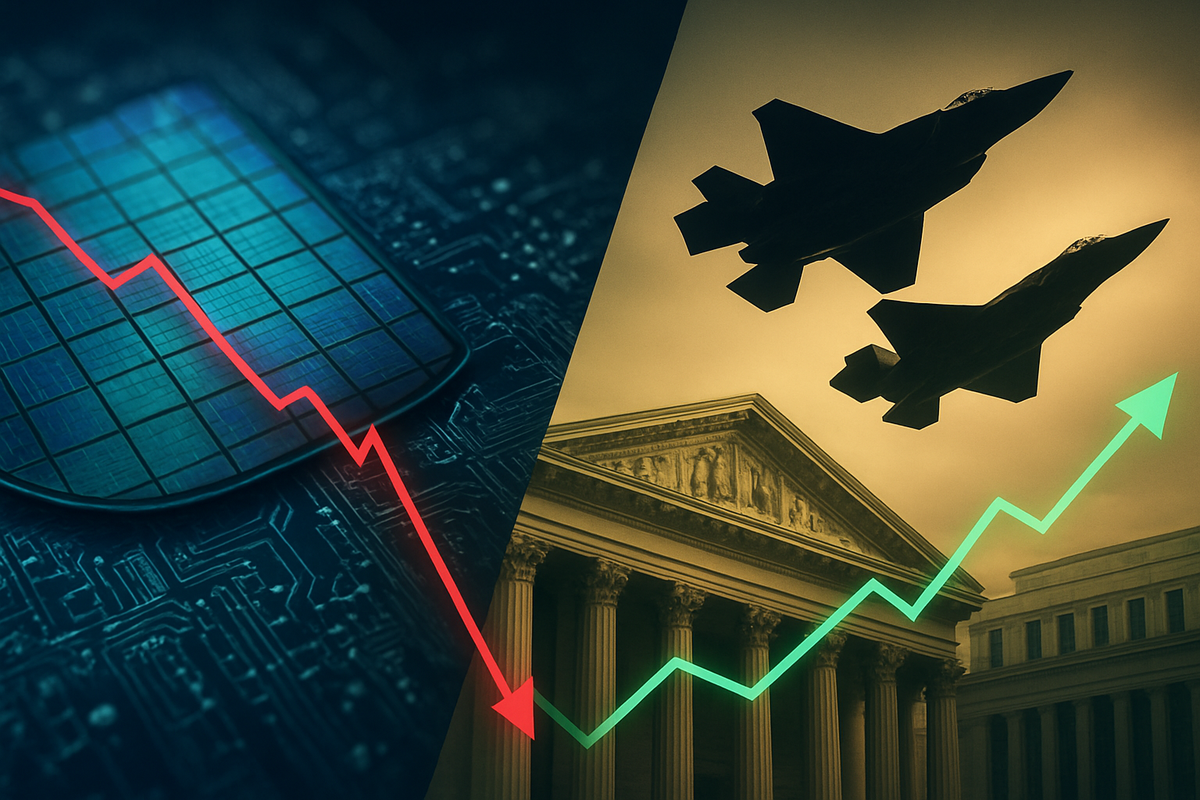
The semiconductor sector, the undisputed engine of the 2025 market rally, faced a stark reality check on January 8, 2026. After a blistering start to the year that saw several industry leaders touch all-time highs, a wave of aggressive profit-taking swept through the sector. The reversal was catalyzed by a combination of geopolitical friction in Asia and a massive structural shift in capital—the so-called "Great Rotation"—as investors moved away from high-flying tech names in favor of "real economy" sectors like defense and heavy industry.
The immediate implications are clear: the "AI at any price" mantra is being replaced by a more disciplined valuation-sensitive approach. While the fundamental demand for artificial intelligence infrastructure remains robust, the technical exhaustion of the semiconductor trade has reached a tipping point. As of midday trading, the VanEck Semiconductor ETF was down significantly, signaling a cooling period for a sector that many analysts now believe had become dangerously overextended.
The January Reversal: A Convergence of Catalysts
The sell-off on January 8, 2026, did not occur in a vacuum. It followed a week of record-breaking performance where the industry was buoyed by the emergence of "Agentic AI" applications. However, the momentum broke sharply when news surfaced of escalating trade tensions between China and Japan. China’s announcement of new export controls on critical "dual-use" materials, such as dichlorosilane, sent shockwaves through the global chip supply chain. This geopolitical uncertainty provided the perfect excuse for institutional traders to lock in gains from the previous year’s historic run.
The timeline of the decline began early in the morning session as sell orders clustered around mid-tier and specialized semiconductor players. Photronics (NASDAQ: PLAB) led the retreat, plummeting 7.6% following reports of clustered insider selling. Several high-ranking directors at the company capitalized on a 75% share price appreciation over the last six months, a move that retail investors interpreted as a signal that the stock had peaked. Similarly, Amkor Technology (NASDAQ: AMKR) saw its shares slide 5.9%, despite having reached a 52-week high of $52.88 just two days prior. The pullback in Amkor was particularly notable as it came on the heels of a major price target upgrade from Needham, suggesting that even positive analyst sentiment could not outweigh the broader desire for liquidity.
The carnage extended to the high-end equipment providers as well. Teradyne (NASDAQ: TER), a linchpin in the AI testing space, retreated 4.3% from its all-time high of $229.70. Meanwhile, Semtech (NASDAQ: SMTC) dropped 3.5%, as market participants grew wary of the company’s valuation. Despite Semtech’s growth in data center connectivity products like FiberEdge, analysts pointed to a potential margin squeeze in its legacy cellular business, leading to a "de-risking" phase ahead of the upcoming Q4 earnings season.
Winners and Losers in the New Market Regime
The primary "losers" in this shift are the growth-oriented tech funds that remained heavily overweight in semiconductors. Companies like Photronics and Amkor, which have been beneficiaries of the AI packaging and mask-making boom, are now seeing their valuations compressed as the market demands more than just "AI potential." For these firms, the challenge will be to prove that their earnings growth can outpace the rising cost of capital and the geopolitical hurdles now facing the industry.
Conversely, the "winners" of this rotation are found in the defense and financial sectors. On January 7, the White House proposed a staggering $1.5 trillion defense budget for 2027, a move that immediately redirected billions in capital toward major contractors. Northrop Grumman (NYSE: NOC) and Lockheed Martin (NYSE: LMT) surged 8.3% and 6.4%, respectively, as the market priced in a multi-year windfall for the defense industrial base. This "budget shock" acted as a massive vacuum, sucking liquidity out of the semiconductor space and into the aerospace and defense sector.
Financial institutions are also benefiting from the rotation. As the "IPO drought" of the mid-2020s finally shows signs of breaking and the yield curve steepens, banks are seeing a resurgence in activity. The financial sector (XLF) has gained over 7% in the first week of January alone. For investors, the message is clear: the market is no longer a monolithic tech trade; it is diversifying into cyclical and value-oriented plays that have been ignored for much of the last two years.
Broader Significance and Historical Precedents
This event marks a significant evolution in the current market cycle, fitting into a broader trend of "valuation fatigue." After the S&P 500 information technology sector led the market with 24% gains in 2025, institutional managers are looking for the next frontier of growth. Historically, such rotations are common after periods of extreme outperformance. The current situation mirrors the "dot-com" cooling periods of the early 2000s, where the underlying technology (the internet) continued to change the world, but the stocks associated with it required a multi-quarter "breather" to align with fundamental earnings.
The ripple effects are likely to be felt by semiconductor partners and customers. If chip stocks continue to slide, it may signal a broader cooling in capital expenditure (CapEx) for AI projects. However, the current decline seems more related to portfolio rebalancing than a fundamental collapse in demand. Furthermore, the regulatory landscape is becoming increasingly complex. The new export controls from China highlight the ongoing "chip wars," which are forcing companies to diversify their manufacturing footprints—a costly and time-consuming endeavor that is now being reflected in stock prices.
Looking Ahead: Strategic Pivots and Scenarios
In the short term, the market is bracing for the Q4 2025 earnings season, which begins in earnest in late January. Companies like Teradyne and Amkor will be under intense scrutiny to provide guidance that justifies their current multiples. If these companies can demonstrate that the "Agentic AI" wave is translating into immediate, high-margin revenue, the current sell-off may prove to be a healthy correction and a "buy the dip" opportunity for long-term investors.
Long-term, semiconductor firms may need to undergo strategic pivots. We are likely to see an increased focus on "sovereign AI" and domestic supply chain security. Companies that can successfully navigate the geopolitical minefield while maintaining their technological edge will emerge as the next generation of leaders. For the broader market, the "Great Rotation" suggests that 2026 will be a year of breadth rather than a year of tech dominance. Investors should prepare for a market where small-caps, materials, and financials play a much larger role in driving index returns.
Final Thoughts for the Investor
The profit-taking witnessed on January 8 is a reminder that no sector, no matter how revolutionary, is immune to the laws of gravity. The semiconductor industry remains the backbone of the modern economy, but the "easy money" phase of the AI rally has likely concluded. The shift toward defense and financials indicates a market that is becoming more attuned to geopolitical realities and fiscal policy shifts than to speculative growth.
As we move forward into 2026, investors should watch for the stabilization of the semiconductor indices and the outcome of the Q4 earnings calls. The key takeaway is not that the AI story is over, but that it is entering a more mature, volatile phase. Watch the $1.5 trillion defense budget developments and the Federal Reserve’s stance on interest rates in the coming months, as these macro drivers will continue to dictate where the next wave of capital will flow.
This content is intended for informational purposes only and is not financial advice.