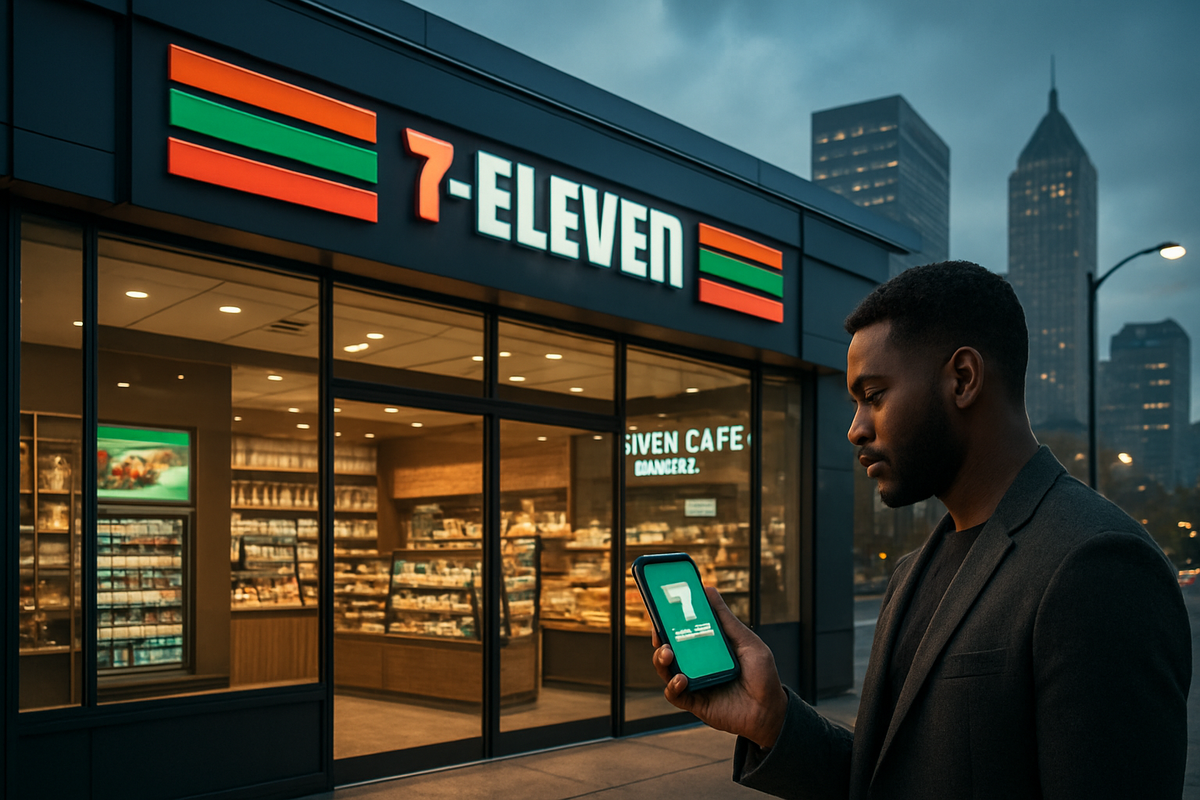
In a watershed moment for the global retail sector, Seven & i Holdings (OTC:SVNDY) reported a dramatic surge in net profit for its fiscal third quarter on January 8, 2026, signaling the early success of its "Turning Point 2026" strategy. The Japanese retail giant, which has spent the last year aggressively shedding non-core assets to focus exclusively on its convenience store empire, saw its net profit jump to 76.66 billion yen ($489 million)—a six-fold increase compared to the same period last year. This financial rebound comes as the company pivots toward a "convenience-first" model, heavily reliant on digital integration and high-margin fresh food.
While total revenue for the quarter fell by 20% to 2.434 trillion yen, the decline was a deliberate byproduct of the company’s massive restructuring. By divesting its legacy supermarket and department store operations, Seven & i has streamlined its balance sheet to better compete in a rapidly evolving global market. The market's immediate reaction has been one of cautious optimism, as investors weigh the company's newfound agility against the challenges of a standalone convenience business facing inflationary pressures in North America.
The Road to Transformation: A Timeline of Strategic Realignment
The earnings report delivered on January 8, 2026, is the culmination of a tumultuous 18-month period that saw Seven & i Holdings (OTC:SVNDY) transform from a sprawling, defensive conglomerate into a focused retail predator. The catalyst for this change was a hostile $47 billion takeover bid from Canadian rival Alimentation Couche-Tard (TSX:ATD) in late 2024. Although the bid was ultimately withdrawn in July 2025 due to what Couche-Tard described as a "persistent lack of constructive engagement," the threat forced Seven & i’s board to accelerate a radical restructuring plan that had been stalled for years.
Key to this transformation was the appointment of Stephen Hayes Dacus as the company's first foreign CEO, who spearheaded the "Turning Point 2026" initiative. Under his leadership, the company successfully completed the divestiture of its supermarket unit, York Holdings, to Bain Capital in September 2025 for approximately $5.5 billion. This move effectively removed lower-margin businesses like Ito-Yokado and Denny’s Japan from the consolidated books, allowing the company to focus its capital and management attention on the high-growth 7-Eleven brand.
The current earnings reflect the first full quarter of operations under this streamlined structure. Management highlighted the "Food Leadership" program in North America as a primary driver of value, aiming to replicate the high-quality, fresh-food success of Japanese 7-Eleven stores in the Western market. The rollout of proprietary "Seven Cafe Bakery" and made-to-order meal concepts has begun to differentiate the brand from traditional gas-station-focused competitors, providing a buffer against declining fuel margins.
Winners and Losers in the New Retail Landscape
Seven & i Holdings (OTC:SVNDY) emerges as the primary winner in this transition, having successfully defended its independence while unlocking shareholder value that had long been trapped in its conglomerate structure. By raising its full-year profit forecast to 270 billion yen, the company has proven to activist investors like ValueAct Capital that its standalone strategy can deliver superior returns. However, the pressure remains high; the company must now prove it can sustain this growth without the safety net of its diversified holdings.
On the other side of the ledger, Alimentation Couche-Tard (TSX:ATD) faces a more complex outcome. While the Canadian firm missed out on the "deal of the century," it forced its largest competitor to reveal its playbook. Couche-Tard remains a formidable predator in the sector, but with Seven & i now more lean and expensive, the Canadian giant may have to look toward other targets, such as Casey's General Stores (NASDAQ: CASY), to fuel its expansion ambitions. Casey’s, meanwhile, finds itself in an increasingly competitive "food-forward" convenience market, where Seven & i’s new digital and fresh-food capabilities pose a direct threat to its traditional dominance in the U.S. Midwest.
The broader Japanese retail sector may also see "losers" among traditional supermarket chains that are now facing a revitalized and well-capitalized York Holdings under Bain Capital’s ownership. As York Holdings operates independently, it is expected to aggressively modernize, potentially squeezing smaller regional players who lack the scale or private equity backing to compete. Conversely, tech partners and delivery platforms are seeing a windfall as Seven & i doubles down on its 7NOW delivery service, which reported double-digit growth this quarter.
A Shift in the Global Convenience Paradigm
The "convenience-first" pivot at Seven & i is more than just a corporate restructuring; it represents a fundamental shift in the global retail industry. For decades, convenience stores in the West were viewed primarily as fuel stops with a side of tobacco and snacks. Seven & i is attempting to export the "Japanese model"—where convenience stores serve as essential community hubs offering high-quality fresh meals, financial services, and logistics—to the rest of the world. This strategy places a heavy emphasis on digital integration, using data from the 7NOW app to personalize offerings and optimize supply chains.
This event fits into a wider trend of "retail-as-a-service," where the physical storefront is merely one node in a larger digital ecosystem. By integrating Seven Bank’s digital payment capabilities directly into the 7-Eleven loyalty app, the company is creating a frictionless "closed-loop" economy. This move mimics the "super-app" strategies seen in China and Southeast Asia, suggesting that the future of retail lies in the seamless merger of finance, food, and logistics.
Regulatory scrutiny is also likely to increase as Seven & i becomes a more dominant, specialized player. In the United States, the Federal Trade Commission (FTC) has already signaled a closer look at consolidation in the "last-mile" delivery and convenience space. As Seven & i pursues further "bolt-on" acquisitions of regional chains to strengthen its North American footprint, it may face higher antitrust hurdles than it did during its 2021 acquisition of Speedway.
The Path to the 2026 North American IPO
Looking ahead, the most critical milestone for investors is the planned initial public offering (IPO) of 7-Eleven Inc.’s North American operations, slated for the second half of 2026. This listing is expected to be one of the largest in the retail sector, with the goal of raising over $6.6 billion. The proceeds are earmarked for a massive 2 trillion yen share buyback program through 2030 and to fund the construction of 1,300 new "food-centric" stores across the U.S. and Canada.
In the short term, the company must navigate persistent inflationary headwinds that have begun to dampen consumer spending in the North American market. The success of the "7-Eleven 2.0" store format—which emphasizes fresh, made-to-order food over packaged goods—will be the litmus test for whether the company can maintain its premium valuation. If the U.S. consumer continues to trade down, Seven & i may need to adjust its pricing strategy or lean more heavily into its "Signature" private-label brands to maintain margins.
The long-term scenario for Seven & i involves transforming Europe into its "fourth major pillar" of growth. Having identified the European market as underserved by the Japanese-style convenience model, the company is expected to seek major partnerships or acquisitions across the continent once the North American IPO is finalized. This global expansion will require a delicate balance of local adaptation and the centralized digital control that CEO Stephen Dacus has championed.
Final Assessment: A High-Stakes Evolution
The January 2026 earnings report confirms that Seven & i Holdings (OTC:SVNDY) has successfully navigated the most dangerous period in its history. By warding off a hostile takeover and executing a complex divestiture of its legacy assets, the company has emerged as a pure-play convenience powerhouse. The 6x jump in net profit is a powerful validation of the "convenience-first" strategy, but it also sets a high bar for future performance.
Investors should closely monitor the progress of the North American IPO and the rollout of the new store formats in the coming months. The primary risk remains the execution of the "Japanese food model" in a Western context; if American consumers do not embrace high-end convenience meals at scale, the company’s heavy investment in proprietary food production could become a liability. However, for now, Seven & i has reclaimed the narrative, shifting from a target of acquisition to a leader of industry transformation.
As the market moves forward, the success of Seven & i will be judged by its ability to maintain digital momentum and integrate its global operations into a unified, tech-driven platform. For the retail industry at large, the "Seven & i experiment" will serve as a definitive case study on whether a legacy conglomerate can truly reinvent itself for the digital age.
This content is intended for informational purposes only and is not financial advice