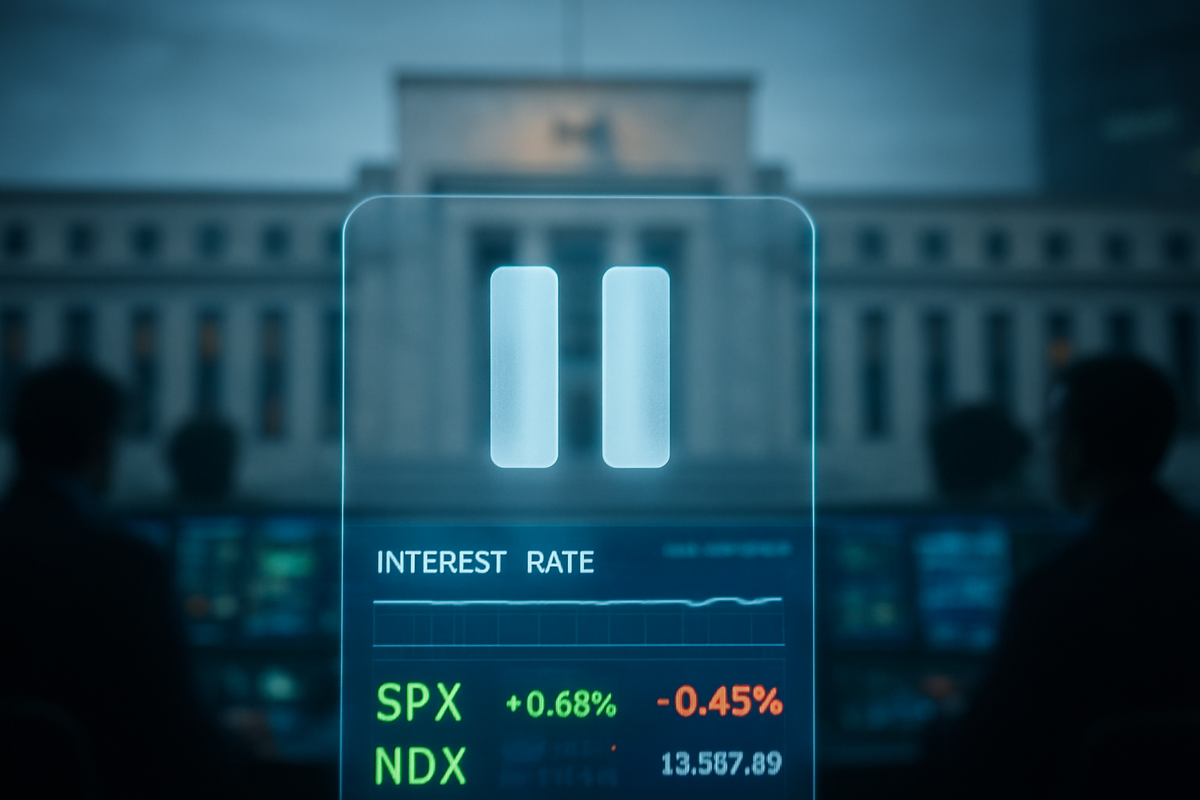
In a move that signaled a shift from aggressive easing to a strategic "wait-and-see" approach, the Federal Open Market Committee (FOMC) concluded its two-day policy meeting on January 28, 2026, by voting to maintain the federal funds rate at a target range of 3.50% to 3.75%. The decision marks the first pause in a rate-cutting cycle that had seen three consecutive reductions in late 2025, effectively putting the brakes on Wall Street’s expectations for a rapid return to "cheap money."
The immediate impact on the major indices was remarkably muted, as the markets had largely priced in the pause. The S&P 500 (INDEXSP: .INX) hovered near the psychological milestone of 7,000, closing the day virtually flat at 6,978.04. Meanwhile, the Dow Jones Industrial Average (INDEXDJX: .DJI) edged up a mere 12 points to 49,015.60, and the tech-heavy Nasdaq Composite (INDEXNASDAQ: .IXIC) outperformed slightly with a 0.20% gain. While the broad market reaction was a "ho-hum" affair, the underlying message from Fed Chair Jerome Powell was clear: the American economy is proving more resilient than expected, and the central bank is in no rush to further stimulate growth.
A "Hawkish Hold" and the Dissenting Voices
The Federal Reserve's decision to hold steady was not without internal friction, highlighting a growing debate within the central bank about the path forward. The vote was 10–2, with Governors Christopher Waller and Stephen Miran casting the dissenting votes in favor of a 25-basis-point cut. The dissenters reportedly argued that the labor market, while stable, still required additional support to prevent a late-cycle cooling. However, the majority of the committee leaned toward caution, citing a "solid pace" of economic growth and an inflation rate that—while down to 2.7%—remains "somewhat elevated" above the Fed's 2% long-term target.
In his post-meeting press conference, Chair Jerome Powell struck a confident, if slightly hawkish, tone. "The economy has once again surprised us with its strength," Powell stated, emphasizing that the Fed has removed previous language from its statement regarding "downside risks to employment." This pivot suggests that the central bank is now more concerned about sticky inflation than a potential recession. The timeline leading up to this moment has been one of gradual recalibration; after a flurry of cuts in late 2025 to head off a perceived slowdown, the Fed has now signaled a plateau that may last until at least June 2026.
Market participants noted that the Fed is navigating a complex geopolitical and domestic landscape, including potential inflationary pressures from new trade tariffs and a looming leadership transition. With Powell’s term set to expire in May 2026, this meeting was viewed by many as one of his final opportunities to solidify the "soft landing" narrative that has defined his recent tenure. The bond market reflected this stability, with the 10-year Treasury yield holding firm at 4.25%, suggesting that fixed-income investors have accepted the "higher for longer" (or at least "steady for now") reality.
Winners and Losers: AI Resilience vs. Real Estate Stagnation
While the indices remained flat, the "Fed pause" created distinct winners and losers across various sectors. NVIDIA Corporation (NASDAQ: NVDA) emerged as a notable winner, rising 1.60% to close at $191.16. The gain was fueled less by the Fed and more by fundamental catalysts, including news that the company had secured regulatory approval for advanced chip sales in key international markets. Similarly, UnitedHealth Group Inc. (NYSE: UNH) saw a 4.00% relief rally to $291.30, rebounding from a sharp sell-off earlier in the week. For these mega-cap giants, a stable interest rate environment provides a predictable backdrop for capital allocation, even if it lacks the tailwind of a fresh rate cut.
On the losing side, the residential real estate sector felt the sting of the Fed's caution. Shares of D.R. Horton, Inc. (NYSE: DHI) and other homebuilders struggled as the hope for lower mortgage rates vanished in the short term. D.R. Horton has been forced to rely on expensive "mortgage rate buy-downs" to maintain sales volume, a strategy that has increasingly squeezed profit margins. The pause means that borrowing costs for prospective homebuyers will remain elevated, keeping the housing market in a state of "affordability paralysis."
The technology sector also provided a cautionary tale of "priced for perfection." While Microsoft Corp. (NASDAQ: MSFT) finished the regular session up slightly at $481.63, the stock plunged in after-hours trading following an earnings report that highlighted massive capital expenditures on AI infrastructure. This reaction underscored a critical market reality: while the Fed’s pause provides stability, investors are now shifting their focus toward corporate earnings and the actual return on investment for AI, rather than relying on central bank liquidity to drive multiples higher.
The Broader Significance: A Shift in the "Soft Landing" Playbook
This latest Fed decision fits into a broader industry trend where central banks globally are struggling to determine the "neutral" rate—the interest rate that neither stimulates nor restrains the economy. The Jan 2026 pause suggests that the Fed believes it may have already reached that elusive target. By holding rates steady, the Fed is essentially betting that the 2025 cuts were sufficient to sustain the labor market while maintaining enough pressure to move inflation the final mile toward 2%.
Historically, a Fed pause after a brief easing cycle has often preceded a period of extended market consolidation. Comparing this to the mid-1990s "soft landing" under Alan Greenspan, the current FOMC is attempting to calibrate policy in real-time without the benefit of a clear historical precedent for the post-pandemic, AI-driven economy. The policy implication is that the "Fed Put"—the idea that the central bank will always step in to save the market with lower rates—is currently on hiatus.
Furthermore, the decision has significant ripple effects for regional banks, such as those tracked by the SPDR S&P Regional Banking ETF (NYSEARCA: KRE). These institutions are caught in a margin squeeze; the pause keeps deposit costs high, while the lack of further rate cuts prevents the refinancing activity that typically generates loan fees. As credit quality risks begin to surface in commercial real estate portfolios, the Fed’s "wait-and-see" approach puts the onus on these banks to manage their balance sheets without the help of a declining rate environment.
What Comes Next: The Path to June 2026
In the short term, all eyes will shift from the Federal Reserve to the Department of Labor and the Bureau of Economic Analysis. The upcoming February inflation data and employment reports will be the primary catalysts for market movement. If inflation continues to stall near the 2.7% mark, the "pause" could easily extend into the second half of the year. Conversely, any signs of unexpected weakness in the labor market could reignite the calls for a cut, potentially vindicating the dissenters, Waller and Miran.
Strategic pivots will be required for investors who had been betting on a continuous slide in rates. Wealth managers are likely to move away from "rate-sensitive" proxies and toward "quality" stocks with strong cash flows and low debt-to-equity ratios. The market may also see a resurgence in "carry trades" if U.S. rates remain higher than those of other G7 nations, potentially strengthening the dollar and impacting multi-national corporations' overseas earnings.
The most significant event on the horizon remains the May 2026 expiration of Jerome Powell’s term. The transition to a new Fed Chair—or a potential reappointment—will introduce a layer of political and policy uncertainty that the market has not had to grapple with for years. Until then, the "Fed pause" represents a transition from a policy-driven market to an earnings-driven one, where individual company performance will once again become the primary driver of alpha.
Final Thoughts: Navigating the Plateau
The Federal Reserve’s decision to keep interest rates steady at 3.50% to 3.75% marks a pivotal moment in the current economic cycle. By prioritizing the battle against "elevated" inflation over the urge to further stimulate a "solid" economy, the FOMC has effectively declared the end of the emergency easing phase. For the market, this represents a graduation of sorts—an opportunity to prove that it can sustain its record-breaking levels near S&P 7,000 without the constant crutch of falling borrowing costs.
Investors should watch for two key themes in the coming months: the stabilization of profit margins in rate-sensitive sectors like homebuilding and the sustainability of high-growth valuations in the face of persistent AI infrastructure costs. While the "soft landing" remains the base case, the margin for error has narrowed. The Fed has laid out its cards; now, it is up to the corporate sector and the American consumer to play the next hand in an environment where the "Great Wait" has officially begun.
This content is intended for informational purposes only and is not financial advice.