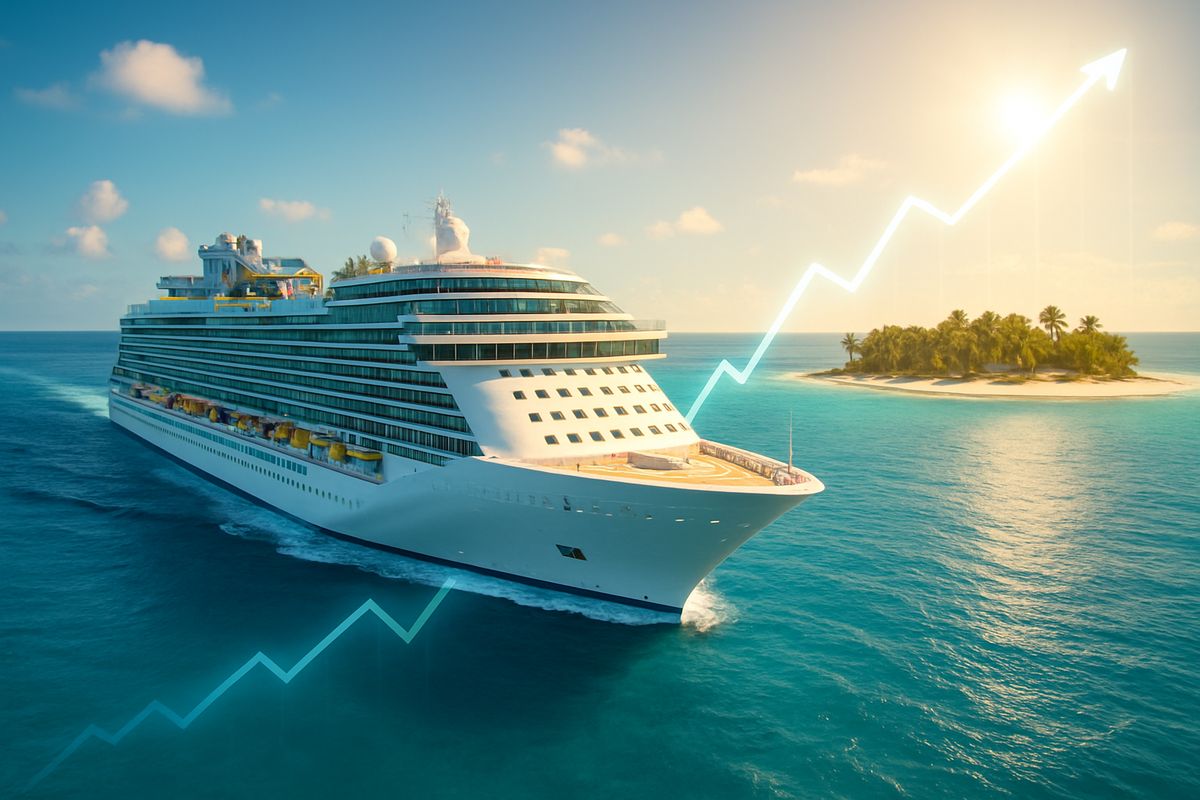
In a landmark day for the travel and leisure sector, Royal Caribbean Group (NYSE: RCL) announced record-breaking financial results for the full year 2025, sending its stock price on a meteoric ascent. As of the market close on January 29, 2026, the company’s shares surged nearly 19%, gapping up from a previous close of $291.60 to reach intraday highs of $347.51. The rally was ignited by a fourth-quarter performance that exceeded even the most optimistic analyst forecasts and a 2026 guidance package that suggests the post-pandemic "revenge travel" phase has successfully transitioned into a sustainable, high-growth era for the cruise giant.
The immediate implications of this earnings beat extend far beyond the company’s Miami headquarters. Royal Caribbean’s performance is being viewed as a bellwear for the global high-end consumer, signaling that demand for experiential luxury remains robust despite broader macroeconomic uncertainties. By posting a record full-year net income of $4.3 billion and providing a 2026 earnings-per-share (EPS) forecast that outpaced Wall Street consensus, Royal Caribbean has cemented its position as the undisputed leader in the cruise industry’s financial recovery and expansion.
A Perfect Storm of Profitability: Breaking Down the 2025 Results
The January 29, 2026, earnings call detailed a year where Royal Caribbean effectively rewrote the financial playbook for the maritime industry. The company reported a total revenue of $17.9 billion for 2025, an 8.8% increase year-over-year, driven largely by the massive success of its Icon-class vessels. Adjusted EPS for the year reached a staggering $15.64, a 33% jump from the already impressive 2024 figures. This performance was underpinned by what CEO Jason Liberty described as the "strongest Wave booking season in the history of the company," with approximately two-thirds of all 2026 capacity already booked at record pricing levels by the end of January.
The timeline leading to this moment is one of aggressive strategic pivots. After achieving its ambitious "Trifecta" goals—which included $100+ Adjusted EBITDA per APCD and double-digit ROIC—18 months ahead of schedule in mid-2024, the company launched its "Perfecta" program in March 2025. This new three-year initiative aims for a 20% compound annual growth rate in Adjusted EPS through 2027. The 2025 results serve as the first major validation of this program, demonstrating that the company can maintain high margins even as it scales its fleet with massive new ships like Star of the Seas, which entered service last year.
Stakeholders, from institutional investors to retail traders, reacted with a frenzy of buying activity on the news. Goldman Sachs and other major investment banks immediately revised their price targets upward, citing Royal Caribbean’s disciplined cost management and its ability to extract a 40% price premium on its Icon-class ships compared to the rest of its fleet. The company's operating cash flow, which hit nearly $6.5 billion in 2025, has also allowed it to pivot toward shareholder-friendly moves, including $2 billion in combined dividends and share buybacks over the past year.
Rising Tides and Competitive Anchors: Winners and Losers
Royal Caribbean Group is the primary winner in this scenario, having successfully leveraged its "Perfect Day at CocoCay" private island and high-tech fleet to capture a larger share of the vacation wallet. The company’s ability to pre-sell nearly 50% of onboard revenue before a passenger even steps onto a ship has significantly de-risked its earnings profile and improved margin visibility. Furthermore, the announcement of a new "Discovery Class" of ships, slated for 2029, suggests that Royal Caribbean’s capital expenditure is being funneled into long-term dominance rather than just debt repayment.
However, the ripple effects for competitors like Carnival Corporation & plc (NYSE: CCL) and Norwegian Cruise Line Holdings Ltd. (NYSE: NCLH) are more complex. While their stocks saw a "sympathy rally" on the general news of strong cruise demand, the performance gap between Royal Caribbean and its peers is widening. Carnival, while improving, still carries a heavier debt load and lower margins per passenger. Norwegian, which caters to a similar upscale demographic as Royal Caribbean, finds itself in a fierce arms race for shipyard slots and private destination development, where Royal Caribbean currently holds a significant first-mover advantage with its expanding "Royal Beach Club" portfolio.
On the supplier side, the winners include major shipbuilders and marine technology firms like Wärtsilä (HEL:WRT1V), which are benefiting from the renewed order books for the Discovery Class and the upcoming Legend of the Seas. Conversely, traditional land-based resort operators may feel the squeeze as Royal Caribbean continues to pull market share away from land-based vacations. The "Perfect Day Mexico" expansion set for 2027 is specifically designed to compete with Mexican land resorts, turning what was once a transportation company into a full-scale destination hospitality powerhouse.
The Evolution of Leisure: Industry Trends and Economic Significance
The record earnings of January 2026 signify a profound shift in the travel industry, marking the end of the "recovery" narrative and the beginning of a "structural growth" phase. Historically, the cruise industry was often viewed as a cyclical, lower-margin alternative to land-based vacations. Royal Caribbean has shattered this perception by integrating land-based private destinations with mega-ships that serve as floating theme parks, allowing the company to capture the entire value chain of a traveler’s vacation spending. This vertical integration is now the gold standard for the industry.
From a regulatory and policy perspective, Royal Caribbean’s success comes amid tightening environmental standards. The 2026 forecast includes significant investments in liquefied natural gas (LNG) propulsion and shore-power connectivity, showing that the company’s profitability is not coming at the expense of its decarbonization goals. This alignment with ESG (Environmental, Social, and Governance) mandates is critical for maintaining access to capital markets and institutional backing in the 2026 financial environment.
Moreover, this event sets a historical precedent for how capital-intensive industries can deleverage after a crisis. By focusing on "net yield" growth rather than just volume, Royal Caribbean has returned its balance sheet to investment-grade health far faster than analysts predicted in 2022. The "Perfecta" program represents a move toward the high-margin, predictable growth typically associated with software or luxury goods companies, rather than traditional transport sectors, potentially leading to a permanent re-rating of the stock’s valuation multiples.
The 2026 Horizon: What Lies Ahead for Investors
Looking forward, the short-term outlook for Royal Caribbean is bolstered by the upcoming delivery of Legend of the Seas in the second quarter of 2026. This third Icon-class vessel is expected to immediately contribute to the company’s high-margin capacity. The market will be watching closely to see if the company can maintain its pricing power as it adds more of these massive ships to the water. A potential strategic pivot may involve even more aggressive expansion into private land-based clubs, such as the upcoming Nassau and Cozumel locations, which are proving to be higher-margin assets than the ships themselves.
However, challenges remain. The 2026 guidance assumes a stable fuel price environment and continued consumer resilience. Any significant geopolitical instability in the Middle East or Caribbean, or a sudden spike in energy costs, could test the company’s "Perfecta" growth targets. Investors should also monitor the potential for interest rate shifts, as Royal Caribbean still manages a multi-billion dollar debt stack, even if it is significantly reduced from 2023 levels. The ability to continue refinancing this debt at favorable rates will be key to hitting the $18.10 EPS ceiling of their guidance.
The next 12 to 24 months will likely see Royal Caribbean exploring more sophisticated loyalty programs and data-driven personalization to keep repeat guest rates high. As the company moves toward the 2027 conclusion of the "Perfecta" program, the focus will likely shift from yield growth to massive capital returns, potentially making RCL a favorite for dividend-growth investors.
A Sea Change in Financial Performance
Royal Caribbean Group’s performance at the start of 2026 represents a masterclass in corporate turnaround and strategic scaling. By delivering record net income of $4.3 billion and a bullish forecast that suggests $18.00+ EPS is within reach, the company has proved that its business model is robust enough to handle high interest rates and fluctuating global sentiment. The stock's 19% surge is not just a reaction to a single quarter, but a coronation of a strategy that successfully turned the company's private destinations and mega-ships into a cohesive, high-margin ecosystem.
As the market moves forward, the key takeaway is the widening "quality gap" in the cruise sector. Royal Caribbean’s dominance in the 2025-2026 period suggests that scale and technological innovation are the primary drivers of alpha in this space. For investors, the focus should now shift to the execution of the "Perfecta" goals and the initial reception of the new "Discovery Class" orders. While the stock has reached all-time highs, the underlying earnings power suggests that the voyage may still have plenty of room to run.
Investors should keep a watchful eye on the 2026 "Wave" season results in the coming months, as well as the progress of the Legend of the Seas launch. These will be the primary indicators of whether Royal Caribbean can sustain the record-breaking velocity it has established in this historic January reporting period.
This content is intended for informational purposes only and is not financial advice.