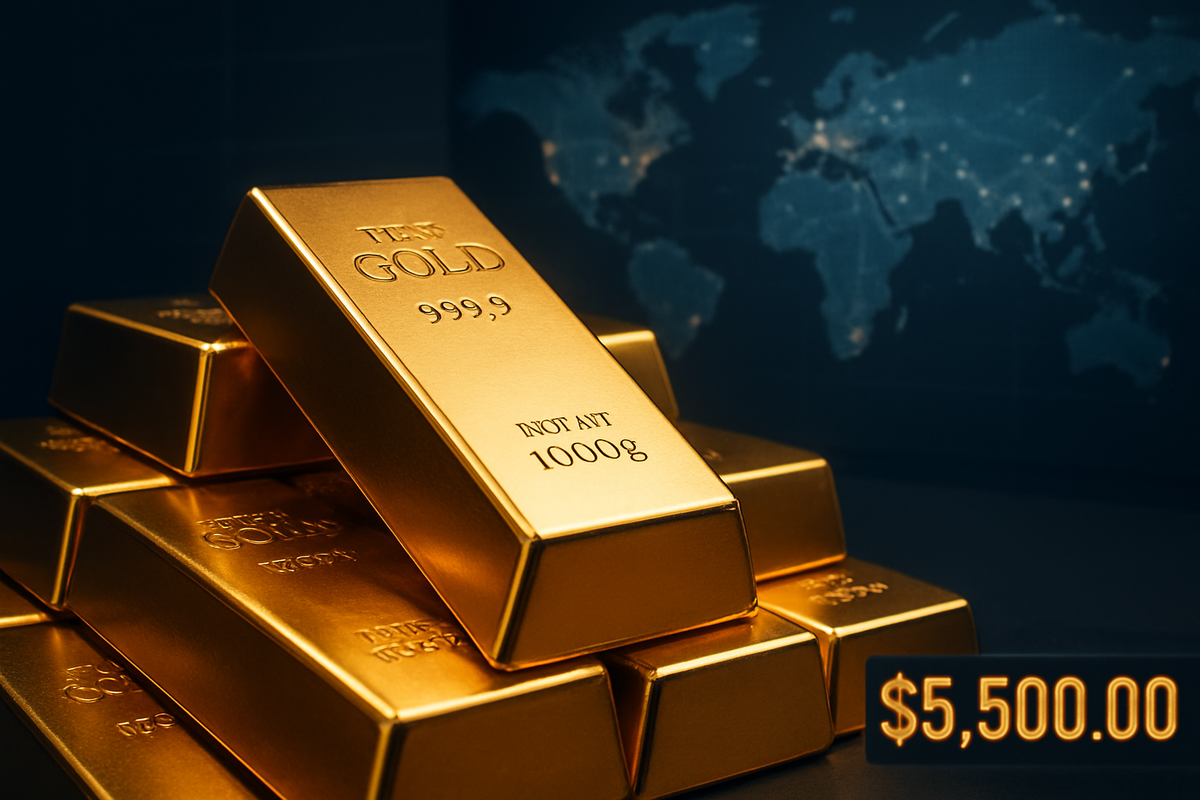
The global financial landscape reached a historic inflection point on January 29, 2026, as gold prices surged past the $5,500 per ounce mark, marking an unprecedented milestone in the history of precious metals. This "metal mania" reflects a profound shift in investor sentiment, as the traditional pillars of the global economy—most notably the U.S. dollar and the stability of the sovereign bond market—face mounting pressure from fiscal instability and relentless geopolitical tensions.
The immediate implications of this rally are being felt across all asset classes. While equity markets remain volatile, the commodities sector has become the primary theater for capital preservation. For the public, $5,500 gold signals a significant devaluation of purchasing power in fiat currencies, as institutional investors and central banks alike rush to the "neutral currency" of bullion to hedge against a darkening macroeconomic horizon.
The Path to $5,500: A Two-Year Surge in the Making
The ascent to $5,500 did not happen in a vacuum; it was the culmination of a series of systemic shocks that began in late 2024. Throughout 2025, the Federal Reserve entered a definitive easing cycle, catalyzed by the "September Pivot" of 2025, which saw interest rates slashed to combat slowing domestic growth. As real yields compressed toward zero and negative territory, the opportunity cost of holding non-yielding gold evaporated, making the yellow metal the most attractive asset for those seeking to escape the eroding value of cash.
Geopolitics acted as the ultimate accelerant. The year 2025 was defined by "perpetual risk," as conflict in Eastern Europe became a permanent fixture of the global economy and tensions in the South China Sea threatened to sever vital trade arteries. By early 2026, the specter of direct conflict in the Middle East reached a fever pitch, triggering massive "flight-to-safety" flows. Central banks, particularly those in the BRICS+ nations, responded by aggressively diversifying away from the U.S. dollar, adding more than 1,000 tonnes of gold to their reserves annually for three consecutive years—a trend that fundamentally altered the supply-demand balance.
Market participants have watched in awe as gold broke through the psychological $5,000 barrier in late 2025, only to charge another 10% higher in the first month of 2026. This rally has been supported by a "Sell America" sentiment among international investors, driven by U.S. national debt levels exceeding 120% of GDP and persistent fiscal deficits that many now view as unsustainable. The move to $5,500 represents not just a price peak, but a loss of confidence in the debt-based financial order.
Corporate Champions and Industrial Casualties
The primary beneficiaries of this price explosion have been the major mining conglomerates, which have seen their margins expand to record levels. Newmont (NYSE: NEM), the largest gold producer in the world, reported a staggering $1.6 billion in free cash flow in the final quarter of 2025, with its shares climbing over 170% in the last twelve months. Similarly, Barrick Gold (NYSE: GOLD) has leveraged the high-price environment to expand its share buyback programs and dividend yields, positioning itself as a cash-flow powerhouse in a market starved for yield.
Investors who preferred direct exposure without the operational risks of mining have flooded into exchange-traded funds. The SPDR Gold Shares (NYSE Arca: GLD), the world's largest gold-backed ETF, saw its assets under management double over the past year to a record $559 billion. The sheer volume of inflows into GLD has at times outpaced the ability of the physical market to supply the underlying bullion, leading to temporary premiums in the paper gold markets.
Conversely, the "metal mania" has created significant headwinds for industrial users and consumer-facing sectors. Electronics manufacturers like Apple (NASDAQ: AAPL) and Samsung have been forced to accelerate "de-golding" strategies, substituting gold with copper or silver where possible to maintain margins. In the luxury sector, while the total value of the jewelry market has reached record highs, the volume of units sold has plummeted by nearly 20% as consumers find themselves priced out of the traditional 18-karat and 22-karat markets, shifting instead toward lower-purity alternatives or smaller, lighter designs.
A Structural Shift in the Global Order
The significance of $5,500 gold extends far beyond a simple commodity rally; it represents a fundamental re-evaluation of the U.S. dollar's role as the world's primary reserve currency. As the dollar index (DXY) retreated by over 12% throughout 2025 and early 2026, gold has increasingly been treated as a proxy for the dollar's demise. This "de-dollarization" is no longer a theoretical risk but a documented strategy for central banks in Poland, Turkey, China, and India, who now prioritize gold for its lack of counterparty risk and its immunity to geopolitical sanctions.
Historically, gold and the stock market often move in opposite directions, but 2025 and 2026 have seen a rare positive correlation. Investors are using both gold and equities as "safety plays" against a collapsing bond market. With confidence in U.S. Treasuries wavering due to debt sustainability concerns, gold has emerged as the ultimate "alternative duration hedge." This shift mirrors the inflationary era of the 1970s but on a much larger, more systemic scale, as the world grapples with the fallout of decades of fiscal expansion.
Furthermore, the rise in gold prices is forcing a regulatory and policy reckoning. Governments are now looking closer at "circular electronics" and urban mining initiatives to recover gold from e-waste, as the cost of primary mining and the geopolitical risks of supply chains make recycling a strategic necessity. The high price of gold is effectively acting as a tax on technological advancement and global trade, prompting a search for new economic models that are less dependent on rare and increasingly expensive raw materials.
The Road Ahead: New Floor or Temporary Peak?
As the market digests the $5,500 milestone, the immediate question for investors is whether gold is overextended. Short-term technical indicators suggest the metal is in overbought territory, and some analysts at institutions like UBS have suggested that a consolidation phase is likely. However, many believe that the $5,000 level will now act as a hard floor rather than a ceiling. The structural drivers—specifically the U.S. debt crisis and the ongoing fragmentation of the global geopolitical order—show no signs of abating, providing a permanent tailwind for the metal.
In the coming months, we may see a strategic pivot from institutional investors who are currently "under-allocated" to precious metals. If pension funds and insurance companies begin to move even 1-2% of their portfolios into gold to match the actions of central banks, the price could feasibly challenge the $6,000 mark by the end of 2026. The challenge for the market will be liquidity; if physical demand continues to outstrip mining output, the "scarcity premium" could lead to extreme volatility and potential "short squeezes" in the futures markets.
The most likely scenario for the remainder of 2026 is a period of high-level consolidation as the market waits for the next move from the Federal Reserve. If inflation remains sticky while growth stalls—a "stagflationary" environment—gold will likely maintain its upward trajectory. Investors should watch for any signs of a "truce" in global trade wars or a surprise fiscal tightening in the U.S., as these are the only factors likely to significantly dampen the current metal mania.
Conclusion and Investor Outlook
The ascent of gold to $5,500 per ounce is a clarion call that the global financial system is undergoing a period of intense stress and transformation. It highlights a massive reallocation of capital away from fiat-based assets and toward tangible, "hard" money. The key takeaways for the market are clear: central banks have returned to gold as a core reserve asset, mining giants are generating unprecedented cash flows, and the U.S. dollar’s long-standing dominance is facing its sternest test in decades.
Moving forward, the market for gold will likely remain elevated as the "perpetual risk" of the current geopolitical climate remains unresolved. The lasting impact of this rally will be a permanent change in how investors view "safety." In a world of 120% debt-to-GDP and fractured global alliances, gold is no longer a "fringe" asset or a "barbarous relic"; it is once again the centerpiece of the global financial architecture.
Investors should closely monitor central bank purchase reports and U.S. Treasury auction results in the coming months. Any sign of failing demand for government debt will likely provide the next leg up for gold. While the journey to $5,500 was driven by a convergence of crises, the stay at these levels will be determined by whether the world can find a new equilibrium or if the current "metal mania" is merely the prelude to a much larger economic reset.
This content is intended for informational purposes only and is not financial advice.