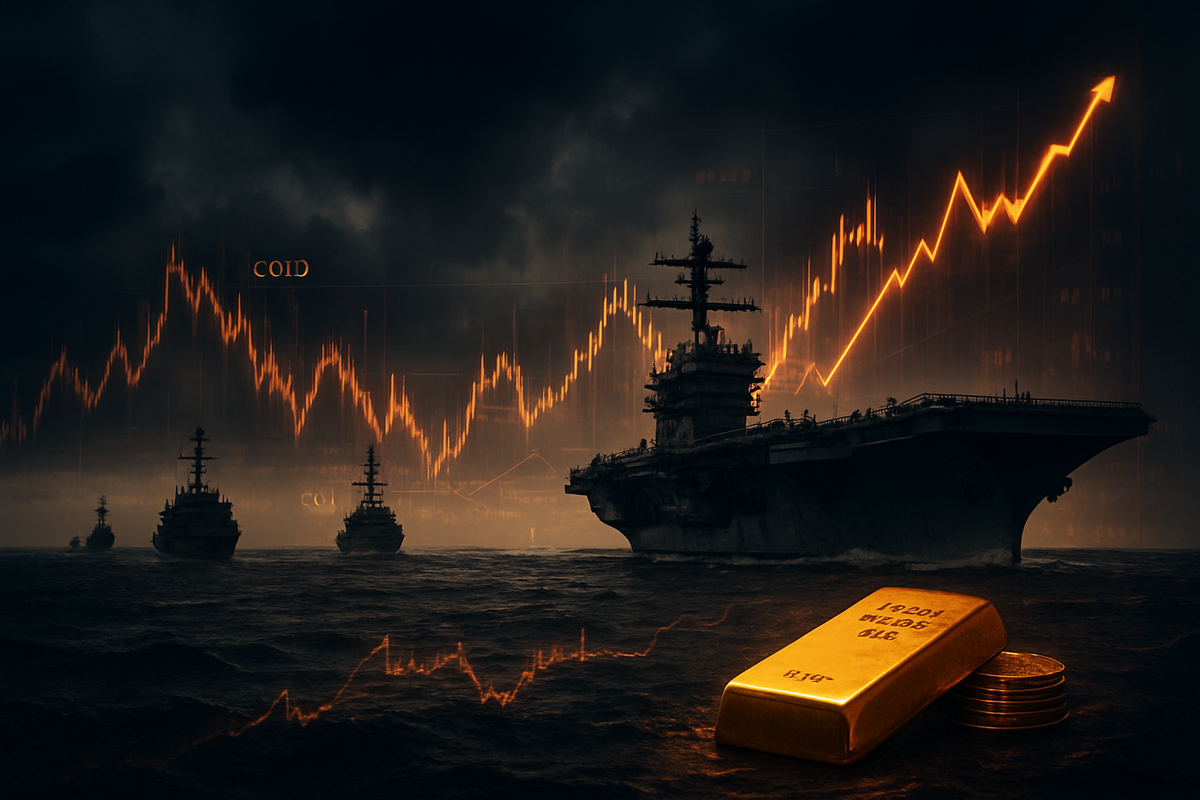
As of January 29, 2026, global financial markets are grappling with a dramatic intensification of geopolitical risk as tensions between the United States and Iran reach a boiling point. The deployment of a massive naval armada, led by the USS Abraham Lincoln to the Persian Gulf, has sent shockwaves through trading floors, triggering a rapid migration of capital into safe-haven assets. While the S&P 500 has shown surprising resilience by hovering near the 7,000-point mark, the underlying market breadth tells a story of deep anxiety, with traditional safe harbors like gold reaching unprecedented price levels.
The immediate implications are felt most acutely in the commodities and defense sectors. A "geopolitical risk premium" has been firmly re-established in the energy markets, with Brent crude oil surging past $70 per barrel amid fears of a blockade in the Strait of Hormuz. Simultaneously, the historic "flight to quality" has decoupled from the U.S. dollar, which is currently languishing at four-year lows, leaving gold as the primary beneficiary of the global rush for security.
A Perfect Storm: From Economic Collapse to Military Standfall
The current crisis traces its roots to late 2025, when Iran began experiencing its most severe internal instability since the 1979 revolution. By December 28, 2025, a total collapse of the Iranian rial—which plummeted to a staggering 1.4 million per USD—ignited nationwide protests. These demonstrations quickly evolved from economic grievances into a full-scale movement for regime change, met by a government crackdown that has reportedly resulted in over 3,400 deaths. In Washington, the administration’s "maximum pressure" strategy has entered a high-stakes phase, with President Trump threatening kinetic action far exceeding the June 2025 strikes on Iranian nuclear facilities.
Throughout January 2026, the situation has moved with dizzying speed. After nuclear mediation efforts in Ankara, Turkey, hit a deadlock over uranium enrichment demands, the U.S. military posture shifted toward active deterrence. The arrival of the USS Abraham Lincoln in the region this week serves as a physical manifestation of the White House’s vow to prevent Tehran from further destabilizing the region or closing vital shipping lanes. Key stakeholders, including NATO allies and regional powers like Saudi Arabia and Israel, remain on high alert as the possibility of a direct military confrontation looms larger than it has in decades.
Initial market reactions have been characterized by extreme bifurcation. While the broader indices have been propped up by a few high-performing sectors, the volatility index (VIX) has spiked, reflecting investor uncertainty. The suddenness of the naval deployment and the failure of diplomatic channels in Turkey have left institutional desks scrambling to recalibrate their risk models for a "high-conflict" scenario in the Middle East.
The Winners and Losers of the New Geopolitical Reality
In the wake of this escalation, defense contractors have emerged as the market’s primary beneficiaries. Lockheed Martin (NYSE: LMT) saw its shares climb 7.1% today, January 29, 2026, after the company reported a record backlog and a bullish forecast driven by the operational success of its F-35 and F-22 platforms. The sentiment is further bolstered by the White House's proposed $1.5 trillion defense budget for fiscal year 2027, which signals a sustained era of high military spending. Other major players like Northrop Grumman (NYSE: NOC) and General Dynamics (NYSE: GD) are similarly outperforming the benchmark indices as the threat of regional war drives new procurement cycles.
The energy sector has also seen a massive influx of capital, though for different reasons. ExxonMobil (NYSE: XOM) shares have surged nearly 13% since the start of the month. Beyond the boost from rising oil prices, Exxon is benefiting from a unique geopolitical shift: the U.S. capture of the Venezuelan president on January 3, 2026. This has led to speculation that U.S. energy majors may soon gain unprecedented access to Venezuela’s massive reserves, the largest in the world, providing a strategic hedge against Middle Eastern supply disruptions. Conversely, the SPDR Gold Shares (NYSEARCA: GLD) has witnessed a historic surge as spot gold prices soared past $5,500 per ounce. This "precious metals supercycle" reflects a lack of confidence in fiat currencies during times of extreme geopolitical stress.
On the losing side, the U.S. dollar has faced an unusual decline for a period of international conflict. The U.S. Dollar Index (DXY) fell to 95.5, a four-year low, as investors reacted to political pressure on the Federal Reserve and the administration’s stated preference for a weaker dollar to boost exports. High-growth technology stocks, particularly those without significant defense or energy exposure, have seen their valuations compressed as "risk-off" sentiment triggers sell-offs in names with high price-to-earnings ratios. Airlines and consumer discretionary sectors are also under pressure as the prospect of $90+ oil threatens to eat into margins and consumer spending power.
Strategic Shifts and Historical Echoes
The current crisis represents a significant departure from previous Middle East flare-ups. Historically, conflict in the Persian Gulf has led to a "triple crown" for the U.S. dollar, gold, and oil. However, the early 2026 landscape is defined by a weakened dollar and a ballooning U.S. fiscal deficit, which has changed the calculus for global investors. This event fits into a broader trend of "de-dollarization" and a pivot toward physical assets, a trend that has accelerated as the Fed faces unprecedented political scrutiny and a Department of Justice probe into its independence.
The potential ripple effects extend far beyond the immediate combatants. A blockade of the Strait of Hormuz—which carries roughly 25% of the world's daily oil supply—would likely force a re-routing of global trade, benefiting logistics companies with robust non-Gulf routes while crippling those dependent on the region’s petrochemical output. In terms of policy, the $1.5 trillion defense budget proposal marks a return to a Cold War-style footing, suggesting that the "peace dividend" of the post-Cold War era has officially been buried.
Regulatory implications are also mounting. If oil prices continue their upward trajectory toward $91 per barrel, as some analysts predict for later this year, the Federal Reserve may be forced to choose between raising interest rates to combat energy-driven inflation or maintaining a dovish stance to avoid a recession during a time of war. This "stagflationary" risk is a ghost of the 1970s that has returned to haunt modern markets.
The Road Ahead: Diplomacy or Detonation?
In the short term, all eyes remain on the naval maneuvers in the Persian Gulf and the ongoing mediation attempts in Turkey. Should a diplomatic "off-ramp" be found, we could see a massive reversal in the safe-haven trade, with gold and defense stocks potentially seeing a sharp "give-back" of their recent gains. However, if a skirmish occurs or the Strait of Hormuz is even partially closed, the market could see a "limit-down" scenario for broader indices while energy and gold reach new, untested heights.
Strategic pivots are already underway. Many institutional investors are increasing their exposure to "real assets"—commodities, land, and energy infrastructure—as a hedge against both geopolitical instability and currency devaluation. The long-term challenge for the market will be navigating a world where geopolitical risk is no longer a "tail risk" but a central component of everyday valuation. Companies with diversified supply chains and those that can pivot toward the burgeoning defense and national security sectors will likely remain the preferred choice for wary investors.
Navigating a Volatile Horizon
The takeaway for the end of January 2026 is clear: the era of low-volatility, tech-led growth is facing its sternest test. The escalation in Iran has acted as a catalyst, exposing the fragility of a global financial system already burdened by high debt and political polarization. As the U.S.-Iran standoff enters this dangerous new phase, the market's focus has shifted from "growth at any cost" to "preservation of capital."
Moving forward, investors should closely monitor the price of Brent crude and the daily movements of the DXY. A further breakdown in the dollar alongside rising gold prices would suggest a deeper structural shift in global finance that transcends the immediate conflict. While the defense sector offers a clear tactical opportunity, the broader risk to global supply chains and consumer stability cannot be ignored. The coming months will determine whether the current tensions are a temporary spike in the long history of Middle Eastern conflict or the beginning of a profound realignment of the global economic order.
This content is intended for informational purposes only and is not financial advice.