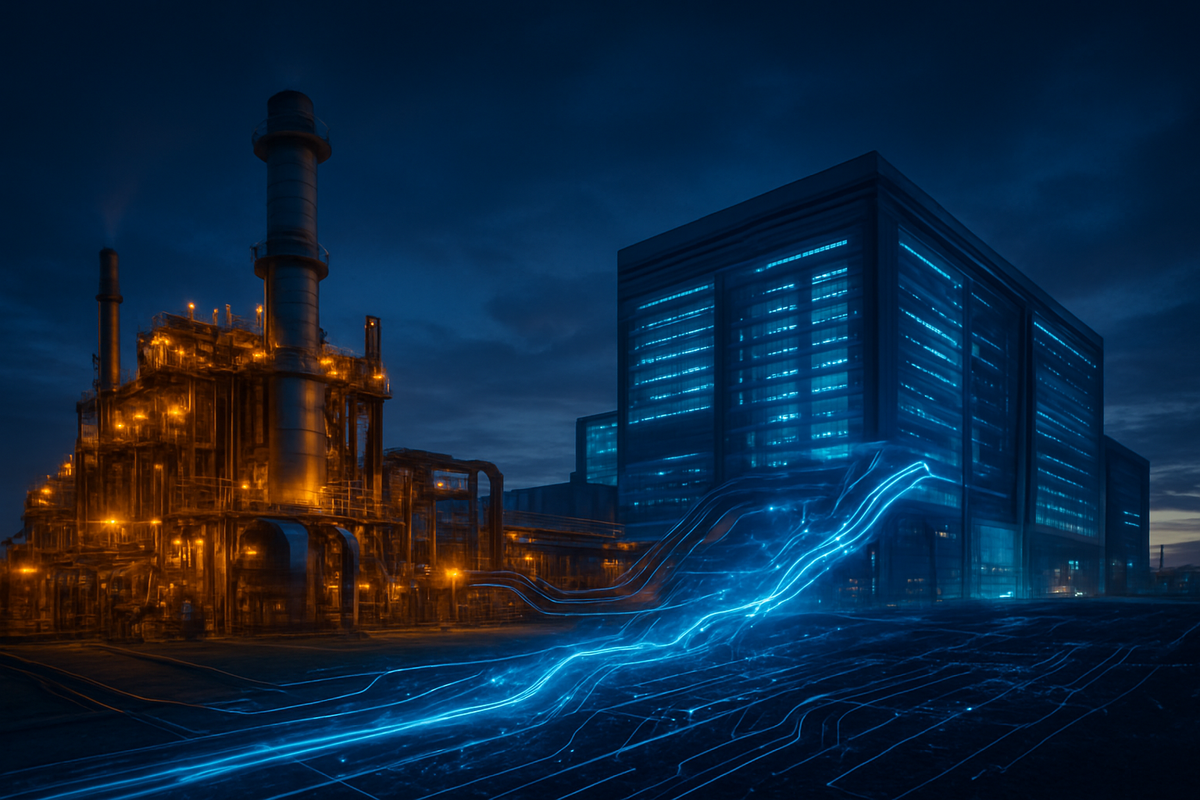
In a move that underscores the insatiable appetite for reliable electricity in the age of artificial intelligence, Vistra Corp (NYSE: VST) announced on January 5, 2026, a definitive agreement to acquire Cogentrix Energy for approximately $4.7 billion. The acquisition, which targets a massive 5,500-megawatt (MW) portfolio of natural gas-fired generation facilities, marks a pivotal moment in the energy sector’s consolidation. As the "Step Change" in power demand from hyperscale data centers becomes the primary driver of market valuations, Vistra’s strategic pivot toward a diversified, dispatchable fleet is setting a new benchmark for the industry.
The deal comes at a time when the U.S. power grid is under unprecedented strain, with projections indicating that AI-driven demand could more than quadruple by the end of the decade. By securing these high-efficiency gas assets, Vistra is not just expanding its footprint; it is positioning itself as a dominant provider of the "firm power" required to keep the world’s most advanced digital infrastructure running 24/7. This acquisition effectively signals the end of the "intermittent-only" transition era, ushering in a "reliability-first" paradigm where dispatchable natural gas and nuclear assets command a premium.
The Deal Mechanics: A Multi-Billion Dollar Capacity Sprint
The $4.7 billion acquisition of Cogentrix from Quantum Capital Group represents one of the most significant transactions in the independent power producer (IPP) space since the early 2020s. While Cogentrix was famously owned by the Carlyle Group (NASDAQ: CG) until 2024, Quantum Capital Group optimized the portfolio for roughly 18 months before selling it to Vistra at a substantial valuation. The transaction structure includes $2.3 billion in cash, $925 million in Vistra common stock, and the assumption of approximately $1.5 billion in existing debt. To fund the cash portion, Vistra successfully finalized a $2.25 billion bond offering in late January 2026, demonstrating strong institutional support for the merger.
The portfolio consists of 10 modern natural gas plants strategically located in the most competitive and high-demand power markets in the United States. Key assets include the high-efficiency Patriot and Hamilton-Liberty facilities in Pennsylvania (PJM Interconnection), which are crucial for serving the "Data Center Alley" corridor. Additionally, the deal adds significant capacity in ISO New England and the Altura cogeneration facility in ERCOT (Texas). The timeline for the merger anticipates a close in mid-to-late 2026, pending standard regulatory reviews from the Federal Energy Regulatory Commission (FERC) and the Department of Justice (DOJ).
Market reaction has been overwhelmingly positive, with Vistra’s stock price reaching new heights as investors applaud the company’s "all-of-the-above" strategy. Analysts note that the acquisition significantly de-risks Vistra’s growth profile by providing immediate cash flow and a massive increase in MW-hours that can be sold into capacity markets where prices have surged over the past 12 months.
Winners and Losers: Consolidation Reshapes the Leaderboard
The primary winner in this transaction is undoubtedly Vistra Corp (NYSE: VST), which has successfully transformed itself from a legacy utility into a high-growth energy infrastructure giant. By integrating Cogentrix’s gas fleet with its existing world-class nuclear assets—including the recently acquired Energy Harbor portfolio—Vistra now boasts a generation mix that is uniquely suited to the needs of hyperscalers like Microsoft (NASDAQ: MSFT) and Amazon (NASDAQ: AMZN). These tech giants are also winners, as the consolidation of these assets under a sophisticated operator like Vistra increases the likelihood of long-term, multi-gigawatt power purchase agreements (PPAs) that are vital for their AI expansion.
Other "winners" in the current environment include peer companies like Constellation Energy (NASDAQ: CEG) and Talen Energy (NASDAQ: TLN). Constellation’s recent $16.4 billion acquisition of Calpine has set a high floor for valuation multiples, and Vistra’s Cogentrix deal further validates the "firm power" thesis. However, the losers in this shift are likely the smaller, less-capitalized independent power producers who lack the scale to compete for the massive grid interconnection queues and the specialized engineering talent required to manage large-scale data center co-location projects.
The renewable energy sector faces a nuanced impact. While wind and solar remain essential for meeting corporate sustainability goals, the recent surge in M&A activity for gas and nuclear assets suggests that pure-play renewable developers may see a cooling in valuation multiples. Investors are increasingly favoring companies that can provide "round-the-clock" power, a requirement that intermittent sources cannot yet meet without massive, and currently expensive, battery storage backup.
A Broader Trend: The "Gas-for-Data" Renaissance
Vistra’s expansion is a flagship example of the broader "Gas-for-Data" trend that has gripped the energy sector as of January 2026. This resurgence in M&A fits into a larger pattern of consolidation intended to solve the "Interconnection Crisis." With the U.S. grid suffering from massive backlogs in connecting new power sources, acquiring existing "behind-the-meter" or "front-of-the-meter" dispatchable plants has become the fastest way for utilities to grow. Historical precedents, such as the utility mergers of the late 1990s, focused on deregulation and cost-cutting; the current wave is focused almost entirely on capacity and reliability.
Furthermore, the deal highlights a significant shift in the role of private equity. Firms like Quantum and Blackstone (NYSE: BX) have become the "kingmakers" of the energy world, buying up distressed or undervalued fossil fuel assets, optimizing them, and selling them to strategic buyers at a premium when the market realizes their necessity. This has created a secondary market for gas plants that many analysts believed would be "stranded assets" just five years ago.
Regulatory and policy implications are also coming to the forefront. The FERC’s recent rulings on co-location—where data centers sit directly next to power plants—have forced companies to pivot. Vistra’s acquisition of Cogentrix provides it with a diverse geographic footprint that allows it to bypass regional grid congestion by offering "localized" power solutions to tech companies, a strategy that is becoming a necessity as the national grid reaches its physical limits.
The Path Forward: What Comes Next for Vistra and the Market
In the short term, Vistra will focus on the complex regulatory approval process and the integration of the 5,500 MW portfolio. However, the long-term strategy likely involves leveraging these assets for direct co-location with AI data centers. Market watchers expect Vistra to announce several "mega-deals" with hyperscalers in the coming 12 to 18 months, mirroring the landmark agreement between Constellation and Microsoft for the Three Mile Island restart.
We should also anticipate a "Nuclear Phase 2" for Vistra. With the Cogentrix gas assets providing a stable cash flow foundation, Vistra may look to follow the industry trend of recommissioning retired nuclear reactors or investing in Small Modular Reactors (SMRs). As the AI arms race intensifies, the company that can provide the most "clean, firm power" will effectively control the gate to the digital economy. Potential strategic pivots could include Vistra entering the data center development business itself, moving from being a mere supplier to a full-stack infrastructure partner.
The market should also watch for further consolidation. With Vistra and Constellation having moved first, other major players like NextEra Energy (NYSE: NEE) and Duke Energy (NYSE: DUK) may feel pressured to engage in their own large-scale acquisitions to prevent losing market share in the lucrative data center segment. The challenge will remain the aging grid infrastructure, which could act as a bottleneck for even the most well-capitalized energy giants.
Summary and Investor Outlook
The acquisition of Cogentrix by Vistra Corp marks a definitive end to the era of energy uncertainty. It confirms that natural gas, long viewed as a "bridge fuel," has reclaimed its status as a cornerstone of the American economy—at least as long as the AI boom continues. The key takeaways for investors are clear: scale matters, dispatchability is the ultimate currency, and the convergence of Big Tech and Big Power is the most significant investment theme of 2026.
Moving forward, the market will likely see continued volatility in utility stocks as they transition from "widows and orphans" dividend plays into high-growth infrastructure assets. Vistra’s successful integration of Cogentrix will be the litmus test for this new model. Investors should watch for the closure of the deal in mid-2026, the announcement of new hyperscale PPAs, and any regulatory shifts that might impact the ability to co-locate data centers at these new gas facilities. The energy sector is no longer just about keeping the lights on; it’s about powering the intelligence of the future.
This content is intended for informational purposes only and is not financial advice.