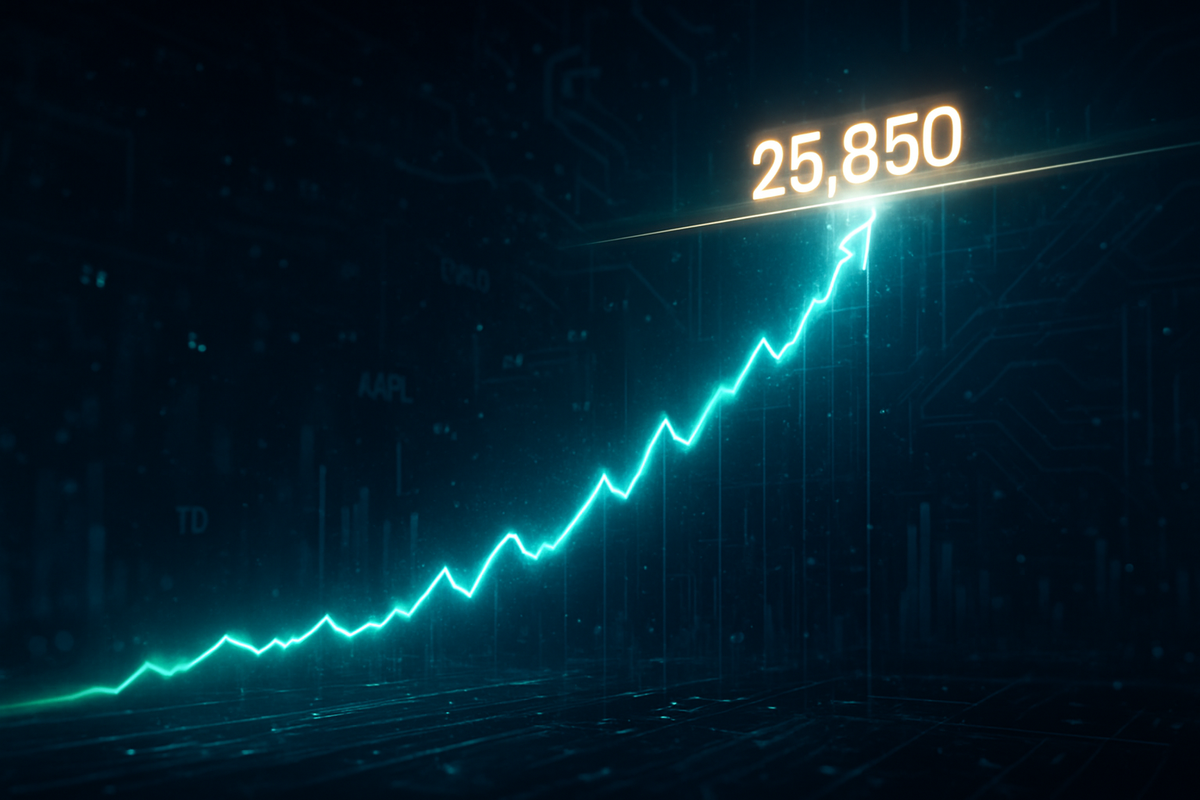
The tech-heavy Nasdaq is currently locked in a high-stakes tug-of-war as it approaches a critical technical resistance level at 25,850. After a volatile start to the year, market participants are laser-focused on this threshold, which many analysts believe is the final gatekeeper before the index makes a run for its previous record highs. With the broader market looking for direction, the ability to punch through this level could set the tone for the first half of 2026.
Conversely, the downside remains well-defined, with a robust support zone established between 25,200 and 25,500. This 300-point cushion has served as a safety net during recent bouts of profit-taking, but its strength is being tested as investors weigh the Federal Reserve's "higher-for-longer" pause against the accelerating earnings power of the tech sector. The immediate implications are clear: a breakout above 25,850 signals a renewed "risk-on" phase, while a failure to hold 25,200 could trigger a broader correction.
The Battle for 25,850: A Technical and Fundamental Crucible
The current standoff at 25,850 is the culmination of a multi-month consolidation phase that began after the Nasdaq Composite reached a peak in late 2025. Following a record-setting October that saw the index touch 26,399, the market entered a cooling period as investors grappled with a shift in Federal Reserve policy. The timeline leading to today, January 28, 2026, has been characterized by a transition from speculative AI enthusiasm to a demand for "AI ROI"—tangible returns on the massive capital expenditures made by the world's largest technology firms.
Key players in this drama include institutional desk traders and systematic funds that have algorithms keyed into the 25,850 level. Throughout the past two weeks, every attempt to breach this resistance has been met with automated selling pressure, leading to the current sideways "coiling" effect. Market sentiment is currently described as "cautiously constructive," with the VIX hovering near 14, suggesting that while uncertainty remains, there is no widespread panic.
Initial market reactions to the recent testing of support levels at 25,500 were positive, as dip-buyers stepped in aggressively to defend the 50-day Exponential Moving Average (EMA). This defense suggests that the underlying appetite for tech growth remains healthy, provided the macroeconomic environment remains stable. However, the stagnation at 25,850 highlights a "wait-and-see" approach from larger pension and sovereign wealth funds, which are holding back capital until a definitive trend emerges.
The High-Stakes Winners and Losers of the 2026 Tech Landscape
In this environment of technical resistance, the "Magnificent Seven" continue to dictate the index's pulse. NVIDIA (NASDAQ: NVDA) remains the primary driver of market momentum; as the provider of the backbone for the global AI infrastructure, its ability to maintain high margins is viewed as the "canary in the coal mine" for the 25,850 breakout. If NVDA can push past its own individual resistance, the broader Nasdaq is likely to follow. On the other hand, legacy hardware firms that have failed to integrate generative AI into their core business models are finding themselves as the "laggards" of early 2026, weighing down the index's upward trajectory.
Microsoft (NASDAQ: MSFT) and Alphabet (NASDAQ: GOOGL) are also at the center of the current technical struggle. Microsoft’s Azure cloud growth, now heavily influenced by AI workloads, is a critical metric that investors are using to justify the current valuations. Meanwhile, Alphabet is seen by many as a potential "win" in this scenario due to its relatively attractive price-to-earnings ratio compared to its peers. If the Nasdaq breaks out, these hyperscalers are expected to lead the charge, as they are the primary beneficiaries of the $500 billion in AI capital expenditure projected for this year.
Conversely, consumer-sensitive tech like Apple (NASDAQ: AAPL) may face more of a challenge if the support levels at 25,200 fail to hold. With global consumer spending showing signs of cooling under the weight of 3.5% interest rates, Apple’s hardware cycle must perform flawlessly to maintain its weight in the index. A failure to break 25,850 could lead to a rotation out of "expensive" growth and into defensive sectors, leaving companies with high price-to-earnings multiples, like Amazon (NASDAQ: AMZN), vulnerable to short-term multiple compression.
The "AI Maturity" Phase and the Macro Ripple Effect
The current technical setup is more than just a chart pattern; it reflects a broader industry trend toward AI maturity. In 2024 and 2025, the market was fueled by the potential of artificial intelligence. In 2026, we have entered "The Great Deployment" phase, where companies are being judged on how AI improves their bottom line. This event fits into a historical precedent similar to the mid-1990s build-out of the internet, where a period of massive infrastructure spending was followed by a technical consolidation before a second, more sustainable leg higher.
Regulatory and policy implications also loom large. As of late January 2026, the Federal Reserve has paused its rate-cutting cycle, maintaining the federal funds rate between 3.5% and 3.75%. This "hawkish pause" has created a ceiling for valuations, as the discount rate used to value future tech earnings remains higher than many had hoped a year ago. Furthermore, with the impending change in Fed leadership in May 2026, the market is pricing in a "risk premium" associated with the uncertainty of the next Chair’s monetary philosophy.
The ripple effects of the Nasdaq’s current struggle extend beyond Silicon Valley. If the index breaks above 25,850, it will likely pull global markets higher, particularly the semiconductor-heavy indices in Taiwan and South Korea. However, a failure at this resistance could embolden "bears" who argue that the AI cycle has peaked. This technical juncture is effectively a referendum on whether the "New Economy" can continue to grow in a world where capital is no longer free.
The Path to 30,000: Potential Scenarios and Strategic Pivots
Looking ahead, two primary scenarios emerge for the Nasdaq. In the "Bullish Breakout" scenario, a sustained daily close above 25,850, supported by strong quarterly guidance from Meta Platforms (NASDAQ: META) and others, could trigger a short squeeze that catapults the index toward 28,000 by mid-year. This would require the Fed to signal at least two more rate cuts in 2026, providing the liquidity needed for another leg of expansion.
In the "Consolidation and Correction" scenario, the 25,850 resistance holds firm, and the index drifts back to test the 25,200 support floor. If this floor breaks, we could see a 10% correction back toward the 23,000 level, which would represent a healthy "reset" of valuations. Investors should be prepared for a strategic pivot toward "Quality Growth"—companies with strong free cash flow and low debt—as the era of growth-at-any-price continues to fade.
The short-term challenge for the market is overcoming the psychological "exhaustion" of the past three years of gains. However, the long-term opportunity remains significant. If the productivity gains promised by AI begin to manifest in non-tech sectors like manufacturing and healthcare, the Nasdaq could reach the 30,000 milestone by early 2027, as projected by several major investment banks.
Wrap-Up: What Investors Should Watch in the Coming Months
As the Nasdaq sits at the precipice of 25,850, the key takeaways for investors are patience and precision. The technical levels of 25,850 (resistance) and 25,200 (support) are the definitive boundaries of the current market regime. A breach of either side will dictate the investment strategy for the remainder of the year. The move away from "hype" and toward "ROI" is the defining characteristic of this 2026 market, making fundamental analysis more important than it has been in a decade.
Moving forward, the market is likely to remain sensitive to three things: monthly inflation data, "Mag 7" earnings quality, and any shifts in the Federal Reserve’s "dot plot." While the 25,850 level feels like a formidable ceiling today, it is worth remembering that every historical peak in the Nasdaq eventually became a floor during the next expansion.
For the coming months, watch for the "breadth" of the market to improve. If the Nasdaq can rally with more than just the top five companies participating, the breakout will be much more sustainable. The current tension is merely the market's way of asking for proof that the AI-driven future is as profitable as promised.
This content is intended for informational purposes only and is not financial advice.