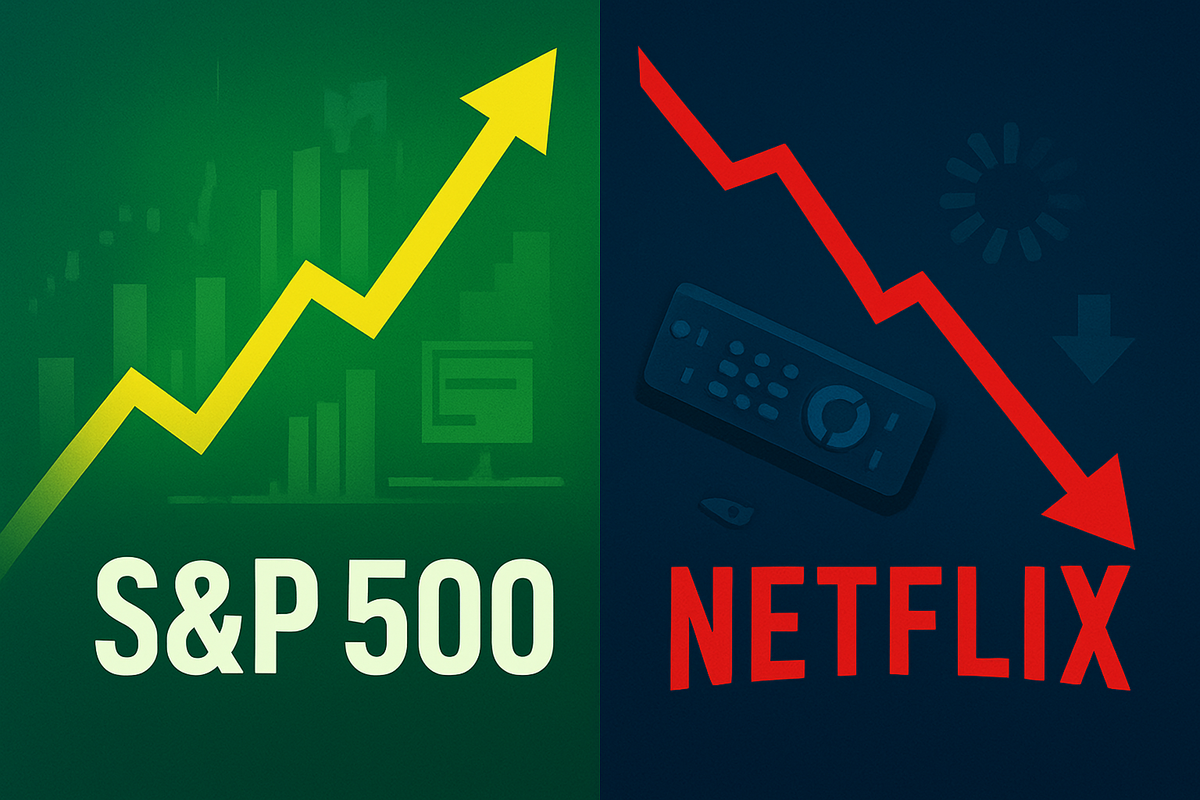
The financial markets are currently presenting a tale of two distinct narratives as the S&P 500 index stands on the precipice of an all-time record high, extending an impressive winning streak fueled by optimistic investor sentiment. This broad market resilience, however, sharply contrasts with the recent fortunes of streaming giant Netflix (NASDAQ: NFLX), whose stock has been experiencing a notable and sustained slide. This divergence highlights a nuanced market environment where broader economic optimism coexists with significant challenges for individual sectors and companies.
This contrasting performance underscores the complex interplay of macroeconomic factors, sector-specific headwinds, and company-specific developments shaping investment landscapes. While the overall market appears robust, signaling confidence in future economic conditions, the struggles of a high-profile technology stock like Netflix indicate that not all boats are rising with the tide, prompting closer scrutiny of underlying corporate fundamentals and competitive pressures.
A Market on the Brink, a Streaming Giant in Retreat
As of December 5, 2025, the S&P 500 index is tantalizingly close to setting a new all-time record, showcasing remarkable strength in the face of various economic signals. On December 4, 2025, the index closed at 6857.12 points, a mere 0.49% shy of its record closing high of 6890.89, achieved on October 28, 2025. This recent surge marks a significant winning streak, with the index closing higher in eight of the last nine trading sessions and recording gains for three consecutive days leading up to December 4. This bullish momentum, briefly interrupted on December 1, 2025, is largely underpinned by strong investor expectations of a monetary easing stance from the Federal Reserve, with an 87% probability of a 25-basis-point rate cut anticipated at the December 10 meeting. This optimism persists despite mixed economic data, including a dip in initial jobless claims and reports of substantial job cuts earlier in 2025.
In stark contrast, Netflix (NASDAQ: NFLX) has been grappling with a significant downturn, sliding over 20% from its year-to-date high reached in mid-2025. The stock closed at $103.22 on December 4, 2025, marking a 0.71% drop from the prior day. This represents a roughly 23% decline from its 52-week high of $134.12, set on June 30, 2025. The primary catalysts for this decline include a disappointing Q3 2025 earnings report, where the company missed EPS expectations due to a substantial Brazilian tax charge and a subsequent reduction in its full-year operating margin guidance. Additionally, the prospect of an $83 billion acquisition of Warner Bros. Discovery (NASDAQ: WBD) assets has introduced significant antitrust concerns and regulatory scrutiny, threatening to burden Netflix with considerable debt and integration challenges, alongside a potential $5.8 billion "breakup fee" if the deal fails.
Adding to the pressure, Netflix co-founder and chairman Reed Hastings executed a notable insider sale on December 1, 2025, trimming his direct stake by selling 375,470 NFLX shares. While reportedly part of a scheduled plan, this move contributed to investor unease. The stock has also faced technical selling after breaking below key moving averages, further exacerbated by a new class-action lawsuit concerning disclosures and subscriber metrics, and several analyst downgrades. This confluence of factors has led to a significant "tech risk-off" sentiment affecting Netflix, pushing its valuation lower after a strong rally earlier in the year.
The initial market reaction to Netflix's woes has been a clear bearish trend, with the stock experiencing a roughly 5% drop in recent sessions leading up to December 5, 2025, and a 14.3% decline over the past month. This indicates a significant loss of investor confidence in the short to medium term, contrasting sharply with the broader market's bullish sentiment.
Divergent Fortunes: Who Wins and Who Loses in the Current Market Climate
The S&P 500's robust performance, nearing record highs, signals a broad-based market optimism that is benefiting several key sectors and the companies within them. The primary drivers of this rally include strong enthusiasm for artificial intelligence (AI) innovation, expectations of future interest rate cuts by the Federal Reserve, and favorable shifting trade policies. The Information Technology sector continues to lead the charge, with mega-cap companies like Nvidia (NASDAQ: NVDA) and Broadcom (NASDAQ: AVGO) posting triple-digit returns, propelled by the insatiable demand for custom AI chips. Dell Technologies (NYSE: DELL) has also reported record orders for its AI servers, while stalwarts such as Microsoft (NASDAQ: MSFT) and Apple (NASDAQ: AAPL) remain significant contributors to the sector's gains, forming a substantial portion of the S&P 500's weight.
The Communication Services sector is another major beneficiary, with heavyweights like Meta Platforms (NASDAQ: META) and Alphabet (NASDAQ: GOOGL) seeing substantial returns driven by strong digital advertising revenues and robust consumer spending. The Financials sector is also performing well, buoyed by stronger bank earnings and the anticipation of Federal Reserve interest rate cuts, which tend to stimulate lending activity. Furthermore, Industrials companies, including machinery and equipment makers such as Caterpillar (NYSE: CAT) and GE Vernova (NYSE: GEV), and aerospace and defense giants like GE Aerospace (NYSE: GE) and RTX (NYSE: RTX), are thriving due to increased infrastructure spending, a recovery in air travel, and strong government defense contracts. Even the traditionally defensive Utilities sector has reversed its trend, showing strong returns primarily due to escalating electricity demand from AI hyperscalers, with Vistra (NYSE: VST) emerging as a top performer.
Conversely, Netflix's significant stock slide has created a ripple effect, impacting not only the streaming giant itself but also potentially other players in the entertainment and technology sectors. The most immediate loser is, unequivocally, Netflix (NASDAQ: NFLX), which has seen its stock price plummet and investor confidence erode due to missed earnings, regulatory scrutiny over a potential major acquisition, and perceived insider selling. The proposed $83 billion acquisition of Warner Bros. Discovery (NASDAQ: WBD) assets, while potentially transformative, has introduced significant antitrust concerns, dampening investor enthusiasm for both companies. Should the deal face insurmountable regulatory hurdles or collapse, WBD could also suffer, and the substantial "breakup fee" would be a significant blow to Netflix.
Other streaming services and content creators could also feel the pressure. While increased competition from players like Disney+ (NYSE: DIS), Hulu, Amazon Prime Video (NASDAQ: AMZN), Comcast's Peacock (NASDAQ: CMCSA), and Paramount Skydance (NASDAQ: PARA) is already a factor in Netflix's struggles, a heavily consolidated market resulting from a successful Netflix-WBD merger could force rivals to pursue their own consolidation strategies or intensify their focus on niche content. Conversely, if the deal fails due to regulatory intervention, it could set a precedent, deterring other large mergers in the media sector and pushing companies towards organic growth. Content creators and production studios might also face a more concentrated market with fewer buyers for their content, potentially diminishing incentives for new productions and theatrical releases, thereby affecting a wide range of industry professionals. The broader tech and entertainment sector could also be influenced by any new regulatory precedents set by the scrutiny of Netflix's potential acquisition.
Wider Significance: Trends, Ripple Effects, and Historical Parallels
The current market dichotomy, characterized by the S&P 500's ascent and Netflix's descent, reflects several broader industry trends and economic undercurrents. The S&P 500's flirtation with record highs underscores a prevailing "risk-on" sentiment driven by optimism around technological innovation, particularly in AI, and the anticipation of a more accommodative monetary policy from the Federal Reserve. This suggests a market that is increasingly valuing growth and innovation, with a focus on companies demonstrating strong earnings momentum and clear pathways to future expansion. This trend indicates that investors are willing to overlook some macroeconomic uncertainties in favor of compelling growth narratives, especially within the technology and growth-oriented sectors.
Netflix's struggles, on the other hand, highlight the increasing maturity and intense competition within the streaming industry. What was once a relatively unchallenged growth story has evolved into a highly fragmented market where subscriber growth is slowing, content costs are soaring, and customer churn is a constant threat. The antitrust concerns surrounding Netflix's potential acquisition of Warner Bros. Discovery assets also signal a growing regulatory scrutiny over large-scale mergers in the digital entertainment space. Regulators are increasingly wary of consolidation that could grant excessive market power, potentially stifling competition and limiting consumer choice. This regulatory environment could have significant ripple effects, making future mega-mergers across the tech and media landscape more challenging and time-consuming, forcing companies to reconsider their growth strategies.
Historically, periods of broad market strength often mask underlying weaknesses in specific sectors or individual companies. The dot-com bubble of the late 1990s, for instance, saw the broader market rally even as many internet companies with unsustainable business models eventually collapsed. While the current situation is far from a bubble, Netflix's challenges serve as a reminder that even market leaders can face significant headwinds. The "tech risk-off" sentiment affecting Netflix could also spread to other high-valuation tech stocks, particularly those in competitive or maturing markets, prompting investors to re-evaluate their positions and prioritize companies with clearer profitability and more sustainable growth trajectories. This period could be analogous to shifts seen in other industries after rapid expansion, where initial innovators face increased competition and regulatory oversight as the market matures.
The potential acquisition of Warner Bros. Discovery assets by Netflix also brings to the forefront the ongoing content wars and the strategic imperative for streaming services to control vast libraries of exclusive content. This trend could accelerate further consolidation in the media industry as companies vie for intellectual property to attract and retain subscribers. However, increased regulatory intervention could also lead to more cautious approaches, with companies opting for strategic partnerships or organic content development rather than large, potentially problematic mergers. This event could therefore set a precedent for how governments approach market concentration in the rapidly evolving digital media landscape, impacting future M&A strategies across the entire sector.
What Comes Next: Navigating the Future Landscape
The immediate future for the S&P 500 appears poised for continued momentum, at least in the short term, as it flirts with new record highs. Investor sentiment remains largely bullish, underpinned by expectations of Federal Reserve interest rate cuts and ongoing enthusiasm for technological advancements, particularly in AI. In the short-term, market participants will closely watch the Federal Reserve's December 10 meeting for confirmation of the anticipated 25-basis-point rate cut, which could provide further impetus for the market. However, any unexpected hawkish signals or disappointing economic data could temper this optimism. For the long term, the sustainability of the S&P 500's rally will depend on continued corporate earnings growth, the successful integration of AI technologies across various industries, and the broader economic health of the U.S. and global markets.
For Netflix (NASDAQ: NFLX), the short-term outlook is more challenging. The company faces immediate pressure to reassure investors following its Q3 2025 earnings miss and the uncertainty surrounding the potential Warner Bros. Discovery (NASDAQ: WBD) acquisition. Netflix will need to provide clearer guidance on its operating margins and demonstrate a robust strategy for subscriber growth in an increasingly competitive landscape. The resolution of the antitrust concerns and the fate of the WBD deal will be pivotal. A successful, albeit heavily scrutinized, acquisition could offer a path to expanded content libraries and market dominance, but it also carries significant integration risks and potential debt burdens. Conversely, a failed deal, while avoiding debt, would necessitate a strategic pivot towards organic growth and potentially smaller content partnerships to compete effectively.
Market opportunities may emerge from this divergence. For investors, the S&P 500's strength might present opportunities in sectors driving its growth, such as technology, communication services, and industrials, especially companies with strong AI exposure. However, the high valuations in some of these areas warrant careful consideration. In the streaming space, Netflix's struggles could create opportunities for competitors to gain market share or for investors to find value in rival platforms that demonstrate more sustainable growth models or innovative content strategies. Potential strategic pivots for Netflix could include a renewed focus on cost-effective content production, exploring new revenue streams beyond subscriptions (e.g., advertising tiers, interactive experiences), or even divesting non-core assets to streamline operations and improve profitability. The market will be looking for clear signs of adaptation and strategic clarity from the streaming giant.
Potential scenarios range from a continued bullish S&P 500 rally, with tech and growth stocks leading the charge, to a more cautious market if economic data deteriorates or regulatory scrutiny intensifies across sectors. For Netflix, outcomes could range from a successful, value-accretive acquisition of WBD assets that solidifies its market position, to a prolonged period of underperformance if the deal collapses and the company fails to address its core competitive challenges. The broader market will also be watching for any spillover effects from Netflix's issues, particularly if the "tech risk-off" sentiment extends to other high-growth, high-valuation stocks. The coming months will be crucial for both the overall market's trajectory and Netflix's strategic direction.
Comprehensive Wrap-up: Assessing the Market's Path Forward
The current financial landscape presents a fascinating study in market divergence: the S&P 500's relentless march towards a new record high, contrasted sharply with the precipitous slide of streaming titan Netflix (NASDAQ: NFLX). The key takeaway from this event is that while broad market sentiment remains robust, driven by AI optimism and anticipated monetary easing, individual company and sector-specific challenges can significantly impact performance, even for established market leaders. The S&P 500's strength underscores investor confidence in the broader economic outlook and the transformative power of technology, particularly AI, which is fueling growth across various sectors from IT to industrials and even utilities.
Moving forward, the market's trajectory will largely depend on the Federal Reserve's policy decisions and the sustained strength of corporate earnings. Investors should watch for any shifts in the Fed's stance or unexpected economic headwinds that could dampen the current bullish sentiment. For Netflix, the coming months will be a critical period of strategic re-evaluation. The resolution of the Warner Bros. Discovery (NASDAQ: WBD) acquisition saga, coupled with the company's ability to articulate a clear path to renewed subscriber growth and improved profitability, will dictate its short-to-medium-term performance. The ongoing competition in the streaming space and increasing regulatory scrutiny over large tech mergers will continue to shape the industry landscape.
Ultimately, this period highlights the importance of discerning between broad market trends and individual company fundamentals. While the S&P 500's ascent reflects a generally healthy market, Netflix's struggles serve as a potent reminder that even highly successful companies are not immune to competitive pressures, evolving consumer preferences, and regulatory challenges. Investors should remain vigilant, focusing on companies with strong fundamentals, sustainable competitive advantages, and clear growth strategies, while also keeping a keen eye on macroeconomic indicators and the evolving regulatory environment. The next few months will reveal whether the S&P 500 can cement its new record and how Netflix navigates its current turbulent waters, offering valuable insights into the resilience and adaptability of different market segments.
This content is intended for informational purposes only and is not financial advice