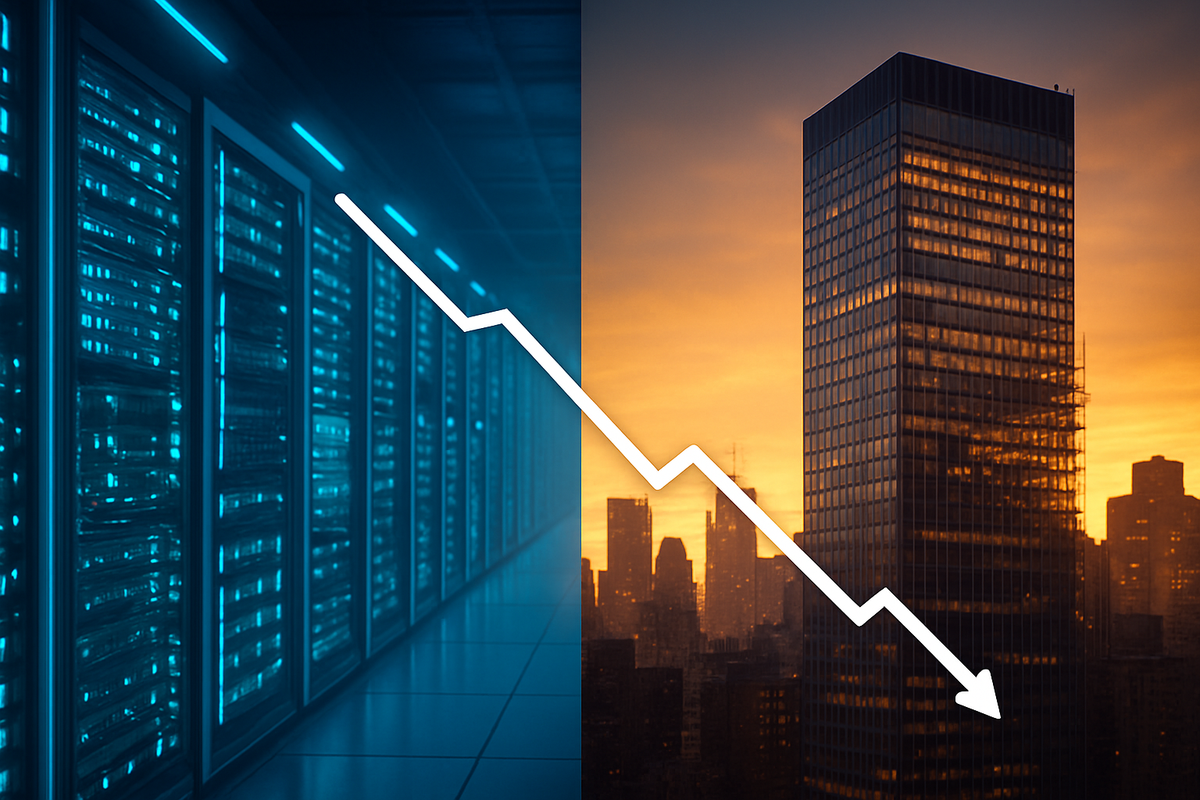
As the clock strikes midnight on 2025, the Real Estate Investment Trust (REIT) sector stands at a historic crossroads. After years of battling restrictive monetary policy and a post-pandemic identity crisis, the industry has emerged from 2025 transformed. The year was defined by a dramatic "sector bifurcation," where the AI-fueled explosion in data centers and a late-year Federal Reserve pivot rescued the broader market from what many feared would be a catastrophic collapse in commercial property values.
The immediate implications of 2025’s performance are clear: the "one-size-fits-all" approach to real estate investing is dead. While specialized sectors like healthcare and digital infrastructure posted record-breaking gains, the traditional office market faced a "year of reckoning" that saw high-profile bankruptcies and a record-breaking reduction in total office inventory. As interest rates finally began their descent in the fourth quarter, investors are now recalibrating their portfolios for a 2026 that promises lower borrowing costs but demands extreme selectivity.
A Tale of Two Halves: The Fed’s Pivot and the Office Reckoning
The story of 2025 was written in two distinct chapters. The first half of the year was characterized by a "wait-and-see" malaise as the Federal Reserve kept interest rates at their highest levels in decades, stifling transaction volume and putting immense pressure on REITs with looming debt maturities. However, the narrative shifted abruptly in the third quarter. Facing a cooling labor market and inflation that finally settled near the 2% target, the Federal Reserve initiated a series of three 25-basis point cuts in September, October, and December. By today, December 31, 2025, the federal funds rate sits at a target range of 3.50%–3.75%, its lowest level since 2022.
This monetary easing arrived just in time for some, but too late for others. The timeline of 2025 was punctuated by the dramatic collapse of Office Properties Income Trust (Nasdaq: OPI), which filed for Chapter 11 bankruptcy in October after failing to restructure its debt amid a 19% national office vacancy rate. Simultaneously, the industry witnessed a massive structural shift; for the first time in modern history, more office space was removed from the market through demolitions and conversions—roughly 23.3 million square feet—than was added. This "managed decline" of the office sector became the backdrop for a broader market rally that saw the FTSE Nareit All Equity REITs Index finish the year in positive territory, buoyed by the late-year rate cuts.
Initial market reactions to the Fed’s December cut were cautiously optimistic. While the rate cuts lowered the cost of capital, the "deeply divided" sentiment within the Fed regarding sticky service-sector inflation has kept a lid on irrational exuberance. Investors spent the final weeks of 2025 rotating out of defensive positions and into growth-oriented specialized REITs, signaling a belief that the worst of the liquidity crunch is now in the rearview mirror.
Winners and Losers: The AI Boom vs. The Office Bust
The performance gap between the top and bottom of the REIT market in 2025 was nothing short of staggering. The undisputed champions of the year were specialized REITs tied to the "AI Supercycle." Digital Realty Trust (NYSE: DLR) and Equinix (Nasdaq: EQIX) capitalized on an insatiable demand for generative AI infrastructure, with DLR reporting funds from operations (FFO) growth of over 21%. These companies have become the landlords of the new economy, with much of their capacity pre-leased through 2027.
In a surprising turn, the healthcare sector also emerged as a massive winner. Diversified Healthcare Trust (Nasdaq: DHC) delivered a jaw-dropping one-year return of approximately 116%, driven by a successful operational turnaround and the undeniable tailwinds of an aging demographic. Similarly, retail giants like Simon Property Group (NYSE: SPG) and Realty Income (NYSE: O) proved their resilience. Despite fears of a consumer slowdown, grocery-anchored centers and high-end malls maintained high occupancy, with SPG benefiting from a "flight to quality" as retailers consolidated their footprints into the most productive locations.
Conversely, the losers of 2025 were concentrated in the "commodity" office space. Beyond the bankruptcy of OPI, Wheeler REIT (Nasdaq: WHLR) saw its market value nearly evaporate. Even regional players that avoided bankruptcy, such as Kilroy Realty (NYSE: KRC), struggled with the ongoing transition to hybrid work. However, a few "trophy" office providers managed to buck the trend. Cousins Properties (NYSE: CUZ) leveraged its focus on high-growth Sunbelt markets to maintain positive net absorption, proving that while "office" as a category is struggling, high-quality, modern assets in the right geographies can still thrive.
Broader Industry Trends and the "Flight to Quality"
The events of 2025 fit into a larger structural transformation of the American economy. The "AI Supercycle" is no longer a speculative trend but the primary driver of industrial and data center demand. This has led to a fascinating convergence of sectors; for instance, Prologis (NYSE: PLD) has begun repurposing portions of its massive logistics portfolio to house data center operations, effectively blurring the lines between traditional warehousing and high-tech infrastructure. This shift toward "nearshoring" and supply chain resilience has kept industrial vacancy rates low, even as the broader economy cooled.
Furthermore, the "flight to quality" has become the defining strategy for both tenants and investors. In the office and retail sectors, the gap between "Trophy/Class A" properties and "Class B/C" properties has widened into a canyon. This has significant regulatory and policy implications, as cities grapple with declining property tax revenues from devalued office towers. In 2025, we saw an increase in municipal incentives for office-to-residential conversions, a trend that is expected to accelerate as urban centers attempt to reinvent themselves.
Historically, the REIT market’s performance in 2025 mirrors the post-2008 recovery, albeit with different catalysts. Just as the market had to purge subprime debt then, it is currently purging obsolete commercial space now. The resilience of the 2025 market, despite the office crisis, suggests that the REIT structure remains a robust vehicle for public real estate investment, provided it evolves alongside technological and social shifts.
The 2026 Outlook: Strategic Pivots and New Opportunities
Looking ahead to 2026, the primary challenge for REITs will be navigating the "higher-for-longer-than-expected" reality of interest rates, even as the Fed continues to cut. While the 3.50%–3.75% range is a relief, it is still significantly higher than the zero-rate environment of the previous decade. REITs will need to focus on "organic" growth—increasing rents and managing expenses—rather than relying on cheap debt to fuel acquisitions.
Short-term, we expect a surge in M&A activity. Many smaller, distressed REITs are now attractive targets for larger, well-capitalized players like Prologis (NYSE: PLD) or Blackstone's private vehicles. Long-term, the opportunity lies in the "de-carbonization" of real estate. With new environmental regulations looming for 2027 and beyond, REITs that have invested in green infrastructure and energy-efficient buildings will likely command a "green premium" from institutional investors.
The most significant scenario to watch in 2026 is the potential stabilization of the office market. If the record-breaking removal of inventory continues at its current pace, we may finally see a floor in office valuations by mid-2026. This would allow the sector to move from a state of crisis to one of slow, managed recovery, removing a significant drag on the broader REIT indexes.
Summary and Investor Takeaways
As we close the books on 2025, the key takeaway is that real estate has decoupled from the traditional economic cycle and re-attached itself to the technological cycle. The dominance of data centers, the resilience of healthcare, and the collapse of commodity office space are all symptoms of a world that is more digital, more aged, and less tethered to a central desk. The Federal Reserve’s pivot in late 2025 has provided the necessary liquidity to prevent a systemic meltdown, but it has not solved the underlying structural issues facing older assets.
Moving forward, investors should watch for the "refinancing wall" of 2026. While rates are lower, many REITs will still be refinancing debt that was originally issued at 1% or 2%, meaning interest expenses will likely continue to rise in the short term. The winners will be those with "fortress" balance sheets and exposure to the AI and healthcare megatrends.
In conclusion, 2025 was the year the REIT market finally broke its fever. The pain of the office sector was the necessary price for a leaner, more specialized industry. As we enter 2026, the market is no longer just about "location, location, location"—it is about "utility, technology, and adaptability."
This content is intended for informational purposes only and is not financial advice.