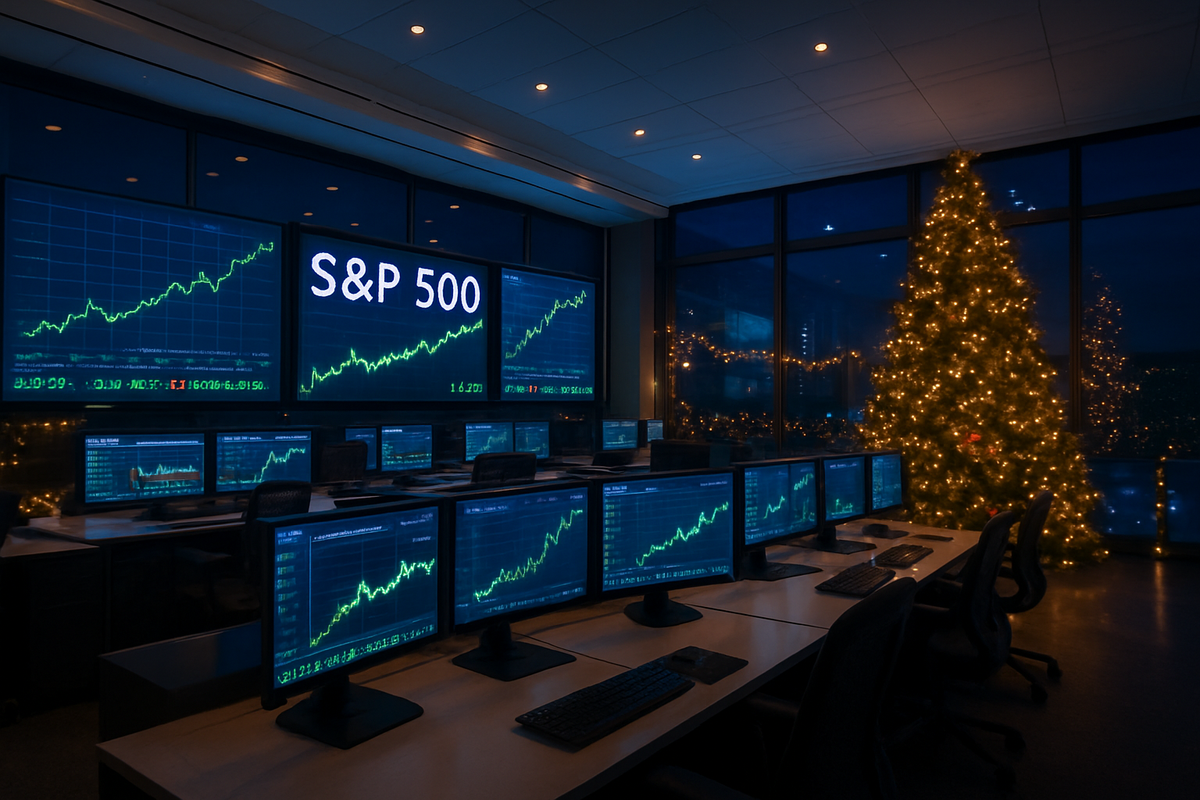
As the holiday lights continue to twinkle across the globe, the financial markets have opened their doors today, December 26, 2025, to a familiar and festive sight: green screens. Despite the skeletal staffing at major trading desks and a noticeable dip in trading volume, the major indices are drifting higher, continuing a storied tradition known as the "Santa Claus Rally." The S&P 500 (INDEXSP: .INX) reached a fresh intraday all-time high of 6,942 this morning, building on the momentum of a year that has already seen the benchmark index rise by approximately 18%.
This peculiar phenomenon, where stocks climb on the back of thin liquidity and holiday cheer, is more than just a seasonal quirk; it is a statistically significant event that investors watch with eagle eyes. Today’s action follows a record-breaking Christmas Eve session, signaling that the year-end "Santa Claus" window—defined as the final five trading days of December and the first two of January—is off to a robust start. For the retail investors who dominate the tape today, the lack of institutional "bears" provides a clear runway for asset prices to ascend without the usual friction of heavy selling pressure.
The Mechanics of the Post-Christmas Push
The historical data for December 26 is remarkably consistent. Since 1953, the S&P 500 has risen on this specific date roughly 85% of the time when the markets were open. The average gain for this single session sits at approximately 0.5%, making it one of the most reliable days for bulls in the entire calendar year. This year is no exception, as the Dow Jones Industrial Average (INDEXDJX: .DJI) hovers near the 48,731 mark, while the Nasdaq Composite (INDEXNASDAQ: .IXIC) pushes toward 23,613. The timeline leading to today’s strength began in mid-December, as the Federal Reserve’s recent 25-basis-point rate cut provided the necessary fuel for a year-end "Goldilocks" scenario—resilient growth paired with easing monetary policy.
The key players in today’s market aren’t the high-frequency trading algorithms or the massive hedge fund managers, many of whom are currently away from their terminals. Instead, the market is being moved by a combination of retail optimism and "window dressing" from the fund managers who remain. Window dressing occurs when portfolio managers buy high-performing stocks at the very end of the year to ensure those names appear on their year-end statements to clients. This creates a self-fulfilling prophecy where the year's winners, particularly in the technology and artificial intelligence sectors, see an extra boost in the final week of December.
Furthermore, the "tax-loss harvesting" season—where investors sell losing positions to offset capital gains—typically concludes by the twentieth of the month. By the time December 26 arrives, the downward pressure from these forced sales has largely evaporated. This leaves the market in a "thin" state; with volume often 50% below the 20-day average, it takes significantly less buying power to move the needle. In 2025, this thin liquidity has amplified the gains in a market already buoyed by a 4.3% GDP growth rate in the third quarter.
Winners and Losers in the Year-End Drift
The primary beneficiaries of the current rally are the high-flying technology giants that have defined the 2025 market. NVIDIA Corporation (NASDAQ: NVDA) and Micron Technology, Inc. (NASDAQ: MU) have seen continued interest today as investors double down on the AI infrastructure trade. These companies benefit from the "momentum" factor that window-dressing managers look for. Additionally, retail giants like Amazon.com, Inc. (NASDAQ: AMZN) and Walmart Inc. (NYSE: WMT) often see a secondary boost on December 26 as investors speculate on strong holiday sales data and the potential for a robust "return-and-spend" cycle in the final days of the year.
On the cyclical side, Freeport-McMoRan Inc. (NYSE: FCX) has emerged as a winner this week, riding a wave of rising commodity prices and a weaker dollar. The materials sector often finds favor in late December when investors pivot toward "reflation" trades in anticipation of the new year's economic activity. For these companies, the Santa Claus Rally isn't just about sentiment; it’s about positioning for a January that many hope will carry the same bullish torch.
Conversely, the "losers" in this environment are often the highly shorted stocks or those in declining industries that failed to participate in the year's broader rally. Because the Santa Claus Rally is driven by momentum and "buying the winners," stocks that have underperformed throughout 2025 are often ignored or used as sources of funds for the year-end surge. While there are few outright "losers" on a day when the indices hit all-time highs, the opportunity cost for holding stagnant assets becomes painfully clear as the rest of the market charges forward.
Analyzing the Significance: Psychology and Precedent
The wider significance of the December 26 performance lies in its role as a psychological barometer for the coming year. There is an old Wall Street adage: "If Santa Claus should fail to call, bears may come to Broad and Wall." Historically, when the market fails to rally during this seven-day window, it has often preceded a flat or negative January, and sometimes a challenging year ahead. By hitting new highs today, the market is sending a strong signal of confidence, suggesting that the "bullish bias" remains the dominant force heading into 2026.
This event fits into a broader industry trend of "retailization." With institutional volume low, the price action today is a pure reflection of retail sentiment and automated passive inflows (like 401(k) contributions). The fact that the market can maintain such high valuations—with the S&P 500 nearing the 7,000 level—without the full participation of institutional desks suggests a high level of underlying support. It also highlights the structural shift in the market where "passive" index buying provides a constant floor, especially during periods of low liquidity.
In terms of historical precedents, the 2025 Santa Claus Rally draws comparisons to the late 1990s and the post-2020 recovery periods, where technological breakthroughs and accommodative monetary policy created a "virtuous cycle" of year-end gains. However, the current rally is also being watched for regulatory implications. As the tech giants continue to swell in market cap, the concentration of the S&P 500 in a handful of names remains a point of contention for regulators, though such concerns are usually sidelined during the festive final week of the year.
The Road to 2026: What Comes Next?
Looking ahead, the short-term focus will shift to the first two trading days of January. If the momentum from today and the rest of the week carries through to January 2nd and 3rd, it will complete a "perfect" Santa Claus Rally, which historically correlates with a positive first quarter. Investors will be watching for any signs of "mean reversion" in the second week of January, as institutional traders return to their desks and rebalance their portfolios. This often leads to a brief period of volatility as the "thin" gains of December are tested by larger volume.
In the long term, the primary challenge for the market will be maintaining the 2025 growth trajectory. With the S&P 500 at record valuations, the "margin for error" is slim. Strategic pivots may be required if inflation begins to tick back up or if the Federal Reserve pauses its rate-cutting cycle. However, the immediate opportunity remains in the "January Effect," where small-cap stocks—often represented by the Russell 2000—tend to outperform large caps in the first month of the year as investors seek out value and laggards from the previous year.
The potential scenarios for early 2026 range from a "melt-up" as the AI revolution continues to scale, to a healthy "pullback" that allows the market to digest the massive gains of 2025. For now, the path of least resistance remains higher. Investors should keep a close eye on the 10-year Treasury yield and upcoming manufacturing data in early January, as these will be the first real tests of the market's holiday-induced optimism.
Wrapping Up the Festive Session
The performance of the stock market on this December 26, 2025, serves as a powerful reminder of the influence of seasonality and investor psychology. The rally to new all-time highs, even on low volume, underscores a market that is fundamentally resilient and supported by a favorable macroeconomic backdrop. The key takeaway for investors is that the Santa Claus Rally is currently in full swing, providing a positive tailwind that often sets the tone for the months to follow.
Moving forward, the market appears poised for a strong start to 2026, but the "thin" nature of today's gains suggests that some caution is warranted once the full weight of institutional trading returns. The lasting impact of this week will be seen in whether the 6,900 level on the S&P 500 can transition from a psychological ceiling to a structural floor.
Investors should watch for the "Early Warning Signal" in the first five days of January; a positive performance during that period, combined with the current Santa Claus Rally, would historically suggest a high probability of a double-digit gain for the full year of 2026. For today, however, the bulls are firmly in control, enjoying a well-earned victory lap as the year draws to a close.
This content is intended for informational purposes only and is not financial advice.