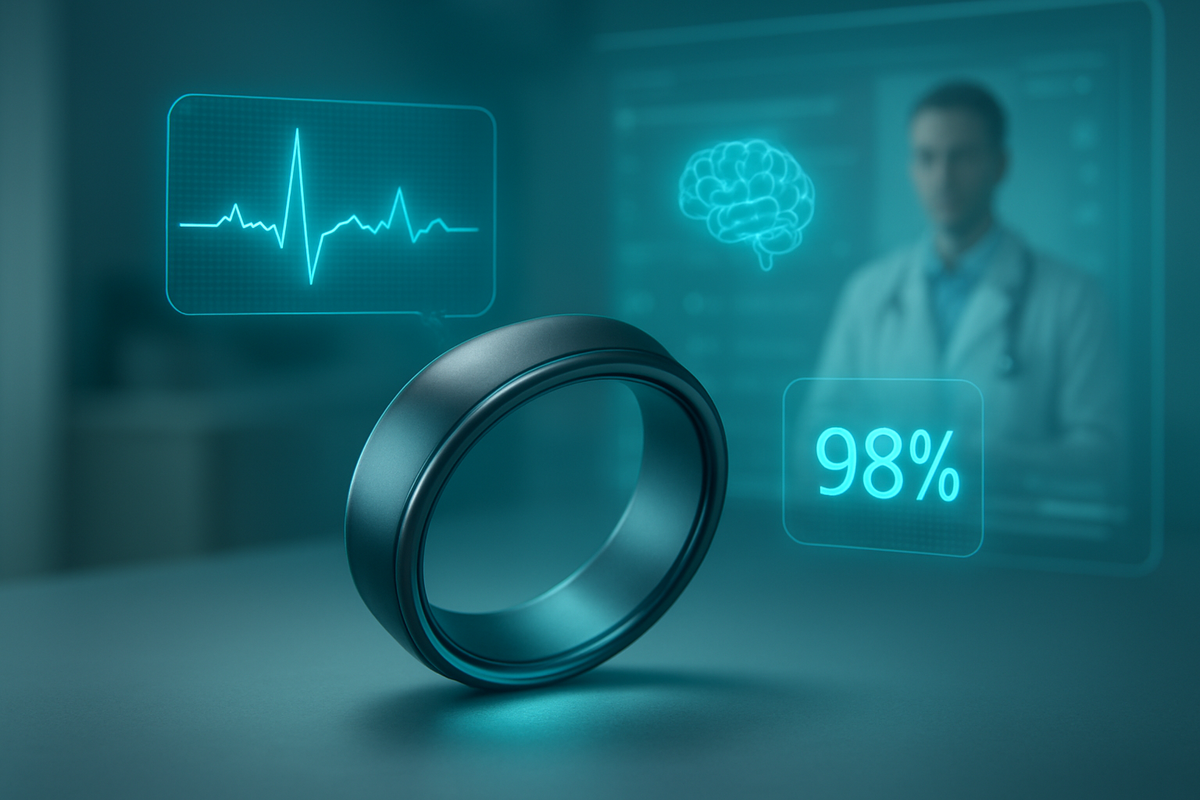
The convergence of consumer technology and clinical medicine has reached a fever pitch as 2025 draws to a close. A landmark report released this December by ResearchAndMarkets.com projects that the wearable AI market will see a staggering $65 billion in incremental growth by 2030, driven almost entirely by its integration into telemedicine ecosystems. This shift marks the end of the "fitness tracker" era and the dawn of the "clinical companion," where devices on our wrists, fingers, and even in our ears act as the primary interface for healthcare delivery.
The immediate implications are profound: healthcare is moving out of the doctor's office and into the living room. By leveraging advanced artificial intelligence to interpret biometric data in real-time, these devices are no longer just counting steps; they are predicting illness, managing chronic conditions, and facilitating a "hospital-at-home" model that promises to reduce costs and improve patient outcomes on a global scale.
The Dawn of the Clinical Wearable
The transition to a $65 billion telemedicine-integrated market has been fueled by a series of technological "tipping points" throughout 2025. Earlier this year, the industry moved beyond simple data collection toward predictive diagnostics. The timeline of this evolution accelerated in the fourth quarter of 2025, as major tech players solved long-standing hardware bottlenecks. One of the most significant breakthroughs came from Samsung Electronics (KRX:005930), which began implementing solid-state batteries in its wearable lineup, including the latest Galaxy Ring. This technology has effectively solved the "battery life barrier," allowing for 24/7 medical-grade monitoring without the frequent charging cycles that previously led to data gaps.
Key stakeholders, including insurance providers and hospital networks, have reacted with aggressive optimism. In late 2025, a strategic alliance between Philips (NYSE: PHG) and Masimo (NASDAQ: MASI) demonstrated the growing synergy between hospital infrastructure and wearable tech. By integrating Masimo’s wireless PPG sensors directly into Philips' clinical monitoring dashboards, the duo has bridged the gap between the intensive care unit and remote patient monitoring. This integration allows for "invisible AI" to run in the background, alerting physicians to subtle changes in a patient's vascular load or oxygen saturation 48 hours before physical symptoms even manifest.
Winners and Losers in the AI Health Race
The market's rapid expansion is creating a clear divide between innovators and legacy players. Apple Inc. (NASDAQ: AAPL) remains a dominant force, leveraging its HealthKit ecosystem to become the de facto data clearinghouse for millions of patients. Similarly, Alphabet Inc. (NASDAQ: GOOGL) has revitalized its Fitbit division by integrating Gemini AI, transforming the platform into a "Personal Health Coach" that provides conversational, actionable medical advice rather than just static charts. In the specialized medical space, DexCom, Inc. (NASDAQ: DXCM) continues to lead as its continuous glucose monitors (CGMs) become standard-issue for non-diabetics looking to optimize metabolic health through AI-driven insights.
Conversely, generic wearable brands that offer basic activity tracking without clinical validation or AI integration are facing an existential crisis. As consumers and healthcare providers demand "medical-grade" accuracy, the market for "me-too" devices is evaporating. Furthermore, companies that have relied too heavily on aggressive monetization of data are seeing a backlash. Garmin Ltd. (NYSE: GRMN), for instance, faced significant user friction in late 2025 following controversies over its "Connect+" subscription model, which placed advanced AI health insights behind a paywall. Investors are increasingly favoring companies that treat AI as a core utility rather than a premium add-on.
Broader Industry Trends and the Regulatory Landscape
The $65 billion telemedicine boom is part of a larger trend toward the "decentralization of care." Historically, medical data was episodic—captured only during infrequent doctor visits. The new wearable AI paradigm makes data continuous, mirroring the shift from traditional software to Software-as-a-Service (SaaS). This "Health-as-a-Service" model is forcing a total rethink of regulatory frameworks. The FDA and European regulators have spent much of late 2025 refining "ambient privacy" laws, especially following the rise of always-on AI devices like the Limitless pendant, which records and summarizes daily interactions.
This event also draws parallels to the mobile revolution of the late 2000s. Just as the smartphone replaced the camera, the map, and the music player, the AI wearable is absorbing the functions of the thermometer, the blood pressure cuff, and the sleep lab. However, the stakes here are higher. Regulatory scrutiny is intensifying around "algorithmic transparency"—ensuring that the AI making a diagnosis can explain its reasoning to a human doctor. The risk of "false positives" remains a concern for an already overstretched healthcare workforce, leading to calls for better AI-to-clinician filtering systems.
The Path Forward: Edge Computing and BCI
Looking ahead to 2026 and beyond, the focus will likely shift toward "edge AI"—processing health data locally on the device rather than in the cloud. This pivot will be essential for maintaining privacy and reducing latency in critical health alerts. We are also seeing the emergence of niche but high-potential sectors, such as non-invasive Brain-Computer Interfaces (BCI). Startups like Neurable have already raised significant capital in late 2025 to commercialize headphones that track cognitive load, potentially opening a massive new telemedicine segment for mental health and neurodegenerative disease monitoring.
For insurers and healthcare providers, the strategic pivot will involve moving from "reactive" to "proactive" reimbursement models. Instead of paying for a hospital stay after a heart attack, insurers are beginning to subsidize the wearable AI that prevents it. The challenge will be the "data deluge"—how to manage petabytes of biometric data without overwhelming the healthcare system. The winners will be those who develop the best "triage AI" to separate routine data from life-saving alerts.
Final Assessment for the Road Ahead
The projection of a $65 billion market by 2030 is more than just a financial forecast; it is a roadmap for the future of human longevity. The integration of wearable AI with telemedicine represents the most significant shift in medical practice since the invention of the stethoscope. For the market, this means a period of intense M&A activity as tech giants look to acquire clinical-grade sensor companies to bolster their health credentials.
Investors should keep a close watch on the "clinical validation" of new devices over the coming months. As the line between consumer gadget and medical device blurs, the companies that can secure FDA clearances while maintaining a seamless user experience will capture the lion's share of this emerging $65 billion prize. The era of the "smartwatch" is over; the era of the "digital twin" has begun.
This content is intended for informational purposes only and is not financial advice.