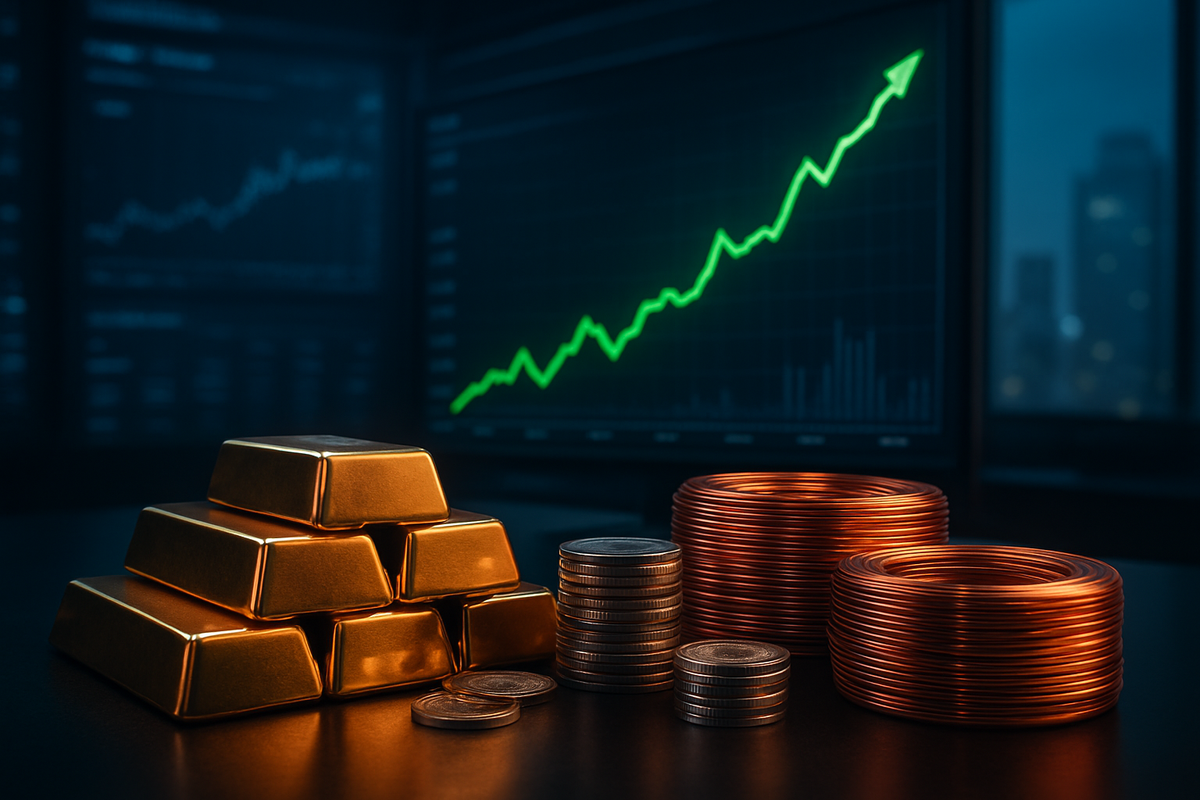
The United States economy has delivered a stunning performance in the third quarter of 2025, with growth figures significantly outpacing even the most optimistic forecasts. On December 23, 2025, the Bureau of Economic Analysis revealed that the U.S. GDP expanded at an annualized rate of 4.3%, a figure that would typically signal a cooling period for non-yielding assets like gold. Instead, the market is witnessing a historic anomaly: a simultaneous surge in both economic output and commodity futures, as gold, silver, and copper continue their relentless climb toward new record highs.
This "growth paradox" has left analysts and investors re-evaluating the traditional relationship between a strong dollar and hard assets. While a robust economy often leads to higher interest rates—which usually dampens the appeal of precious metals—the current environment is being shaped by deeper structural fears. Investors are increasingly viewing strong GDP not as a sign of stability, but as a precursor to sustained inflation and fiscal instability, fueling a "debasement trade" that is keeping the commodity rally alive despite a resilient American consumer.
A Defiant Economic Expansion
The release of the Q3 GDP data today comes after a tense period of anticipation, following a 43-day government shutdown that delayed federal reporting throughout the autumn. The 4.3% growth rate shattered the consensus estimate of 3.3%, building on a strong 3.8% showing in the second quarter. The primary engines of this expansion were a 3.5% jump in consumer spending and a massive wave of government expenditure. Notably, a late-September rush to secure electric vehicles and renewable energy hardware before the expiration of several key tax credits provided a significant, albeit temporary, boost to the final figures.
The timeline leading to this moment has been marked by extreme volatility. In mid-October, the commodity markets experienced what many called a "bloodbath," with gold and silver seeing their sharpest one-day declines in over a decade. At the time, critics argued the commodity supercycle was over, citing "technical exhaustion" and a pivot back to traditional equities. However, as the government reopened and the sheer scale of U.S. national debt—now approaching $38 trillion—became the focal point of the Q4 narrative, the rally resumed with a vengeance.
Market reactions to the GDP beat were immediate but complex. While the US Dollar Index (DXY) saw a modest bump to 98.00 and the 10-year Treasury yield edged up to 4.17%, the downward pressure on commodities was non-existent. Gold futures (GC) surged past $4,400 per ounce, while silver (SI) approached the $70 mark. This suggests that the market is no longer pricing commodities based solely on interest rate expectations, but rather on a "scarcity premium" and a hedge against the long-term erosion of fiat currency.
Winners and Losers in the Resource Sector
The primary beneficiaries of this environment are the major mining corporations and the exchange-traded funds (ETFs) that track physical holdings. Newmont Corporation (NYSE: NEM), the world’s largest gold miner, has seen its margins expand significantly as the spot price of gold remains nearly 70% higher than it was at the start of the year. Similarly, Freeport-McMoRan (NYSE: FCX) is riding the wave of "Doctor Copper," with the red metal trading near $12,000 per ton. For these companies, the high-growth environment translates into robust industrial demand, while the inflationary backdrop ensures their output remains highly valued.
On the investment side, specialized ETFs have become the vehicle of choice for those looking to capitalize on the rally. The iShares Silver Trust (NYSE Arca: SLV) has been the standout performer of 2025, with its price nearly doubling year-to-date. The fund saw inflows exceeding $1 billion in just the last week as retail investors returned to the market, driven by fears of a silver supply deficit. The SPDR Gold Shares (NYSE Arca: GLD) and the United States Copper Index Fund (NYSE Arca: CPER) have also posted gains of 65% and 34% respectively, outperforming the broader S&P 500 by a wide margin.
Conversely, the losers in this scenario are the heavy industrial consumers and utilities that are facing "greenflation." Companies in the manufacturing and construction sectors are seeing their input costs skyrocket, threatening to eat into the very profitability that the 4.3% GDP growth suggests. For companies reliant on silver for solar panels or copper for electrical grid upgrades, the sustained high prices are no longer a temporary hurdle but a structural challenge that may eventually lead to demand destruction or forced pivots to less efficient substitutes.
The Decoupling of Growth and Commodities
The current market dynamic represents a significant departure from historical precedents. Historically, strong U.S. growth bolstered the dollar and pushed real yields higher, making gold a less attractive "store of value." However, in late 2025, we are seeing a "decoupling" where commodities are behaving more like technology stocks—driven by structural shifts rather than cyclical fluctuations. The massive investment in AI data centers, for instance, has created an inelastic demand for copper and silver that traditional economic cooling measures, like high interest rates, have failed to suppress.
This shift mirrors the inflationary environment of the 1970s, but with a modern twist. While the 70s were characterized by stagnant growth and high inflation (stagflation), 2025 is trending toward "boom-flation"—high growth accompanied by high asset prices and high debt. The regulatory environment is also playing a role; aggressive green energy mandates have forced a rapid transition that the current mining infrastructure is struggling to support. This supply-side constraint means that even a "hot" economy cannot produce enough raw materials to bring prices down.
Furthermore, the "Debasement Trade" has gained institutional legitimacy. Central banks, particularly in emerging markets and the Middle East, have been aggressive buyers of gold throughout Q3 and Q4. These institutions are less concerned with the quarterly fluctuations of U.S. GDP and more focused on the long-term sustainability of a dollar-denominated global financial system. This sovereign demand provides a "floor" for precious metals that didn't exist in previous economic cycles, complicating the Federal Reserve's efforts to manage inflation expectations.
The Road Ahead: 2026 and Beyond
As we move into 2026, the primary question for investors is whether this tension between growth and commodity pricing can persist. In the short term, the momentum remains firmly with the bulls. The "FOMO" (fear of missing out) factor is starting to permeate institutional portfolios that were previously underweight in commodities. We may see a strategic pivot where traditional 60/40 portfolios are reallocated to include a 10-15% "hard asset" sleeve as a permanent hedge against fiscal volatility.
However, the risk of a "policy shock" remains. If the Federal Reserve interprets the 4.3% GDP growth as a mandate to keep interest rates significantly higher for longer, or if they initiate a surprise round of quantitative tightening to drain liquidity, the commodity markets could face another sharp correction similar to the October "bloodbath." Investors should also watch for potential regulatory interventions in the futures markets if silver or copper prices begin to threaten the stability of the renewable energy transition, which is a cornerstone of current administration policy.
The long-term scenario hinges on whether mining supply can finally catch up with AI and green energy demand. Most analysts believe a supply response is years away, given the long lead times for new mine permits and construction. This suggests that the "New Commodity Supercycle" may have several more years to run, with the potential for gold to test $5,000 and silver to break the $100 barrier if the current trajectory of U.S. debt and industrial demand continues unabated.
Summary and Investor Outlook
The surprisingly strong Q3 GDP data has served as a catalyst for a new phase in the 2025 market narrative. Rather than cooling the commodity markets, the 4.3% growth rate has reinforced the idea that we are in a period of structural inflation and unprecedented industrial demand. The performance of ETFs like SLV and GLD, alongside miners like Newmont and Freeport-McMoRan, underscores a market that is prioritizing tangible assets over paper currency in the face of mounting national debt and an AI-driven resource grab.
Moving forward, the market is likely to remain highly sensitive to "fiscal sustainability" headlines. Investors should keep a close eye on core PCE inflation data and any shifts in central bank gold-buying patterns. While the current rally is supported by strong fundamentals, the extreme volatility seen in October serves as a reminder that even in a supercycle, the path upward is rarely a straight line.
Ultimately, the events of late 2025 suggest that the old rules of the "Goldilocks" economy—where growth is high and inflation is low—may be a thing of the past. In this new era, a strong economy may simply be the fuel that keeps the commodity fire burning.
This content is intended for informational purposes only and is not financial advice.